
Ukraine Launches Major Drone Assault on Russian Warehouses as Zaluzhnyi Signals Nato Impasse from London
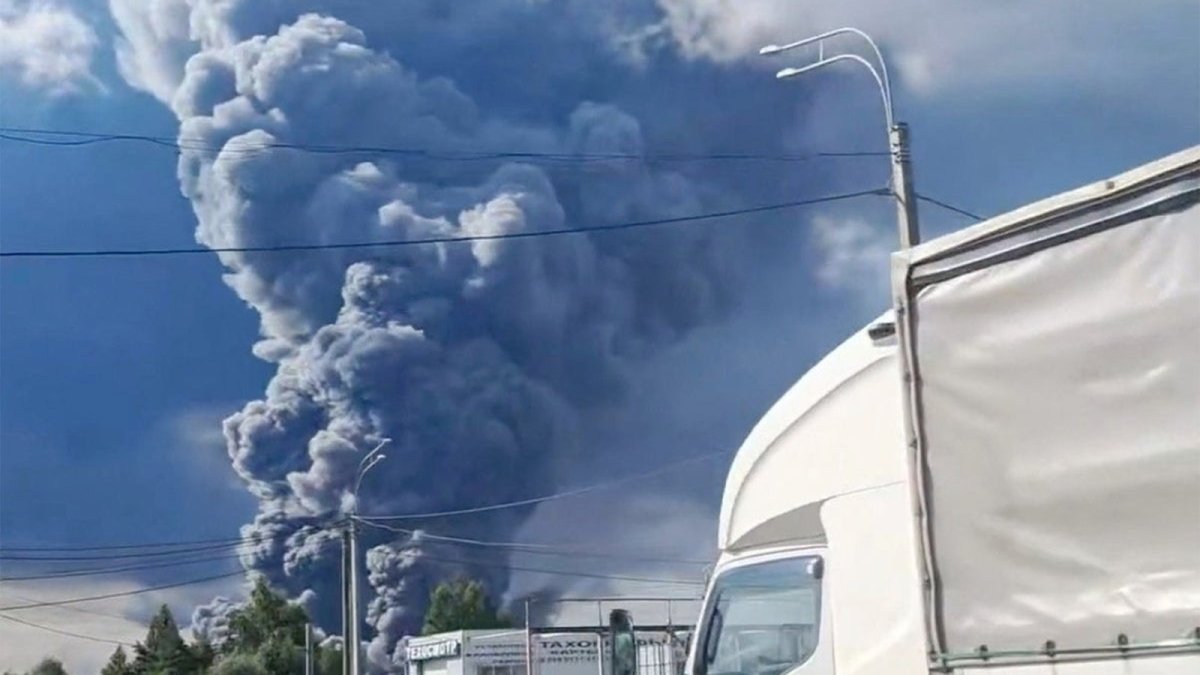
Russian officials reported that Ukrainian drones struck multiple warehouse facilities overnight, including one operated by the online retailer Wildberries in the Tver region. Acting regional governor Vitaly Korolyov stated that the site sustained damage but no workers were injured, with emergency services attending the scene. This formed part of a wider series of attacks that also affected locations near Moscow and St Petersburg.
Ukraine Launches Major Drone Assault on Russian Warehouses as Zaluzhnyi Signals Nato Impasse from London
Warehouses Targeted in Overnight Strikes
Russian officials reported that Ukrainian drones struck multiple warehouse facilities overnight, including one operated by the online retailer Wildberries in the Tver region. Acting regional governor Vitaly Korolyov stated that the site sustained damage but no workers were injured, with emergency services attending the scene. This formed part of a wider series of attacks that also affected locations near Moscow and St Petersburg.
Governors in the affected areas said the overnight strikes killed six people and injured nine, with five of the deaths occurring at a warehouse facility and one in the border region of Belgorod. Regional governor Andrei Vorobyov separately reported at least five fatalities and six injuries in the Moscow region, where a warehouse fire was extinguished and a private house plus a car were also damaged.
Since mid-July, Ukraine has struck around 20 sites belonging to the Russian e-commerce giant Wildberries across various parts of Russia and in annexed Crimea, according to AFP reporting. Wildberries is a highly popular online retail platform in Russia, often dubbed the Russian Amazon. The pattern of strikes against these facilities, according to AFP reporting, appears to be signalling an intent to impose costs on the broader economy rather than limiting action to strictly military targets.
The repeated targeting of Wildberries logistics hubs since mid-July, with around 20 sites hit across Russia and annexed Crimea, points to a deliberate Ukrainian strategy of disrupting a key pillar of Russian domestic commerce. As the country's leading online retailer, often compared to Amazon, Wildberries underpins everyday consumer supply chains in a nation facing sanctions-induced shortages. Strikes on these facilities near major population centres such as Moscow and St Petersburg therefore carry economic ripple effects that extend well beyond immediate military objectives, potentially raising costs and complicating distribution for millions of households.
Attacks reaching the Tver region and other areas close to Russia's two largest cities underscore how the conflict has expanded in 2026 to encompass civilian economic infrastructure far from the front lines. Regional governors' accounts of fires at warehouses and damage to nearby private houses illustrate the growing entanglement of commercial sites with the war effort. This pattern challenges Russian authorities to maintain public confidence while managing incidents that affect ordinary citizens rather than purely military assets.
Russian Defences Report Interceptions Across Regions
Russia's defence ministry announced that its forces brought down or destroyed 320 Ukrainian drones overnight across 19 different regions. Russian authorities typically disclose only the number of drones intercepted rather than the total launched, and they rarely detail full damage assessments unless civilian sites or deaths are involved.
Regional governor Veniamin Kondratyev reported that seven people including three children were killed and 40 others wounded when drone debris struck the Black Sea holiday resort area of Gelendzhik in the Krasnodar region. The health ministry said 21 people including three children had been rushed to hospital, with nine in a serious condition. Arkhipo-Osipovka forms part of the wider Gelendzhik resort area, and a specialist disaster team was dispatched to the holiday village. Kondratyev condemned the incident as a deliberate attack by the Kyiv regime on the civilian population with no connection to military infrastructure, while foreign ministry spokesperson Maria Zakharova accused Ukraine of resorting to terrorism. Ukraine has not issued a statement on the attack, but its military has repeatedly said it does not deliberately target civilians.
Russia's standard practice of reporting only the number of drones intercepted, rather than the total launched or the full scope of resulting damage, creates an inherent asymmetry in public understanding of these exchanges. The defence ministry's figure of 320 drones brought down across 19 regions therefore provides limited insight into the scale of Ukrainian operations or the extent of any economic and civilian disruption that evaded interception.
Zaluzhnyi Delivers Blunt Assessment from UK Posting
Ukraine's former commander-in-chief Valerii Zaluzhnyi, now serving as ambassador to the UK, told a meeting of Ukrainian ambassadors that there is no prospect of his country joining Nato. He noted his 12 years of personal work on meeting alliance standards and recalled repeated assurances that membership would come any day, only to conclude that Ukraine will never actually join.
Zaluzhnyi argued it was impossible for the armed forces of Ukraine, given their current level of development, to enter an organisation still guided by World War 2 doctrines. His comments carry particular weight in Whitehall, where defence planners continue to weigh the implications of prolonged conflict for UK security commitments, energy security and potential refugee flows. The ambassador was dismissed from his military role after public differences with President Volodymyr Zelensky emerged.
Zaluzhnyi's remarks from his London embassy post carry added diplomatic weight because they come from a figure long regarded as a key interlocutor with Western capitals. His twelve years of direct engagement with Nato standards give his assessment particular resonance in Whitehall, where officials must weigh the implications of Ukraine's trajectory for UK security commitments and potential long-term support arrangements. The former commander-in-chief's presence in Britain places his critique at the heart of European discussions on alliance enlargement.
His observation that Ukraine's armed forces cannot integrate into an organisation still shaped by World War 2 doctrines highlights a fundamental mismatch between current Ukrainian capabilities and Nato's established frameworks. This critique, delivered after his dismissal following public differences with President Zelensky, raises questions about how British defence planners should interpret Ukraine's long-term military evolution and the prospects for deeper institutional alignment.
The ambassador's blunt conclusion that membership remains impossible reflects years of repeated assurances that never materialised, colouring the credibility of his military analysis for UK audiences. His comments arrive at a moment when London continues to monitor energy security and refugee considerations tied to the conflict, forcing policymakers to reassess assumptions about Ukraine's path within European security structures.
Deadly Strikes Reported on Both Sides
Ukrainian air force figures showed that Russia launched 181 long-range strike drones overnight from Sunday to Monday, with air defences jamming or intercepting 163 while 14 caused damage at 13 locations. At least 12 people died across separate attacks in Ukraine and Russia during the latest exchange.
In Zaporizhzhia, regional chief Ivan Fedorov said Russian planes dropped eight glide bombs on residential districts within 90 minutes, killing one person and wounding dozens. Ukrainian officials have not issued statements on the Russian resort incidents, though the military has consistently maintained that it does not deliberately target civilians.
The exchange of 181 Russian long-range strike drones and Ukrainian operations that prompted claims of 320 interceptions across 19 regions reveals an industrial-scale dimension to the 2026 fighting. Both sides now project force deep into each other's territory on a nightly basis, with glide bombs striking residential districts in Zaporizhzhia and drone debris affecting Black Sea resort areas. This volume of activity indicates sustained production and deployment capacities that have transformed the conflict into a prolonged war of attrition.
Civilian tolls in urban and holiday settings, including deaths from glide bombs in southern Ukraine and incidents near Russian coastal towns, demonstrate how the intensification pattern exposes non-combatants to direct risk. The sheer number of systems involved each night places continuous strain on air defences, with 14 Russian drones still causing damage despite interception efforts, underscoring the limits of protective measures against massed attacks.
European defence planners must now account for this persistent tempo when assessing requirements for air defence stocks and industrial output. The pattern of reciprocal deep strikes, leaving at least 12 dead in a single day, suggests that neither side intends to limit operations to frontline zones, raising the prospect of further escalation affecting supply chains and civilian infrastructure across wider regions.
Further Diplomatic and Regional Developments
President Zelensky dismissed Ukraine's ambassador to the United States, Olha Stefanishyna, in a decree published yesterday. She described the move as her own decision driven by personal circumstances and highlighted her role in boosting American weapons supplies during a shifting political climate in Washington.
A senior Iranian advisor, Mohsen Rezaei, told state broadcaster PressTV that planned strikes on three Ukrainian sites were cancelled after an apology from Kyiv. The decision followed an earlier Caspian Sea incident that killed one Iranian sailor and injured another, with foreign minister Abbas Araqchi having previously vowed that the attack on an Iranian commercial vessel could not go unanswered.
The Russian Embassy in Rome blamed Ukraine for a weekend bombing at a Moscow restaurant that killed five and injured 19, framing it as an attempt to intimidate the Italian community. The embassy said Kyiv terrorists wanted to scare the Italians working in Russia. These events unfold against a backdrop of sustained pressure on European energy markets and defence budgets, with UK institutions from the Bank of England to local councils monitoring the knock-on effects of escalation.
The widening circle of actors drawn into the conflict, from Iran's cancelled strikes following a Caspian Sea incident to the Russian embassy's accusations over a Moscow restaurant bombing, illustrates how the war continues to generate diplomatic friction far beyond Ukraine's borders. These incidents, alongside the Italian community concerns raised in Rome, show the conflict's capacity to affect third-country nationals and commercial interests, complicating efforts to contain its international repercussions.
By Erica Thornton, Staff WriterThis article was produced with AI-assisted research and editorial support. Reporting is based on sources cited in the article.
What's Your Reaction?
 Like
0
Like
0
 Dislike
0
Dislike
0
 Love
0
Love
0
 Funny
0
Funny
0
 Wow
0
Wow
0
 Sad
0
Sad
0
 Angry
0
Angry
0

US Politics and Policy Correspondent at Global1.News. Based in Washington DC, covering American politics, policy, elections, and the courts. Knows how the system works and tells you what it actually means.













Comments (0)