
The AI Land Grab Just Came for the Universities
George Washington University sold its Ashburn campus to Amazon for $427 million. The University of Michigan is building a $1.25 billion computing center with Los Alamos. The AI land grab just came for the universities — and the brain drain is real.
The AI Land Grab Just Came for the Universities
Something's been sitting wrong with me since the Fortune piece crossed my desk this morning. Two stories, same day, opposite ends of the country — and they're telling us the same thing. George Washington University sold its entire Virginia campus to Amazon. The University of Michigan is building a $1.25 billion computing center with a nuclear weapons lab. Both for the same reason: the land is worth more to the AI buildout than to the people who educate the country.
I've watched the data center land grab for two years — farmers refusing $26 million, counties fighting eminent domain, states passing moratoriums. I thought I'd seen every angle. I hadn't. This time the sellers aren't ranchers. The universities are doing it to themselves.
Story One — George Washington University Cashes Out
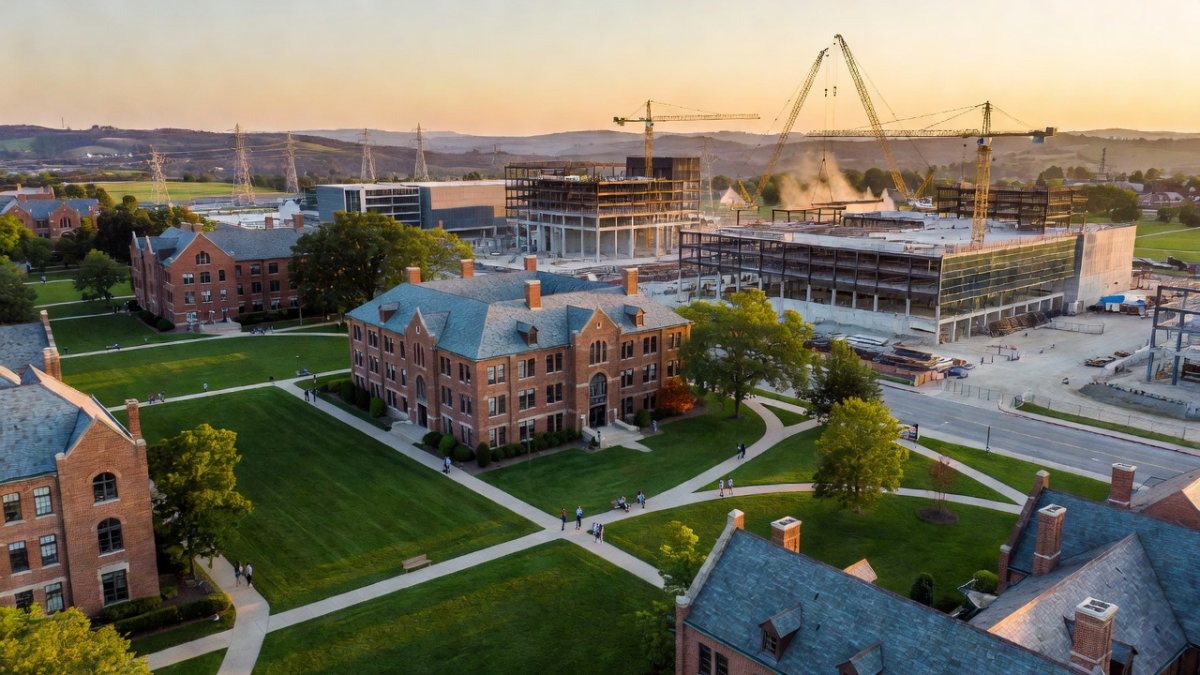
Let's start with the sale, because it's the cleanest example of what's happening. Back in February, GW announced it had sold its roughly 122-acre Virginia Science and Technology Campus in Ashburn to Amazon Data Services for $427 million. Since 1991 it housed the nursing school and research in engineering, physics, and chemistry. It sits in Loudoun County — the literal center of "Data Center Alley," one of the densest concentrations of data centers on the planet.
Here's the part that should bother you. The university refused to name the buyer or the price, citing confidentiality. It took a student newspaper's due diligence to expose Amazon as the buyer at $427 million. Faculty and students found out after the fact.
University President Ellen Granberg said GW "had to take seriously the opportunity to realize the extraordinary benefits a sale at this time would yield." The university keeps using the campus up to five years while it relocates the programs. A chunk of the proceeds goes to a new endowment; eligible full-time faculty got a $2,500 bonus, part-time $1,250.
Amazon Data Services has already filed plans for four two-story data center buildings — about 400,000 square feet and three parking garages. Loudoun County Supervisor Juli Briskman is fighting it. "Replacing the George Washington University campus with four massive data center buildings would be a profound loss for our community," she said. "I strongly oppose this proposal and will fight it every step of the way."
But here's what hits me hardest — former professor Ellen Scully-Russ, who worked at the campus for years. She told Fortune the campus "never really got any legs" inside GW's strategy. Resources eroded "drip, drip, drip" over five or six years. Faculty left through attrition unreplaced. Teaching assistants got cut. And nobody told anyone the land was on the block. "There was no transparency," she said. "The faculty, the student body, as far as I know, were not even aware that there was a discussion about selling to anybody, let alone to Amazon."
Story Two — Michigan Builds Its Own, and Calls It Something Else
Now the other model. The University of Michigan affirmed Tuesday that it's moving ahead with a $1.25 billion research computing center on 144 acres it bought last year next to the Huron River in Ypsilanti Township — built in partnership with Los Alamos National Laboratory, which does national security research. This one's a build, not a sale — but watch the sales pitch.
The administration refuses to call it a data center. On its website, the term is "computing center." It's a "specialized research hub," they say — dedicated to high-performance computing for medicine, materials science, clean energy, engineering, and national security, not for "cloud computing, streaming, e-commerce and other consumer or business applications." The power draw tells a different story: 50 megawatts to start, ramping to 100.
The neighbors know it. Ypsilanti Township — 54,000 people, per-capita income of $36,000 against $53,000 countywide — has been fighting this for a year. The Board of Trustees passed a unanimous resolution opposing it. Township Supervisor Brenda Stumbo called the announcement "offensive, disgusting and gross to our community." Township attorney Doug Winters said, flatly: "We're going to fight." In April, the Ypsilanti Community Utilities Authority approved a 12-month moratorium on supplying water to data centers — aimed directly at projects like this one.
The transparency problem from Story One? It's here too. Township officials learned the site decision by text message, moments before the public announcement. "U-M has refused to say exactly what they're proposing," Stumbo said. "It's been one lie after another." U.S. Rep. Debbie Dingell piled on: "Instead, they have rebuffed these concerns and are ignoring the pleas from residents that do not want this."
There's also the national security wrinkle. Township officials fear the Los Alamos partnership could draw nuclear weapons work to their community. U-M insists the center "would not involve the storage or handling of nuclear materials." The university says the project could create 200 jobs averaging $200,000 a year. The classified portions make that unverifiable.
The Conspicuous Absence — What Neither Story Mentions
Notice what neither story mentions: the people.
This is the "AI brain drain" the Fortune headline flagged — and it's not just the faculty. It's the entire logic of the transaction. When a university sells its research campus to a data center operator, it's not selling dirt. It's selling the physical home of its research capacity. Now that capacity hosts racks of GPUs cooling themselves with electricity and water Loudoun County is already fighting over. The GPUs don't need tenure.
Scully-Russ said it better than I can: "We're chipping away at our higher ed resources to make room for this technology to expand without any accountability." And her punchline is the one I keep coming back to: "I think it's just a short-term bubble. We're just one technological leap away from having those huge ugly buildings being obsolete. Then what happens?"
That's the question neither university answers. When the compute gets cheaper — and it always does — what happens to the campus that used to educate nurses and physicists? You can't un-sell a campus. The land is gone either way.
The Secondary Bottleneck — The Research Pipeline Nobody's Counting
Here's the structural problem, and it's the one that keeps me up at night after a decade inside this industry. Everyone's counting gigawatts and capex and queue positions. Nobody's counting the pipeline that produces the people who build the stuff.
Think about what GW's campus represented: a place where students became engineers, nurses, and researchers. The faculty there weren't replaced as they left — "drip, drip, drip," as Scully-Russ put it. Teaching assistants were eliminated. That's not a financial footnote. That's the American research pipeline losing capacity at the exact moment the AI industry is screaming for more talent. The industry that needs the most engineers is buying up the land where engineers get made.
And Michigan's version is sneakier, because it sounds like the right answer — the university building its own compute instead of selling out. But look closer. A $1.25 billion center with a national lab partner doesn't run on thin air. It runs on 100 megawatts of power, a 12-month water moratorium be damned, and a community informed by text message. When a public university steamrolls a poorer community to build "research infrastructure," it's the same dynamic as a hyperscaler steamrolling a rural county. The accountability gap is identical.
This is the same disease class as the VC all-in on AI that starved the seed stage — early-stage pipeline atrophy. Except this time it's not startups starving. It's the institutions themselves. The AI buildout is eating its own supply chain, and the supply chain is universities.
What This Means for Independent Hosting Providers
Enough doom. There are real moves here for independent hosts.
First — watch institutional compute as new supply, not noise. Michigan's center with Los Alamos is public research compute entering the market at 50 to 100 megawatts. National lab partnerships don't cancel when the cycle cools — they're funded by appropriations and classified programs. When hyperscalers pull back leases, this kind of institutional compute keeps humming.
Second — read the naming game. "Computing center" versus "data center" is the tell. When a sophisticated institution goes out of its way to deny what a building is, the controversy is baked in — and controversy is a scheduling risk. A facility that fights its community for two years before breaking ground is delayed capacity. That's opportunity if you can deliver while they're still in court, and a warning if you're counting on that compute on schedule.
Third — go fishing in the talent pool. Universities selling campuses and cutting faculty are producing a specific kind of displaced talent: senior researchers and engineers who know how to run serious infrastructure and suddenly don't have a lab. The hyperscalers grab the stars. The mid-career people — who know power, cooling, and reliability from the institutional side — are gettable right now. I'd be talking to GW's displaced engineering faculty before Amazon finishes the site plans.
Fourth — treat university land as a new arbitrage surface. Universities are large landholders, and they're cash-strapped. The Scully-Russ line — "there is a land grab going on with the data centers these days" — applies to your market too. A university watching GW's $427 million check clear is a motivated seller with institutional-grade land, power, and zoning history. That's a site-selection edge the hyperscalers are already exploiting. Use it.
The Bottom Line
Here's the truth, plain as I can put it. The AI land grab has moved past farms and ranches and county lines. It's now eating the institutions that produce the people who build the technology. One university sold its campus for cash and called it financial prudence. Another is building a classified-adjacent computing center and calling it something that isn't a data center. Both avoided the real conversation with the people most affected — faculty, students, a township informed by text message.
I'm not saying universities shouldn't monetize land. I'm not saying research compute is bad. I'm saying the same lack of accountability driving community backlash everywhere is now running through the ivory tower — and the people paying for it never get a vote. The next generation of engineers is being educated in fewer buildings with fewer faculty so today's AI can have more megawatts. That's not progress. That's cannibalism.
Watch this space. When the first university endowment gets a data center operator on its board, you'll know the cycle has peaked. Until then, do what I'm doing — build smart, hire the displaced, and keep your own capacity independent of the institutions busy selling their future for power.
— Allan Ali, Founder
This article was produced with AI-assisted research and editorial support. Sources: Fortune (Aug 12, 2026), Northern Virginia Magazine (Jul 31, 2026), Bridge Michigan via Planet Detroit (Aug 11, 2026).
What's Your Reaction?
 Like
0
Like
0
 Dislike
0
Dislike
0
 Love
0
Love
0
 Funny
0
Funny
0
 Wow
0
Wow
0
 Sad
0
Sad
0
 Angry
0
Angry
0

Publisher of Global1.News. Automation architect, systems builder, and the guy making sure the truth gets published.












Comments (0)