
Thailand’s Push for Myanmar’s Reintegration into ASEAN: A Calculated Diplomatic Move
On August 6, 2026, Thai Prime Minister Anutin Charnvirakul hosted Myanmar's military-appointed president Min Aung Hlaing in Bangkok, pledging to work toward Myanmar's full reintegration with ASEAN. The visit produced three bilateral deals, renewed debate over calibrated engagement versus legitimacy, and exposed the deepening deadlock over the Five-Point Consensus.
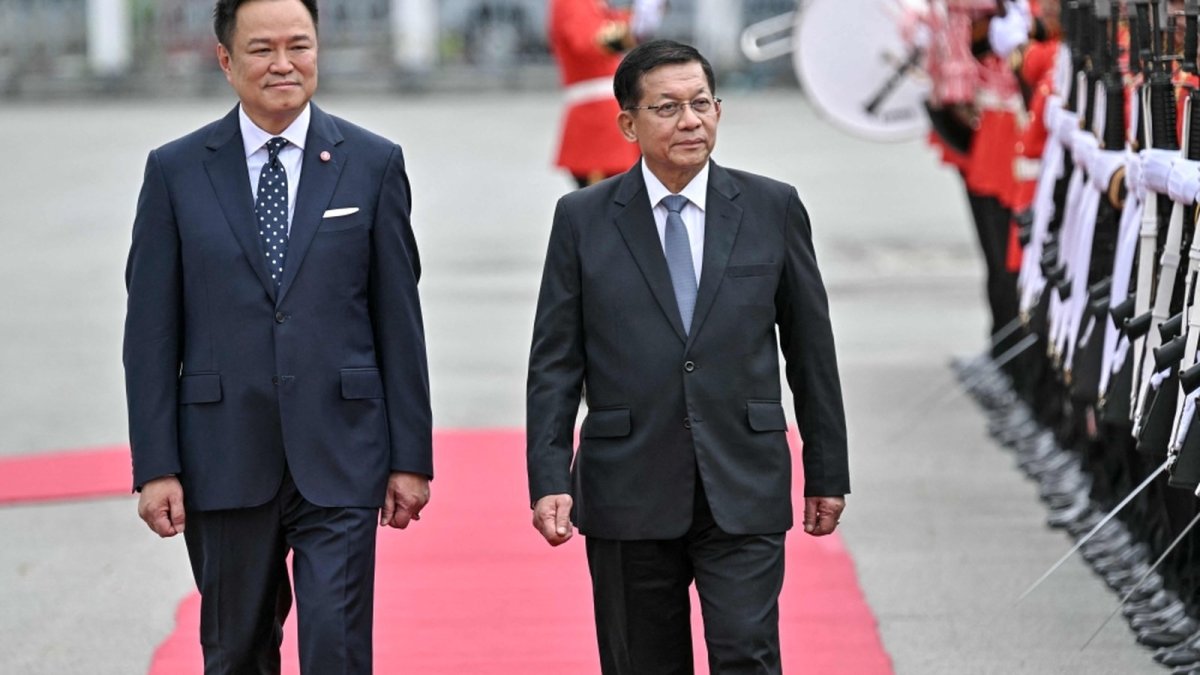
On August 6, 2026, Thai Prime Minister Anutin Charnvirakul hosted Myanmar’s military-appointed president, Min Aung Hlaing, in Bangkok for a two-day visit that marked the junta leader’s first official trip to Thailand since the 2021 coup. The summit, held at Government House, produced a joint statement affirming Thailand’s commitment to Myanmar’s “full and equal participation in ASEAN mechanisms and processes” and resulted in the signing of three bilateral agreements covering migrant labor, rare-earth mining pollution, and cross-border trade. The engagement reflects Bangkok’s long-standing advocacy of a “calibrated” approach to the Myanmar crisis, even as critics warn that such outreach risks legitimizing a regime accused of widespread human rights abuses.
Bangkok Summit and the Agreements Signed
The meeting between Anutin Charnvirakul and Min Aung Hlaing commenced on August 6 and concluded on August 7, 2026, with a red-carpet welcome and a series of high-level discussions. According to the joint statement released late on August 6, Thailand “reaffirmed its commitment to supporting and continuing to work closely with Myanmar for Myanmar's full and equal participation in ASEAN mechanisms and processes.” Myanmar, in turn, “expressed its appreciation for Thailand's constructive role in facilitating the normalization of its relations with ASEAN.”
Three concrete bilateral deals were signed during the visit. First, an agreement on Burmese migrant labor in Thailand aims to regularize the status of workers and improve protections. Second, a joint working group was established to address river pollution stemming from rare-earth mining activities along the border. Third, the sides agreed to boost cross-border trade, including the resumption of cargo movements over the Second Friendship Bridge linking Mae Sot in Thailand with Myawaddy in Myanmar. Politiko reported that the two parties pledged to raise annual bilateral trade to $12 billion, a figure that would represent a significant increase from pre-coup levels.
Joint Statement Language and Its Meaning
The joint statement’s wording is deliberately measured, reflecting Thailand’s effort to balance diplomatic outreach with adherence to ASEAN norms. By stating that it will “support and continue to work closely with Myanmar for Myanmar's full and equal participation in ASEAN mechanisms and processes,” Bangkok signals a willingness to engage the junta while framing the goal as reintegration rather than endorsement. The reciprocal expression of appreciation from Myanmar underscores Bangkok’s role as a conduit for the junta’s attempts to break its diplomatic isolation.
Analysts note that the language avoids any direct endorsement of the junta’s legitimacy, instead focusing on functional cooperation in security, trade, and environmental protection. This phrasing allows Thailand to pursue practical border-related objectives—such as curbing transnational crime and managing migrant flows—without appearing to overturn ASEAN’s collective stance on the Five-Point Consensus. The statement’s emphasis on “dialogue at all levels” suggests a gradual, incremental approach rather than an immediate restoration of full ASEAN privileges.
The Five-Point Consensus Deadlock and Myanmar’s July 31 Rejection
The Five-Point Consensus, adopted by ASEAN in April 2021, calls for an immediate cessation of violence, humanitarian assistance, political dialogue among all parties, the appointment of a special envoy, and humanitarian access. Since its adoption, Myanmar’s military leadership has repeatedly failed to meet these benchmarks, resulting in the country’s exclusion from ASEAN summits and other high-level forums.
On July 31, 2026, Min Aung Hlaing marked the 100th day of his administration’s tenure with a speech in which he declared the Five-Point Consensus “not the consensus of all ASEAN member states” and merely an annex to a statement by then-chair Brunei. The military-dominated Union Parliament subsequently passed a resolution rejecting the Consensus as unwarranted interference in Myanmar’s internal affairs. This formal repudiation underscores the junta’s continued resistance to ASEAN’s core diplomatic framework, even as it seeks bilateral engagement with individual member states such as Thailand.
Critics’ Condemnation
The Bangkok visit drew sharp criticism from human rights advocates and regional observers. Phil Robertson, director of Asia Human Rights and Labour Advocates, declared that “Prime Minister Anutin should be ashamed to host Min Aung Hlaing, a murderous Myanmar military officer with the blood of countless Burmese on his hands... Min Aung Hlaing and his military compatriots are the core problem in Myanmar – and never will be part of the solution.”
Aung Zaw, editor of The Irrawaddy, echoed this sentiment, writing that Thailand “should not lend legitimacy to the thuggish regime in Naypyidaw.” These critiques highlight the moral dilemma inherent in engaging a junta that rights groups accuse of atrocities against civilians since the 2021 coup.
Thailand’s Rationale: Calibrated Engagement and Border Pragmatism
Thai officials have defended the outreach as a matter of necessity rather than endorsement. Foreign Minister Sihasak Phuangketkeow stated, “It's not about legitimacy, it's about reality. We have problems that we face along the border, and at the same time, we have to be proactive in terms of helping Myanmar on the path of peace, stability... the best way to achieve that is to have talks with those who are in the position of power.” This pragmatism is rooted in long-standing concerns over migrant labor flows, cross-border crime, and environmental degradation linked to rare-earth mining.
The three agreements signed in Bangkok directly address these issues. The migrant labor accord seeks to improve protections for the large Burmese workforce employed in Thailand’s fishing, construction, and manufacturing sectors. The joint working group on river pollution aims to mitigate ecological damage from mining activities that affect shared waterways. The revival of trade over the Second Friendship Bridge and the target of $12 billion in annual bilateral commerce are intended to stimulate economic interdependence that, Bangkok hopes, will create incentives for stability.
Thailand’s approach also reflects its historical preference for engagement over isolation. Since the early 2000s, Bangkok has advocated dialogue with Myanmar’s various governments, arguing that sustained contact is essential to manage border security and humanitarian concerns. The current “calibrated engagement” stance mirrors earlier Thai support for ASEAN’s constructive engagement policies, albeit under markedly different circumstances.
Scholarly Analysis: The Engagement Dilemma and Korean Parallels
From an academic perspective, Thailand’s push for Myanmar’s reintegration raises broader questions about the efficacy of engagement strategies in the face of entrenched authoritarianism. The situation invites comparison with South Korea’s Sunshine Policy era (1998-2008), when Seoul pursued rapprochement with North Korea through economic cooperation and diplomatic overtures, hoping to induce gradual reform. While the Sunshine Policy yielded limited tangible changes in Pyongyang’s behavior, it did establish channels of communication that proved useful during later crises.
Similarly, Thailand’s current outreach seeks to maintain functional dialogue with the Myanmar junta while avoiding outright endorsement of its rule. The parallel lies in the belief that sustained interaction can create leverage points—whether through economic interdependence, people-to-people ties, or confidence-building measures—that may eventually encourage moderation. However, scholars caution that engagement without clear benchmarks for reform risks merely bolstering the regime’s longevity, as observed in the Korean case where economic aid did not translate into substantive political liberalization.
The key distinction is that Thailand’s engagement is primarily bilateral and driven by immediate border-security imperatives, whereas the Sunshine Policy was a bilateral strategy pursued by Seoul over a decade. Nonetheless, both cases illustrate the tension between pragmatic cooperation and the moral imperative to reject illegitimate authority—a tension that continues to shape Southeast Asian diplomacy.
What Happens Next: ASEAN’s Deadlock and Prospects
ASEAN’s special envoy for Myanmar, Philippine Foreign Secretary Ma. Theresa Lazaro, assessed in July 2026 that full reintegration of Myanmar remains “far off.” Her assessment reflects the organization’s consensus-based decision-making process, which requires all members to agree on substantive steps—a condition unlikely to be met while the junta rejects the Five-Point Consensus.
In the near term, Thailand’s bilateral initiatives are expected to proceed. The migrant labor agreement will likely enter a phased implementation period, with monitoring mechanisms to be established over the coming months. The joint working group on rare-earth river pollution is slated to convene its first meeting before the end of 2026, aiming to draft technical standards and mitigation plans. Trade facilitation over the Second Friendship Bridge will depend on customs coordination and infrastructure upgrades, both of which are already under discussion.
Should these measures yield tangible improvements in border security and humanitarian conditions, they could gradually shift the calculus within ASEAN, potentially creating a basis for a revised engagement framework. Conversely, if the junta continues to obstruct ASEAN’s core principles while benefiting from bilateral largesse, the regional bloc may face increasing pressure to reassess its non-interference norm. The evolving Thai-Myanmar dynamic will thus serve as a critical test case for the limits and possibilities of engagement in contemporary Southeast Asian politics.
By Prof. David Park, Staff Writer
This article was produced with AI-assisted research and editorial support. Sources: The Diplomat, Reuters, Bloomberg, Malay Mail, DVB, The Irrawaddy, US News
What's Your Reaction?
 Like
0
Like
0
 Dislike
0
Dislike
0
 Love
0
Love
0
 Funny
0
Funny
0
 Wow
0
Wow
0
 Sad
0
Sad
0
 Angry
0
Angry
0

East Asia/Technology Correspondent at Global1.News. Seoul-based voice covering Korean politics, technology, business, and culture. Analyzes how technology and geopolitics intersect across East Asia.














Comments (0)