
Sverdlovsk Lawmaker Calls for Halloween Pumpkin Purge
His proposal frames the act as a “simple alternative” to what he calls “spooky images, devils and pumpkins” that, in his view, clash with Russian cultural norms.
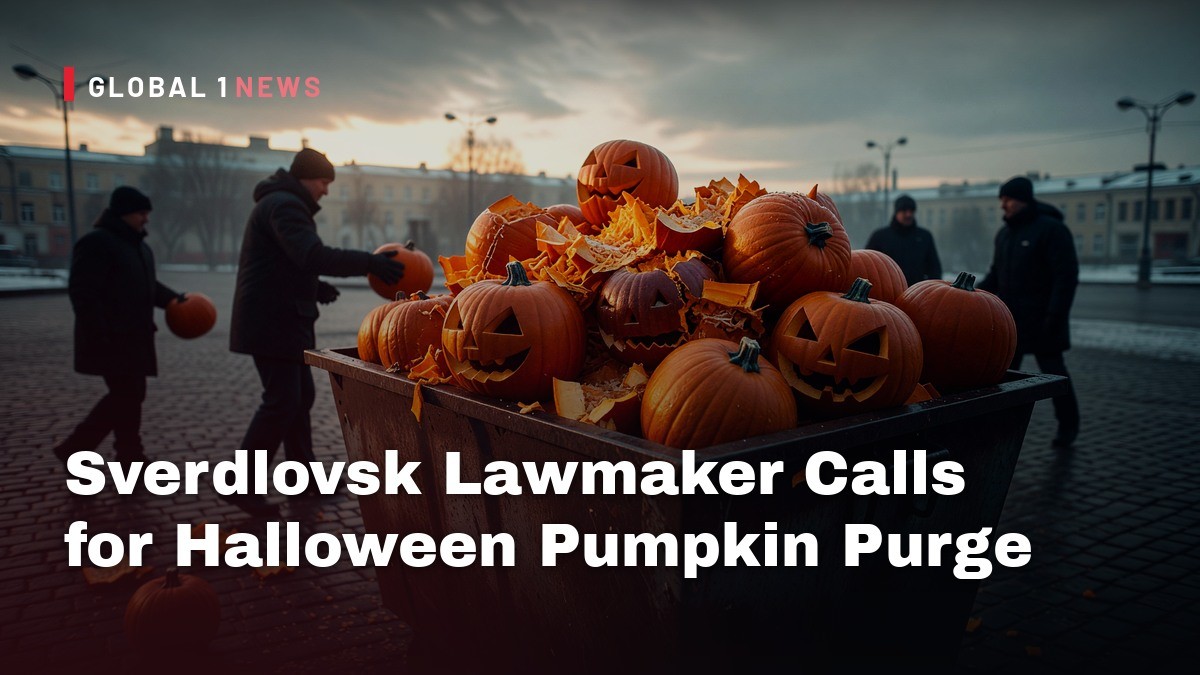
Vyacheslav Vegner, a United Russia deputy from the Sverdlovsk region, has publicly urged Russian youth to hurl pumpkins into the Iset River as a symbolic strike against Halloween, a holiday he describes as “imported from the outside.” In an interview with local media, Vegner said he intends to lobby fellow lawmakers for funding a campaign that would reward each pumpkin‑thrower with a free theater ticket ahead of the October 31 celebration. His proposal frames the act as a “simple alternative” to what he calls “spooky images, devils and pumpkins” that, in his view, clash with Russian cultural norms.
Official Rationale Behind the Pumpkin Initiative
Vegner’s argument rests on a broader narrative promoted by United Russia officials that Western customs threaten the integrity of Russian cultural identity. He emphasized that “our young people are running around with these pumpkins” and suggested that redirecting that energy toward a public river could serve both as a protest and a civic incentive. By offering theater tickets, Vegner links the gesture to a culturally sanctioned activity, implying that participation in the arts aligns more closely with “our own good, beautiful holidays.”
The proposal also taps into a recent chorus of anti‑Halloween sentiment from national legislators. State Duma deputy Vitaly Milonov, for instance, has labeled the holiday “propaganda of everyday superstition and ignorant occultism,” urging instead the promotion of traditional celebrations such as Maslenitsa and Orthodox Easter as tools of Russian “soft power.” Vegner’s local initiative mirrors this top‑down push to replace foreign‑derived festivities with state‑approved cultural forms.
Environmental Concerns and Expert Criticism
Environmental specialists quickly warned that dumping large numbers of organic pumpkins into the Iset River could have serious ecological repercussions. Vitaly Bezrukov, a former environmental minister of the neighboring Chelyabinsk region and current head of an environmental consultancy, warned that the influx of organic waste could trigger “widespread decay, depleting oxygen levels and degrading the water quality.” His assessment underscores the potential for rapid eutrophication, a risk that local authorities have not addressed in the proposal.
Bezrukov suggested an alternative: transporting the pumpkins to zoos or wildlife rescue centers, where they could be repurposed as animal feed. This recommendation reflects a pragmatic approach to waste management that avoids the environmental hazards of river dumping while still providing a channel for community participation.
Political Context: Anti‑Western Morality Campaigns
The pumpkin purge fits within a broader Kremlin‑backed moral campaign that seeks to curtail Western cultural influences. Recent statements from State Duma members have framed Halloween as part of a “creeping reach of Western culture,” positioning it alongside other perceived threats such as “propaganda of everyday superstition.” By championing a domestic alternative—free theater tickets—the state leverages cultural patronage to reinforce loyalty to Russian traditions.
This strategy aligns with long‑standing Russian soft‑power tactics that prioritize Orthodox and folk holidays. Milonov’s call to elevate Maslenitsa and Orthodox Easter reflects an effort to consolidate a cultural narrative that can be exported abroad as a hallmark of Russian identity, contrasting sharply with the “occultism” associated with Halloween.
Public Reception and Youth Culture
Despite official disapproval, Halloween celebrations continue to enjoy popularity among young people in Russia’s major cities. The holiday’s blend of costume parties, themed events, and social media visibility has made it a recurring fixture in urban youth culture, even as it remains less widespread in rural areas. Vegner’s proposal, therefore, targets a demographic that already engages with the holiday, seeking to redirect that enthusiasm toward a state‑sanctioned activity.
The offer of free theater tickets is a calculated incentive, as cultural institutions often rely on government subsidies and patronage. By tying participation in a protest act to a tangible benefit, the proposal attempts to create a feedback loop: the more youths engage in pumpkin‑throwing, the more they receive exposure to state‑approved cultural programming.
Legal and Media Implications
The article’s source, The Moscow Times, notes that the Russian Prosecutor General’s Office has designated the outlet as an “undesirable” organization, criminalizing its operations and threatening staff with prosecution. This designation follows a prior labeling as a “foreign agent,” reflecting a broader crackdown on independent media that report on dissenting viewpoints, including criticism of cultural policies such as Vegner’s pumpkin scheme.
The legal pressure on outlets like The Moscow Times underscores the stakes for journalists covering these culturally charged initiatives. By documenting the pumpkin proposal and the surrounding debate, independent media provide a rare glimpse into how regional lawmakers translate national anti‑Western rhetoric into concrete, locally impactful actions.
Potential Outcomes and Strategic Assessment
If implemented, the pumpkin‑throwing campaign could produce a visible, albeit temporary, spectacle that reinforces state messaging against Western holidays. However, the environmental risks highlighted by Bezrukov suggest that the initiative could also generate public backlash, especially from communities concerned about river pollution and ecological degradation.
Strategically, the campaign serves as a test case for how regional officials can operationalize Kremlin‑endorsed cultural policies. Success would likely encourage similar symbolic actions in other regions, while failure—due to environmental fallout or public resistance—could prompt a recalibration of anti‑Western cultural tactics at the federal level.
Broader Geopolitical Significance
The pumpkin purge illustrates how cultural regulation functions as a tool of geopolitical positioning for the Russian state. By framing Halloween as a vector of “Western cultural infiltration,” officials like Vegner and Milonov seek to fortify domestic cohesion and present Russia as a bastion of traditional values on the world stage. This narrative dovetails with broader foreign‑policy objectives that portray Russia as resisting cultural imperialism while promoting its own heritage abroad.
In this context, the campaign’s emphasis on theater tickets also signals an attempt to harness soft power domestically, reinforcing the idea that state‑supported cultural institutions are the proper venues for patriotic expression. The interplay between cultural policy, environmental concerns, and media suppression highlights the multifaceted nature of Russia’s contemporary internal and external strategies.
This article was produced with AI-assisted research and editorial support. Reporting is based on the source material cited below. Sources: The Moscow Times; themoscowtimes.com; Global1.News (01 November 2026).
By Irina Volkov, Staff Writer
What's Your Reaction?
 Like
0
 Dislike
0
 Love
0
 Funny
0
 Wow
0
 Sad
0
 Angry
0

Russia/Eastern Europe Correspondent at Global1.News. Covering Russian politics, energy, security, and the shifting dynamics of the post-Soviet space. Provides clear-eyed analysis on one of the world's most opaque regions.












Comments (0)