
Springboks Lose No 1 Ranking After All Blacks Ellis Park Hammering
Johannesburg — The Springboks’ fortress at Ellis Park came crashing down on Saturday 22 August 2026, as the All Blacks delivered a 33-16 defeat that will sting for a long time.
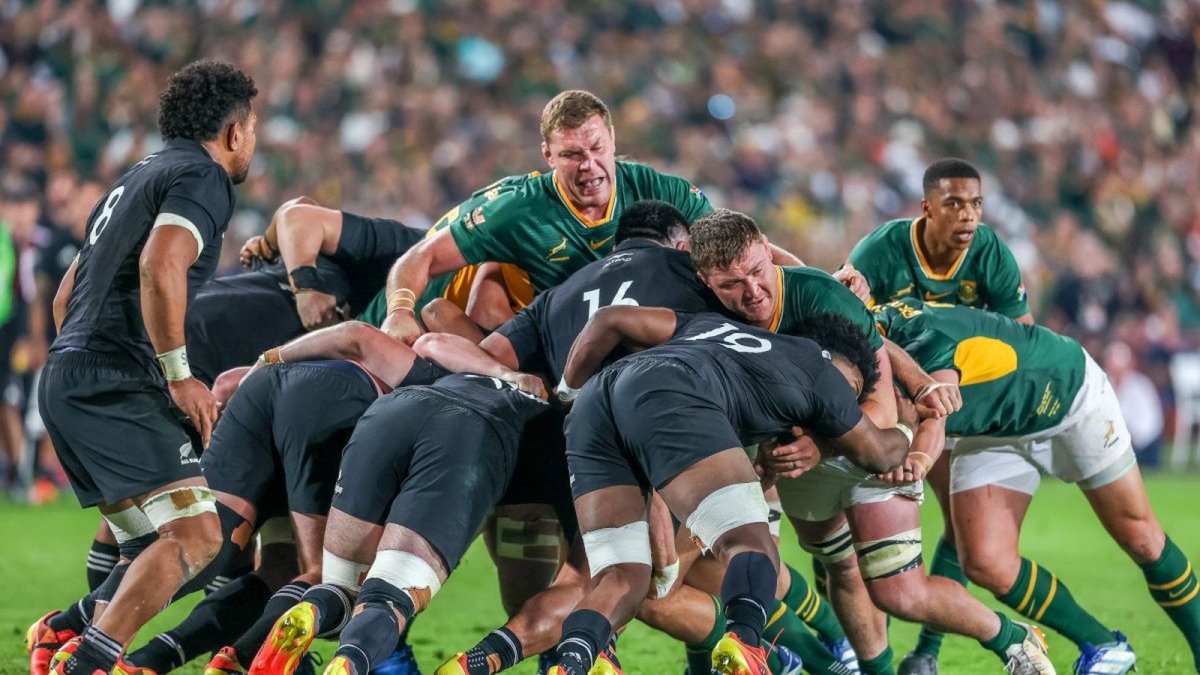
Springboks Lose No 1 Ranking After All Blacks Ellis Park Hammering
Johannesburg — The Springboks’ fortress at Ellis Park came crashing down on Saturday 22 August 2026, as the All Blacks delivered a 33-16 defeat that will sting for a long time. Five tries to one, a 17-point margin that stands as New Zealand’s biggest-ever win over South Africa at the iconic venue, and the World Rugby No 1 ranking slipping away — this was a sobering afternoon for the back-to-back world champions.
The Boks led 13-12 at half-time, but a second-half collapse, a controversial scrum decision, and a ruthless All Blacks efficiency in the 22 turned what should have been a statement win into a painful lesson. The first Test of the four-match “Rugby’s Greatest Rivalry” series — part of an eight-match All Blacks tour of South Africa and the United States, a format absent for three decades — has already set the tone for a blockbuster series.
Tags: Springboks, All Blacks, Ellis Park, Rugby Championship, Rassie Erasmus, Pieter-Steph du Toit, Dave Rennie, World Rugby ranking, Will Jordan, Andre Esterhuizen, Cheslin Kolbe, Cape Town Test
How It Unravelled: A Tale of Two Halves
The opening exchanges were tight, tense, and typically ferocious. Cheslin Kolbe opened the scoring with an early penalty, but the All Blacks responded with a sharp finish from Will Jordan, who capitalised on a clever Cam Roigard pass to cross in the corner. The Boks hit back through replacement Andre Esterhuizen, who barged over after coming on early for the injured Kurt-Lee Arendse. Kolbe’s second penalty edged the home side ahead, but a Malcolm Marx knock-on just before the break — surging for the line off a promising maul — left the Boks with a slender 13-12 lead at half-time.
The second half started with Kolbe extending the lead to 16-13 with his third penalty. But then came the moment that shifted everything. All Blacks lock Fabian Holland charged down a kick and scored within a minute, flipping the momentum completely. Flanker Luke Jacobson then barged over from close range, and the Boks were suddenly chasing the game.
With 10 minutes remaining, the wheels came off. Substitutes Marco van Staden and Cobus Reinach were yellow-carded in quick succession, reducing the Boks to 13 men. Will Jordan capitalised with his second try, sealing a comprehensive victory that flattered the scoreline but reflected the All Blacks’ clinical edge.
The Tactic That Caught the Boks Off Guard
Rassie Erasmus was blunt in his assessment of what went wrong. “They had a very clever tactic — 100% legal — they were stripping in the tackle. They didn’t tackle like we practised that we thought they would... a lot of strips,” he said. The All Blacks’ defensive approach disrupted the Boks’ attacking rhythm, forcing turnovers at crucial moments.
Erasmus cited specific examples: Jordie Barrett stripping Malcolm Marx over the touchline from a maul, and Jasper Wiese being pushed into Grant Williams with the ball knocked on. These were not illegal plays, but they were devastatingly effective. The Boks’ usual dominance at the breakdown was neutralised, and their attacking structure fell apart under the pressure.
All Blacks coach Dave Rennie, unbeaten in seven matches since replacing Scott Robertson this year, credited his defence coach Tana Umaga. “You're doing well to keep South Africa to one try, so it was a big defensive effort,” Rennie said. The stats back him up: South Africa usually score five-and-a-half points per entry into the 22; on Saturday it was 0.9, while New Zealand were at 3.7. “I reckon that's a big stat,” Rennie added.
Erasmus and Du Toit: No Excuses
There was no sugar-coating from the Springboks camp. Erasmus refused to put a positive spin on the performance. “I'm not going to butter it up and say we'll learn from this and get better. We didn't have to learn from this. We knew what we had to do on the day and we didn't do it,” he said. “It's not a wake-up call — there were just so many things we did wrong and New Zealand did right.”
Captain Pieter-Steph du Toit echoed those sentiments. “All credit to New Zealand, they were just better than us. We made some mistakes and we weren't able to convert the opportunities we had, so unfortunately we shot ourselves in the foot and in a game like this, it's those small errors and small opportunities you get that count.” He added: “We'll definitely have to go back to the drawing board.”
One decision that will be scrutinised for weeks came when the Boks trailed 19-16. They turned down three points and went for a third consecutive scrum, only for replacement prop Gerhard Steenekamp to be penalised. Erasmus admitted: “Maybe the instruction from the top, or the suggestion, should have been to take the three points because we were only three points down at that stage. From then on the momentum shifted, without a doubt.”
The Ranking Fallout: All Blacks Back on Top
The defeat has cost the Springboks their World Rugby No 1 ranking. New Zealand gained 1.75 ranking points, while South Africa lost the same amount, meaning the All Blacks are now the top-ranked side in the world. It’s a symbolic shift, but one that carries weight in a Rugby Championship context where every point matters.
Since winning the 2019 World Cup, South Africa had beaten New Zealand seven times in 11 previous meetings. The Boks are back-to-back world champions, but this loss shows the gap is closing — or perhaps that the All Blacks have found a way to counter the Boks’ physical dominance. Rennie was quick to downplay the margin: “There was nothing in that game. I know the score might sound convincing, but it was an absolute arm-wrestle at 19-16. We were under the pump and the boys barred up... we're wary of the response we'll get next week.”
For South African fans, the ranking loss is a bitter pill. But the series is far from over. The second Test is scheduled for Cape Town Stadium on Saturday 29 August, and the All Blacks enjoy fanatical support in the Mother City. The Boks will need to regroup quickly, but the history of this rivalry suggests they will come back swinging.

Injuries and Selection Headaches
The Boks’ injury concerns add to the pressure. Kurt-Lee Arendse left the field in the 9th minute after failing a head injury assessment. Erasmus explained: “His mouthguard pinged and the match doctor didn't clear him.” Players who fail an HIA are usually stood down for at least 10 days, meaning Arendse is likely out of the Cape Town Test.
Cheslin Kolbe also limped off in the 58th minute, though Erasmus was less concerned: “I think Cheslin was more cramp than anything else.” Still, with the series on the line, the Boks will be monitoring both players closely. The All Blacks have their own issues: loosehead prop Ethan de Groot and lock Josh Lord withdrew with head knocks. Rennie confirmed neither can play Tuesday against the Lions and probably not next Saturday.
The All Blacks have been on a brutal tour, beating the Stormers 38-21, Sharks 54-0, and Vodacom Bulls 50-19 over the previous 15 days in Cape Town, Durban, and Pretoria. They face the Lions at Ellis Park on Tuesday before the second Test. The Boks, meanwhile, will be licking their wounds and plotting revenge.
South African Perspective: A Reality Check
This defeat feels different. It’s not just the scoreline or the ranking loss — it’s the manner of the performance. The Boks were dominated in the areas they pride themselves on: the set-piece, the breakdown, and the physical battle. The All Blacks’ defensive stripping tactic exposed a lack of adaptability, and the decision-making under pressure was poor.
There was a moment of celebration before the match, as Damian de Allende became the 10th Bok to reach 100 Test caps, walking out with his wife and two children before kick-off. But the occasion was overshadowed by the result. The national mood is one of frustration, but also of hope — this is a team that has bounced back from adversity before.
One controversial moment will also be debated: Ardie Savea’s shoulder-to-head collision with Jasper Wiese was reviewed, but no card was shown by referee Matthew Carley of England. Savea admitted: “I was nervous, but they made the decision, they made the call, and it worked in our favour.” Rennie backed the officials: “Technically, it's the right call. You'll see in the footage that when he hits him, his head comes forward. That means the first impact's on the body, then the head comes forward.”
What to Watch For in Cape Town
The second Test at Cape Town Stadium on Saturday 29 August is now a must-win for the Boks. The All Blacks will be confident, but they know the Boks’ response will be fierce. Erasmus has already shown he is not afraid to make tough calls, and the selection for Cape Town will be fascinating.
The Boks need to fix their discipline, their decision-making, and their ability to convert pressure into points. The All Blacks, meanwhile, will look to build on their momentum and seal the series early. Rennie’s side has been ruthless on this tour, and they won’t ease off now.
For South African rugby fans, this is a moment of reckoning. The Boks are still a great team, but greatness requires constant reinvention. The Cape Town Test will show whether they have learned from this painful lesson — or whether the All Blacks have truly regained their edge. Stream the action live on SuperSport / DStv, and brace yourselves for another epic chapter in Rugby’s Greatest Rivalry.
This article was produced with AI-assisted research and editorial support. Sources: SARugbyMag, The South African, SuperSport.
By Dante Williams, Staff Writer
What's Your Reaction?
 Like
0
Like
0
 Dislike
0
Dislike
0
 Love
0
Love
0
 Funny
0
Funny
0
 Wow
0
Wow
0
 Sad
0
Sad
0
 Angry
0
Angry
0

Breaking News and Investigations Correspondent at Global1.News. Based in London, covering global breaking news, security, and investigative stories. Known for digging deeper and connecting the dots across continents.













Comments (0)