
US Envoy Barrack Breaks With Trump: Israel Occupies Golan 'Against UN Resolutions'
In a recent Middle East Eye report, Tom Barrack — the US ambassador to Turkiye and special envoy for Syria and Iraq — broke ranks with the Trump administration by declaring that Israel still occupies the Golan Heights "against the UN resolutions, against all of the international order, which has said the Golan is Syria's." The remarks, made in an interview with broadcaster Mario Nawfal and shared widely on X, put a senior American diplomat publicly at odds with Washington's official position on
In a recent Middle East Eye report, Tom Barrack — the US ambassador to Turkiye and special envoy for Syria and Iraq — broke ranks with the Trump administration by declaring that Israel still occupies the Golan Heights "against the UN resolutions, against all of the international order, which has said the Golan is Syria's." The remarks, made in an interview with broadcaster Mario Nawfal and shared widely on X, put a senior American diplomat publicly at odds with Washington's official position on the strategic plateau, which the United States recognised as Israeli sovereign territory in 2019.
US Envoy Tom Barrack Breaks With Trump on Golan, Calls Israeli Occupation a Violation of UN Resolutions
Washington, DC – 22 August 2026 — In a wide-ranging interview published this week, US envoy Tom Barrack acknowledged what the international community has maintained for decades: that Israel's occupation of Syria's Golan Heights runs against UN resolutions and international law. His comments, carried in a Middle East Eye video report, mark a striking departure from the policy of the administration he serves, and they come at a moment of acute tension between Israel and Turkiye over strikes on Syrian territory.
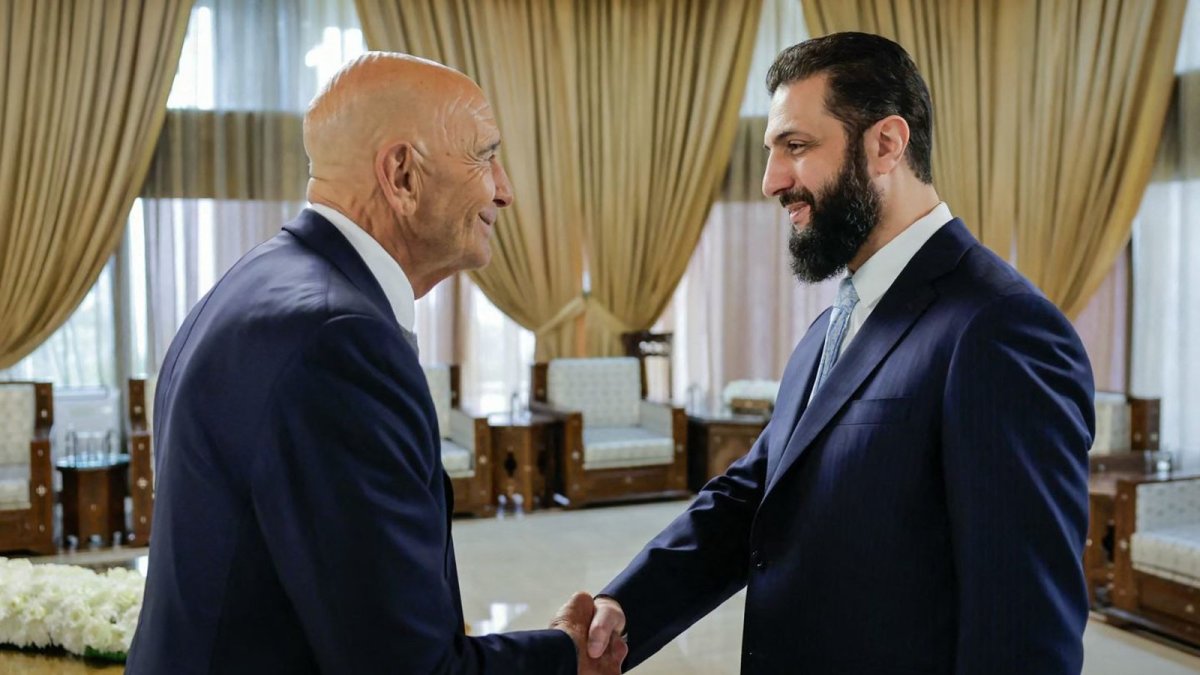
US Envoy Breaks With White House on Golan
Barrack, who serves as the US ambassador to Turkiye and special envoy for Syria and Iraq, made the comments during an interview with broadcaster Mario Nawfal, clips of which were circulated on X. "I just think regardless of what their intent may be now, they know that that's not likely," Barrack said of Israeli ambitions, adding: "Now saying that, in the Golan with Syria, they still occupy the Golan against the UN resolutions, against all of the international order, which has said the Golan is Syria's."
The remarks put Barrack at odds with his own government. In March 2019, President Donald Trump signed a proclamation recognising Israeli sovereignty over the Golan Heights, making the United States the first country to do so. The move reversed decades of US policy that had treated the territory as occupied Syrian land. Israel's occupation of the Golan has continued since, with roughly 20,000 Israeli settlers living there alongside around 26,000 native inhabitants, who are predominantly Druze and identify as Syrian.
Israeli officials were quick to push back. Defence Minister Israel Katz denounced Barrack's comments as "full of inaccuracies and positions that contradict the stance of US President Trump himself," according to Al Jazeera. Katz said Israel had shared "intelligence information to the authorised parties in the United States" before striking a Syrian airbase this week.
A Six-Decade Occupation, Codified in UN Resolutions
The Golan Heights, a strategic plateau straddling Israel and Syria and overlooking southern Lebanon, was captured by Israel during the 1967 Middle East war and annexed in 1981 in a move never recognised by the international community. UN Security Council Resolution 497, adopted on 17 December 1981, declared Israel's decision to impose its laws, jurisdiction and administration on the Golan "null and void and without international legal effect."
UN Resolution 242, passed after the 1967 war, calls for Israel to withdraw from the Golan and other occupied territories, including the Gaza Strip and the West Bank. Syria has repeatedly invoked these instruments. On 29 April 2025, Syrian Foreign Minister Asaad al-Shaibani told the UN Security Council that the Syrian Golan remains under occupation and called for the implementation of Resolution 497 and Israel's withdrawal to the 4 June 1967 line.

'Baiting the Turks': The Abu al-Duhur Strike
Barrack's comments came as Washington, Ankara and Tel Aviv navigated the fallout from an Israeli strike on Syria's Abu al-Duhur airbase early on Tuesday. The envoy called the strikes "serious and worrying" and an "unnecessary escalation," and said Israel gave the United States no prior warning — a claim Israeli officials disputed.
In a social media post on Saturday, Katz said Israel had shared intelligence with authorised US parties before the strike. Israeli Prime Minister Benjamin Netanyahu justified the attack by saying his government feared Turkiye was preparing to deploy troops to the area and had ignored warnings against doing so. Turkiye denied the allegations and blasted the strikes as "reckless."
Barrack offered several theories for the attack. The US had concluded that the purported military activity at the base was "not happening," he said, although Israel may have acted on intelligence suggesting Turkish assets were moving in, or detected movements others missed. His "probably most likely" theory involved intercepted discussions about Turkiye expanding training at the base. He also floated a more explosive possibility: that "the Israelis were baiting the Turks," deliberately testing Ankara with aircraft deployed without prior notification — or that a breakdown inside Israel, with the military, Mossad and the prime minister's office acting on different assessments, had produced the strike. "The unintended consequence of a mistake could be really consequential," Barrack said, describing how Turkish forces might have scrambled their jets without knowing Israel's intentions.
Syrian Foreign Minister Asaad al-Shaibani said on Wednesday that the government had made clear to Israel there were no plans for a Turkish military base at Abu al-Duhur. Turkish military officers had visited the facility as part of "ongoing military cooperation in the areas of training and the exchange of expertise," he said. Syria's interim President Ahmed al-Sharaa, who met Barrack at the Presidential Palace in Damascus on 18 January 2026, has stressed that his government is not seeking conflict with Israel.
Lebanon, Iran and the Limits of US Support
Asked whether Israel intended to annex territory in southern Lebanon, Barrack suggested that Israeli leaders understood the limits of what would be tolerated. "No matter what they are doing. In the long run, I think they are looking and saying 'that is probably unlikely that anybody is going to allow us to do that'. America's support is waning. Even the young Democrats are coming against them," he said.
Barrack said Trump has "drawn a line of attempting to go moderation" and predicted that upcoming Israeli elections will throw up a different setting. On Israel's ongoing incursions into Lebanon, he asked how long those incursions can go on "until the temperature comes down," and stressed that a resolution appeared difficult in the absence of "people who can take a decision at the table" — "And the people who can take a decision are Iran and Hezbollah," he said.
The envoy's comments also laid bare the limits of Washington's leverage. Since the fall of Bashar al-Assad in December 2024, Israel has routinely launched strikes in Syria and occupied swaths of its southern regions, expelling Syrians from their homes and setting up military infrastructure. Despite occasional criticism, the Trump administration has taken no firm measures to pressure Israel over its military campaigns, and Trump has praised Israel as a "great ally." The US has attempted to broker talks between Turkiye and Israel to de-escalate the situation.
Analysis and Implications
For Palestinians and Syrians alike, the significance of Barrack's remarks lies less in any immediate policy change than in what they reveal about the erosion of consensus around Israel's territorial claims. Washington's 2019 recognition of the Golan annexation was widely criticised internationally; a senior US official now openly describing the same territory as occupied in defiance of the "international order" signals that the legal and political foundations of that recognition are no longer treated as settled — even inside the administration.
On the ground, the stakes are human. The Druze communities of the Golan, who largely identify as Syrian and maintain ties across the ceasefire line, have lived for nearly six decades under an occupation their own government and the UN describe as illegal. Displaced Syrian families from the country's southwest, many of whom fled in 1967 and its aftermath, have been unable to return to their homes and lands; figures for the number displaced were not immediately available. For them, a senior US official acknowledging the occupation's illegality is a rare validation — but words, as Syrian diplomacy at the UN has repeatedly stressed, have yet to be translated into action.
Whether Barrack's position reflects a broader shift in the Trump administration remains unclear; the president has given no indication of reversing the 2019 recognition. What is clear is that the Golan, like Gaza and the West Bank, remains occupied territory under international law — and that the "international order" Barrack invoked has yet to find the will to enforce it.
By Fatima Al-Rashid, Staff Writer
This article was produced with AI-assisted research and editorial support. Reporting is based on sources cited in the article.
What's Your Reaction?
 Like
0
Like
0
 Dislike
0
Dislike
0
 Love
0
Love
0
 Funny
0
Funny
0
 Wow
0
Wow
0
 Sad
0
Sad
0
 Angry
0
Angry
0

Gulf/MENA Correspondent at Global1.News. Based in Doha, covering Gulf politics, energy markets, diplomacy, and development across the Middle East and North Africa. Tracks the economic transformation of the Gulf states.














Comments (0)