
Smuggled Snakes and Crocodiles: Seoul Indicts Wildlife Trafficking Ring
The Seoul Eastern District Prosecutors' Office has indicted five individuals on charges of smuggling and trafficking internationally protected wildlife into South Korea. The case involves approximately 200 non-native animals brought into the country over 14 occasions between November 2023 and August 2024. Authorities recovered 95 animals from residential properties across the capital region, with 40 belonging to endangered species.
The Seoul Eastern District Prosecutors' Office has indicted five individuals on charges of smuggling and trafficking internationally protected wildlife into South Korea. The case involves approximately 200 non-native animals brought into the country over 14 occasions between November 2023 and August 2024.
Authorities recovered 95 animals from residential properties across the capital region, with 40 belonging to endangered species. The operation underscores ongoing challenges in enforcing international wildlife conventions within Korean territory, even as Seoul presents itself as a responsible party to the global treaty regime protecting threatened fauna.
Smuggled Snakes and Crocodiles: Seoul Indicts Wildlife Trafficking Ring
Seoul, South Korea – August 7, 2026 — The Seoul Eastern District Prosecutors' Office announced on August 6 the indictment of five people for violations of the Customs Act and the Wildlife Protection and Management Act. Criminal Affairs Division 2, under senior prosecutor Lee Seung-hak, led the investigation, with prosecutor Kim Dong-won overseeing key aspects of the case.
The Indictment
The ringleader, a man in his twenties, was indicted and remains in detention. Four accomplices received indictments without detention. Prosecutors determined that the group purchased animals from sellers in Indonesia, Vietnam, and Thailand through social media platforms before concealing them for transport into South Korea.

The dual invocation of the Customs Act and the Wildlife Protection and Management Act allows prosecutors to pursue cumulative sanctions covering both border violations and domestic trafficking. Detention of the ringleader signals a judicial assessment of elevated flight risk and potential evidence interference, while the non-detention indictments of the four accomplices indicate calculated distinctions in culpability and cooperation within the prosecutorial framework.
How the Ring Operated
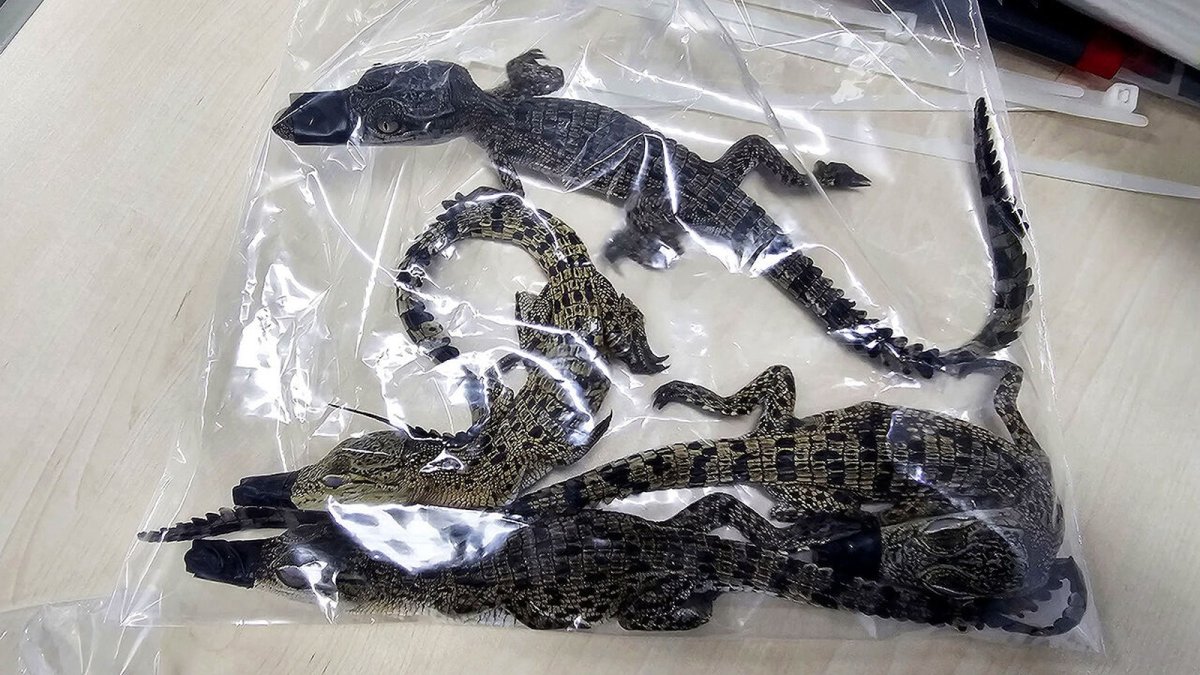
Smugglers hid animals inside metal snack tins, plastic boxes, and even underwear. They taped or bound the mouths of venomous species to suppress noise during transit. Many animals perished from stress before reaching buyers. Sales occurred on Korean online reptile forums using coded language such as "figurines," "dolls," and "stuffed animals" to evade detection.
The case also draws attention to the regulatory blind spots of specialized online communities. Korean authorities have devoted considerable resources to monitoring mainstream e-commerce platforms, yet niche reptile forums operate with comparatively light oversight, relying on coded vocabulary that evades conventional keyword filters. Prosecutors have not indicated whether platform operators were notified or asked to cooperate, but the investigation illustrates how trafficking networks adapt to enforcement by migrating toward smaller, enthusiast-run spaces.
Species and Scale of the Trade
The ring imported Chinese alligators, classified as Class 1 internationally endangered species, along with venomous cobras, saltwater crocodiles, amethystine pythons, reticulated pythons, black marsh turtles, and various lizards. Of the 95 animals confiscated from apartments, villas, and gosiwon studio units, 40 were endangered. Authorities transferred the surviving specimens to the National Institute of Ecology in Seocheon, South Chungcheong Province, roughly 170 kilometers south of Seoul, where the institute operates dedicated facilities for the care of seized wildlife. Prosecutors noted that a substantial number of animals died from stress during transport, a common toll in wildlife trafficking that also complicates evidentiary work in such cases.
Chinese alligators' designation as a Class 1 endangered species under Korean law aligns with their CITES Appendix I status, prohibiting commercial trade and highlighting the ring's direct contravention of extinction-level protections that few other reptiles in the seizure share.
The sale of 54 endangered animals across 14 import cycles reveals a high-volume, repeat-demand market in Korea where individual specimens command prices from hundreds of thousands to tens of millions of won, sustaining Southeast Asian supply chains through social media procurement.
The SBS report on the case described the scale of the operation vividly: plastic baskets densely packed on shelves inside a cramped gosiwon studio, reticulated pythons and Chinese alligators discovered in a villa near an elementary school, and venomous cobras kept in yet another apartment. The proximity of these holdings to schools and residential neighborhoods is precisely what prosecutors say elevates the public-safety stakes of unlicensed exotic-animal keeping in Korean cities.
CITES and Korea's Legal Framework
South Korea has been a party to the Convention on International Trade in Endangered Species of Wild Fauna and Flora since 1993, with the Wildlife Protection and Management Act translating those obligations into domestic prohibitions. Appendix I species such as the Chinese alligator trigger automatic import bans, while Appendix II reptiles require permits that the ring systematically bypassed.
The case nonetheless exposes the practical distance between treaty commitment and border enforcement: the first interception did not occur until July 2025, more than a year after the smuggling began. That gap underscores how CITES obligations ultimately depend on detection capacity at entry points such as Incheon International Airport and on coordination between customs authorities, prosecutors, and the Ministry of Environment.
Public Safety in Urban Korea
Prosecutor Kim Dong-won noted that escaped or lost animals pose direct risks in densely populated areas, where venomous species can transmit disease or cause injury and large reptiles may behave aggressively. Recent incidents — an alligator sighting in the Soyang Stream in Yeoju, a snake entering a home in Yangju, and the August 2024 discovery of a saltwater crocodile carcass in Sacheon — have all been linked to this network. The concentration of exotic reptiles in compact urban dwellings such as gosiwon and apartments amplifies the probability of escape in Korea's high-density residential fabric, where even brief releases of venomous species can trigger rapid public-health responses across municipal boundaries. Prosecutors frame these episodes as predictable outcomes of unregulated private keeping rather than isolated anomalies, urging local governments to develop containment verification systems.
Investigation and Prosecution
The case began when Incheon customs referred an intercepted accomplice to prosecutors. Investigators later uncovered evidence that the ringleader had previously evaded punishment by arranging for an accomplice to confess in his place. He subsequently demanded 60 million won from one associate in exchange for assistance avoiding further scrutiny and extorted an additional 9.1 million won. Prosecutors have stated they will coordinate with environmental authorities and the National Institute of Ecology to pursue strict penalties.
The roughly thirteen months between the Incheon interception and the August 2026 indictment reflect the investigative complexity of transnational wildlife cases. Tracing digital payment trails, matching social media identities to courier deliveries, and establishing a chain of custody for live animals all extended the timeline. The prosecution's decision to seek detention for the ringleader while releasing the four accomplices without detention suggests that investigators obtained cooperation from lower-level participants, a pattern consistent with dismantling organized smuggling networks from the inside.
Looking Ahead
The indictments signal increased scrutiny of online reptile markets and of the Southeast Asian supply chains feeding Korean demand, and they point toward tighter enforcement ahead. Advanced customs screening at major entry points such as Incheon, stricter regulation of online marketplaces, and expanded compliance training under the Wildlife Protection and Management Act are all likely areas of focus for Korean authorities. Regional cooperation will matter as much as domestic measures: Indonesia, Vietnam, and Thailand are themselves CITES parties, and multilateral mechanisms such as the ASEAN Wildlife Enforcement Network offer channels through which Seoul could press for stronger source-country controls. The National Institute of Ecology's continued role in rehabilitating seized animals will also remain central, and the case may ultimately elevate Korea's standing as a CITES party while strengthening the domestic institutions responsible for enforcing its commitments.
By Prof. David Park, Staff Writer
This article was produced with AI-assisted research and editorial support. Reporting is based on sources cited in the article.
What's Your Reaction?
 Like
0
Like
0
 Dislike
0
Dislike
0
 Love
0
Love
0
 Funny
0
Funny
0
 Wow
0
Wow
0
 Sad
0
Sad
0
 Angry
0
Angry
0

East Asia/Technology Correspondent at Global1.News. Seoul-based voice covering Korean politics, technology, business, and culture. Analyzes how technology and geopolitics intersect across East Asia.














Comments (0)