
Relief Carrier Heads to Middle East Amid USS Lincoln Crew Crisis
In a recent BBC News report, the US Navy's decision to dispatch a relief aircraft carrier to the Middle East spotlighted the deteriorating conditions aboard the USS Abraham Lincoln, a deployment that has stretched past nine months. Relief Carrier Heads to Middle East as USS Lincoln Crew Faces Mounting Strain Washington – 15 August 2026 — A US aircraft carrier is steaming toward the Middle East to replace the USS Abraham Lincoln, where thousands of sailors have reportedly endured food...
In a recent BBC News report, the US Navy's decision to dispatch a relief aircraft carrier to the Middle East spotlighted the deteriorating conditions aboard the USS Abraham Lincoln, a deployment that has stretched past nine months.
Relief Carrier Heads to Middle East as USS Lincoln Crew Faces Mounting Strain
Washington – 15 August 2026 — A US aircraft carrier is steaming toward the Middle East to replace the USS Abraham Lincoln, where thousands of sailors have reportedly endured food shortages, broken plumbing and grinding exhaustion on an extended deployment that has raised alarm in Congress and among the families of the crew.

A Nine-Month Deployment Under Strain
The Nimitz-class carrier USS Abraham Lincoln has been at sea since 11 December, according to tracking data compiled by BBC Verify, on a deployment that was initially slated to end in May. Roughly 5,000 sailors are on board. This week, the Military Times and Stars & Stripes reported that the families of multiple sailors said their loved ones had considered jumping overboard because of conditions on the vessel. The reported problems include poor sanitation, infrequent port calls, broken plumbing, exhaustion and shortages of fresh food.
The deployment, which began as a routine rotation, was redirected in January ahead of US military operations involving Iran. Since then, it has been extended several times, leaving the crew at sea for more than 250 days — far beyond the six-month standard that has long been the benchmark for Navy carrier deployments. The Lincoln's prolonged absence from its home port has also complicated maintenance schedules, as the vessel's age and the relentless pace of flight operations take a cumulative toll on both machinery and morale.
Navy officials have acknowledged that supply chains have been strained, but they maintain that the ship remains fully mission-capable. The Pentagon has not released internal morale surveys, and the Navy has denied any increase in suicidal behaviour on board. Yet the accumulation of reported incidents — from food rationing to sewage backups — has made the Lincoln a focal point in a broader debate about how the US military balances operational demands against the welfare of its personnel.
Families Speak Out
In an interview with the BBC, a relative of a sailor on the Lincoln claimed their family member had lost 65 pounds (29kg) since the ship headed to sea and was suffering from exhaustion because of the constant noise of aircraft and the ship's vibrations. The person, who spoke on condition of anonymity due to concerns about retaliation, said their relative had confirmed that sailors had attempted to jump from the ship. The account aligns with reporting from Military Times and Stars & Stripes, which cited multiple families describing similar distress among crew members.
Jefferson Kelly, whose son Jackson is on the Lincoln, told CBS that he has grown concerned for his son after nearly nine months at sea. Deployments typically last about six months. "They should not be deployed this long... These are old ships. It's not like they're even state-of-the-art. And they take a lot of maintenance, a lot of work. It's around the clock," Kelly said. He added: "I would get on a plane or helicopter tonight if it meant bringing him home to his mom and his siblings and his family."
Kelly's frustration echoes a sentiment that has been building among military families for weeks. Many have taken to private social media groups to share updates and compare notes on the Lincoln's condition, with some expressing anger that their concerns have been dismissed by officials in Washington. The emotional weight of the extended deployment is compounded by the difficulty of maintaining communication; sailors on the carrier have limited access to phone and internet services, leaving families to rely on sporadic updates that often lag weeks behind the reality on board.
The Relief Mission: USS George Washington
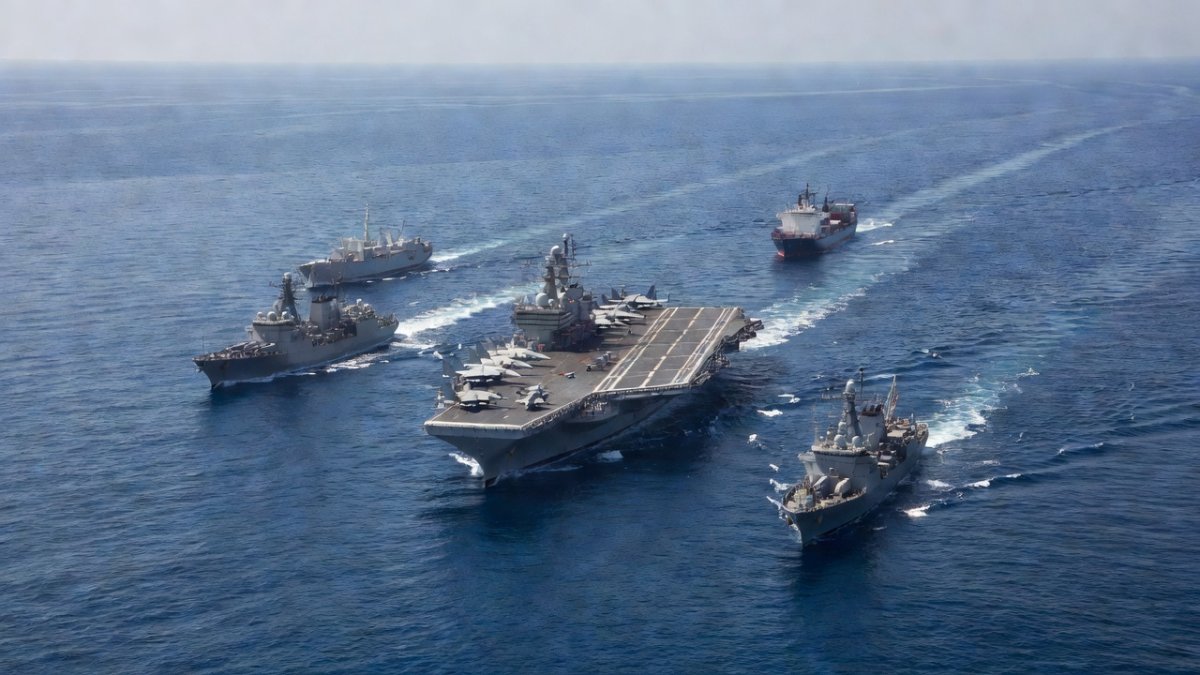
The USS George Washington, which was near Malaysia on Thursday, could arrive in the region in about nine days, BBC analysis shows. Citing a US official, CBS News — the BBC's US partner — reported that the George Washington left a naval facility in Yokosuka, Japan in May to patrol the Pacific and is now headed to replace the Lincoln. Tracking data compiled by BBC Verify shows that at its last recorded speed, the vessel would reach Duqm port in Oman, about 500 miles off the coast of Iran, around 22 August. Once it arrives in the Middle East, it will be the third aircraft carrier in the area — the USS George HW Bush is also there. No US aircraft carrier will remain in the Pacific.
The George Washington's journey represents a significant logistical undertaking. The carrier, which underwent a mid-life refuelling and complex overhaul in recent years, was only recently returned to full operational status. Its departure from the Pacific leaves a gap in America's forward-deployed naval presence in a region where China has been expanding its own carrier capabilities. The Navy has not said how long the George Washington will remain in the Middle East, nor has it outlined a plan for restoring a carrier presence in the Indo-Pacific.
For the crew of the Lincoln, the arrival of the George Washington cannot come soon enough. The handover process, however, is not instantaneous. The two carriers will need to coordinate a transfer of aircraft, munitions and supplies, a process that typically takes several days. Until then, the Lincoln's sailors remain on station, continuing flight operations in support of US missions related to the ongoing conflict with Iran.
Washington's Response: Trump and the Pentagon
Speaking to reporters on Friday, President Donald Trump denied that family members were concerned about the welfare of their relatives and dismissed the possibility that the deployment had been too long. "Not nearly long enough," he said. Trump confirmed that another ship will replace the Lincoln, although he did not identify it by name. The President's remarks stand in stark contrast to the accounts provided by families and the concerns raised by lawmakers on both sides of the aisle.
The US Navy has denied any increase in suicidal behaviour on the Lincoln, but has acknowledged that supplies had been "disrupted by combat actions" during the war with Iran. Defence Secretary Pete Hegseth has said that some of the media reports have been "completely misrepresented". He told reporters on Thursday that the US government was making sure "every ship, every crew, every captain has everything we can provide them at every single moment". Hegseth's comments were an apparent attempt to reassure the public that the Pentagon is responsive to the needs of its forces, even as critics point to the extended deployment as evidence to the contrary.
The disconnect between the administration's public posture and the lived experience of sailors and their families has become a political flashpoint. White House officials have privately pushed back on the notion that conditions on the Lincoln are as dire as reported, suggesting that some accounts may be exaggerated. However, they have not provided alternative explanations for the specific allegations of food shortages and broken plumbing, nor have they offered a timeline for when the Lincoln will finally return to its home port.
Congressional Pressure and the Tempo Question
Democratic lawmakers have expressed concern over the conditions on the ship. In a letter to Defence Secretary Pete Hegseth and Secretary of the Navy Hung Cao on Wednesday, Connecticut Democratic Senator Richard Blumenthal said that reports of shortages and poor conditions "warrant immediate attention". "But they also raise a broader question: whether the Navy can sustain the operational tempo now being demanded of its carrier force," he added. Members of Congress have been worried about the crew's well-being for months, with the carrier redirected to the Middle East in January ahead of US military operations involving Iran and its deployment extended several times since.
Blumenthal's letter is the latest in a series of communications from Capitol Hill seeking detailed information about the Lincoln's condition. Lawmakers have requested internal Navy assessments, maintenance logs and morale data, though it remains unclear whether the Pentagon has complied fully with those requests. The Senator's framing of the issue as a question of "operational tempo" reflects a growing concern among defence experts that the US carrier fleet is being stretched too thin to meet the demands of simultaneous global commitments.
The Navy's carrier force has been operating at an elevated pace for years, with deployments frequently extended to cover gaps in coverage. The Lincoln's ordeal, however, has brought the human cost of that tempo into sharp focus. Military analysts note that the service has struggled to recruit and retain experienced sailors, and that prolonged deployments with limited port visits are likely to exacerbate that challenge. The service has not announced any changes to its deployment policies in response to the Lincoln situation.
Geopolitical Implications: The Pacific Vacuum
The redeployment carries consequences far beyond the crew's welfare. With the George Washington leaving the Pacific and no US carrier remaining there, Beijing's naval build-up in the South China Sea and Taiwan Strait will face a thinner American presence — a shift that analysts say Moscow is also watching closely as it weighs its own force posture in the Asia-Pacific. This could indicate a temporary but significant reduction in US naval deterrence in a region where China has been increasingly assertive in its territorial claims and military exercises.
The strain on the US carrier force — several hulls on extended wartime rotations simultaneously — raises questions about the sustainability of American power projection at a moment of overlapping crises from the Middle East to the Indo-Pacific. Analysts suggest this signals a fundamental tension in US strategy: the demand for carrier presence in multiple theatres is outpacing the Navy's ability to deliver it without exhausting crews and accelerating wear on aging vessels. The Lincoln's deployment, which was extended multiple times to cover operational needs, is a case study in that dynamic.
How the Navy manages the transition in the coming weeks will be closely watched by allies and adversaries alike. For America's partners in the Pacific, the absence of a carrier may be a source of concern, even if temporary. For the sailors of the Lincoln, the arrival of the George Washington is the first step toward a long-awaited journey home. Whether the Navy can learn from this episode and adjust its deployment model remains an open question — one that will shape the future of American naval power for years to come.
By Irina Volkov, Staff Writer
This article was produced with AI-assisted research and editorial support. Reporting is based on sources cited in the article.
What's Your Reaction?
 Like
0
Like
0
 Dislike
0
Dislike
0
 Love
0
Love
0
 Funny
0
Funny
0
 Wow
0
Wow
0
 Sad
0
Sad
0
 Angry
0
Angry
0

Russia/Eastern Europe Correspondent at Global1.News. Covering Russian politics, energy, security, and the shifting dynamics of the post-Soviet space. Provides clear-eyed analysis on one of the world's most opaque regions.














Comments (0)