
Nepal Flood Toll Tops 1,295 as Tunnel Rescue Raises Hopes
The death toll from the catastrophic flash flood that tore through Nepal’s Himalayan foothills on August 26 has surpassed 1,295, even as rescue teams pulled two workers alive from a flooded hydropower tunnel nine days after the disaster.
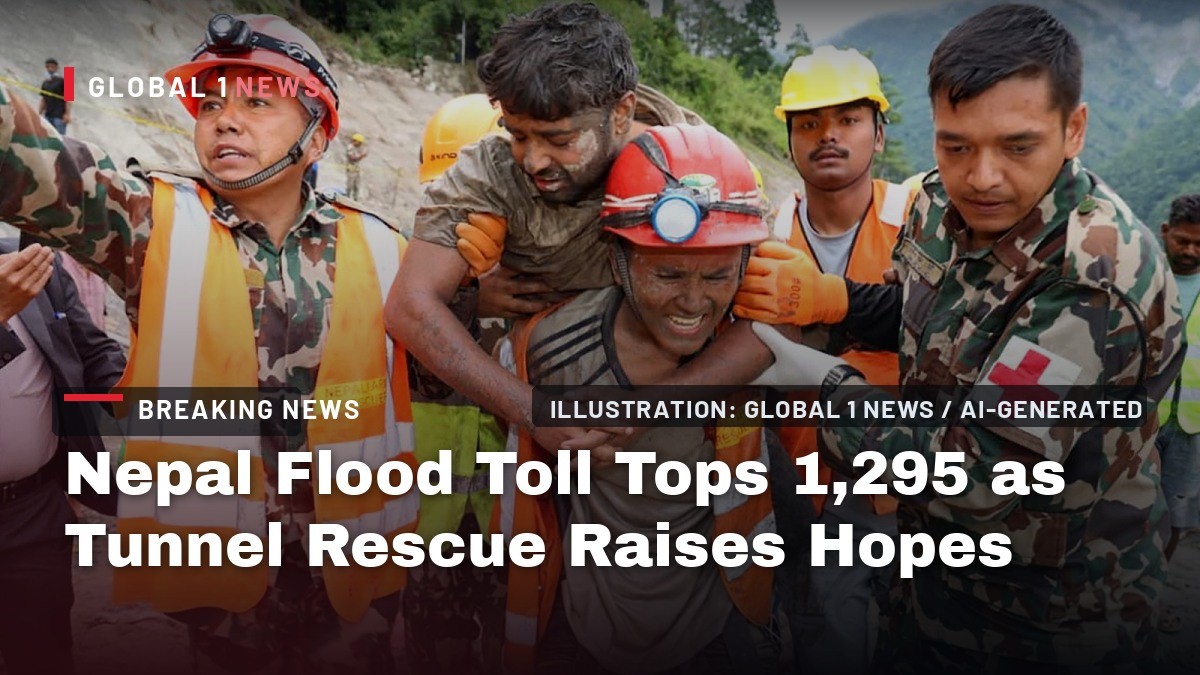
The death toll from the catastrophic flash flood that tore through Nepal’s Himalayan foothills on August 26 has surpassed 1,295, even as rescue teams pulled two workers alive from a flooded hydropower tunnel nine days after the disaster. The extraordinary rescue in Nepal’s Rasuwa district offered a rare moment of relief in a crisis that has displaced tens of thousands — even as surging monsoon rivers strain India’s Ganges basin states just across the border.
Nepal Flood Toll Tops 1,295 as Tunnel Rescue Raises Hopes
Kathmandu, Nepal — Saturday, September 5 — Search teams in Nepal achieved what officials called a miracle on Friday, extracting two men from the main tunnel of the Trishuli 3A hydropower project nine days after a glacier-collapse flood buried the site under mud and debris. The rescue came as Nepal Police confirmed the disaster’s death toll had risen to 1,295, with more than 5,000 people still missing across the country and in Chinese-controlled Tibet, and as India rushed a seventh relief flight to Kathmandu while simultaneously battling its own flooding emergency in the Ganges basin.
The two survivors, identified by Nepal’s Home Minister Sudan Gurung as Sanjay Sah, 30, a mechanical foreman, and Kabir Maharjan, 45, a mechanical supervisor, were found alive at a depth of about 170 metres inside the tunnel. Nepal Army spokesman Brig. Gen. Raja Ram Basnet confirmed the details of the rescue, which was broadcast live by Energy Minister Biraj Bhakta Shrestha. Maharjan was flown to the Nepal Army Hospital in Chhauni, Kathmandu, in critical condition, while Sah was treated at a hospital in Trishuli. They are the first survivors recovered from any hydropower site since the disaster began.
A Wall of Ice and Rock: The August 26 Catastrophe
The disaster began on Wednesday, August 26, when an ice-rock avalanche following the partial collapse of a glacier near the Nepal-Tibet border sent a wall of ice, rock, mud and debris down the Bhote Koshi and Trishuli river valleys in northern Nepal. The torrent devastated towns and villages in Rasuwa and Nuwakot districts, wrecked roads and bridges, destroyed schools, and buried or washed away hydropower construction sites, including the Trishuli 3A project and tunnels at Chilime.
The sheer force of the flood transformed the landscape in minutes, cutting off entire communities and leaving rescue teams to navigate treacherous terrain. The event is part of a broader pattern of Himalayan glacial instability, where warming temperatures have made high-altitude ice formations increasingly prone to sudden collapse. Hydropower projects built in narrow river valleys across the region remain particularly exposed to such cascading hazards, a vulnerability that has drawn renewed scrutiny in the wake of the disaster.
Nepal’s National Disaster Risk Reduction and Management Authority (NDRRMA) said the flood damaged 7,570 private homes, directly affecting an estimated 32,963 people. The agency’s initial assessment also counted 55 kilometres of roads fully damaged, 37 motorable bridges and 68 suspension bridges destroyed, along with 48 government buildings, 18 schools and 7 health facilities.
The Human Toll: Districts, Children and Lost Schools
Nepal Police said Friday that 1,293 bodies had been recovered across eight districts, and two more victims died in Kathmandu hospitals on Friday, raising the toll to 1,295. The district breakdown shows the flood’s reach far beyond the immediate impact zone: Chitwan recorded 359 deaths, Nawalparasi East 221, Nawalparasi West 212, Nuwakot 186, Rasuwa 140, Gorkha 72, Dhading 65 and Tanahu 38. NDRRMA put the toll at 1,294 as of 6:30 pm Friday, while Reuters reported at least 1,287 killed in Nepal with more than 5,080 still missing. Al Jazeera said more than 5,000 people remain missing across Nepal and Tibet. China has reported 21 killed and 541 missing on the Tibet side.
The toll on children has been especially severe. Around 600 children remain unaccounted for in Rasuwa and Nuwakot districts alone. Rasuwa’s local education chief, Durga Prasad Silwal, said preliminary records indicate 280 students are missing across the district. Across both districts, 22 teachers and school staff are missing — 16 in Rasuwa and 6 in Nuwakot. Ministry of Education data shows 22 schools across Rasuwa, Nuwakot and Dhading were affected, with 12 completely destroyed.
For families still searching for loved ones, the absence of closure compounds the physical devastation. Identification of the dead remains a slow and painful process, with forensic teams working to match remains to missing-person reports. The scale of the missing — more than 5,000 people — suggests the final death toll could rise significantly as search operations continue.
Nine Days Underground: The Trishuli 3A Rescue
The rescue of Sah and Maharjan from the Trishuli 3A main tunnel stands as the operation’s singular success story. At least 557 workers are missing from the project, with about 115 believed to have been trapped in the main tunnel when the flood struck. The two men survived nine days in darkness and confined space, sustained by whatever air pockets and resources remained after the deluge.
Rescue efforts at the site were led by the Nepali Army, with experts from India, South Korea and China providing technical support. A 24-member Indian tunnel-rescue team also worked at the Chilime hydropower tunnels under difficult conditions, facing restricted access and marshy tunnel floors that slowed progress. The operation required careful coordination to avoid further collapses while digging toward trapped workers.
Energy Minister Shrestha confirmed the rescue live, a moment of transparency that offered the public a window into the painstaking work underway. The survival of Sah and Maharjan has raised hopes that others may still be found alive, though officials caution that conditions inside the tunnels remain extremely hazardous and time is running out.
India’s Relief Push: Flights, Forensics and Missing Nationals
India has mobilised a substantial Humanitarian Assistance and Disaster Relief (HADR) operation under its ‘Neighbourhood First’ policy. External Affairs Minister S. Jaishankar announced on Wednesday that a fifth relief aircraft had been sent, carrying an 11-member specialised rescue team with equipment and 5.5 tonnes of essential medicines. A sixth and seventh C-130J aircraft, carrying 21.5 tonnes of relief including forensic kits and medical supplies, arrived in Kathmandu on Thursday night, confirmed by India’s Ambassador to Nepal Naveen Srivastava and Ministry of External Affairs spokesperson Randhir Jaiswal.
The forensic kits are a critical component of the aid, reflecting the immense challenge of identifying the dead. India’s Ministry of External Affairs said Friday that 169 Indian nationals have been rescued from flood-hit regions while 275 remain missing. The ministry also confirmed that no Indian travellers remain stranded in Tibet, closing one chapter of the crisis even as the search for the missing continues.
The relief flights represent one of the largest cross-border disaster responses India has mounted in recent years. The C-130J aircraft, capable of operating into Kathmandu’s constrained airfield, have delivered specialised equipment and personnel to support Nepal’s overwhelmed rescue services. More than 13,000 people have been rescued so far across the affected region, according to Nepali authorities.
Rivers of Grief: The Flood’s Path Through Nepal’s Hydropower Corridor
The Bhote Koshi and Trishuli rivers form the backbone of Nepal’s hydropower industry — a corridor of dams, tunnels and construction sites where hundreds of workers were caught when the flood struck. The August 26 disaster turned that infrastructure into a trap, burying workers inside tunnels and sweeping others away in the torrent. The Trishuli 3A project and the Chilime tunnels became sites of mass casualties, with hundreds of workers still unaccounted for.
The flood’s path carried debris and bodies downstream through Rasuwa and Nuwakot into Chitwan and Nawalparasi, districts far from the original collapse but equally devastated by the wall of water. The presence of 359 bodies recovered in Chitwan, a lowland district, underscores how the flood transformed from a mountain avalanche into a river-borne catastrophe, overwhelming communities with little warning.
Nepal’s hydropower corridor has long been recognised as vulnerable to glacial lake outburst floods and related hazards. The August 26 event, triggered by a glacier collapse rather than a lake breach, highlights a less-studied but equally deadly risk. As climate change alters high-altitude environments, the frequency and intensity of such events are expected to increase, posing an ongoing threat to both infrastructure and downstream populations.
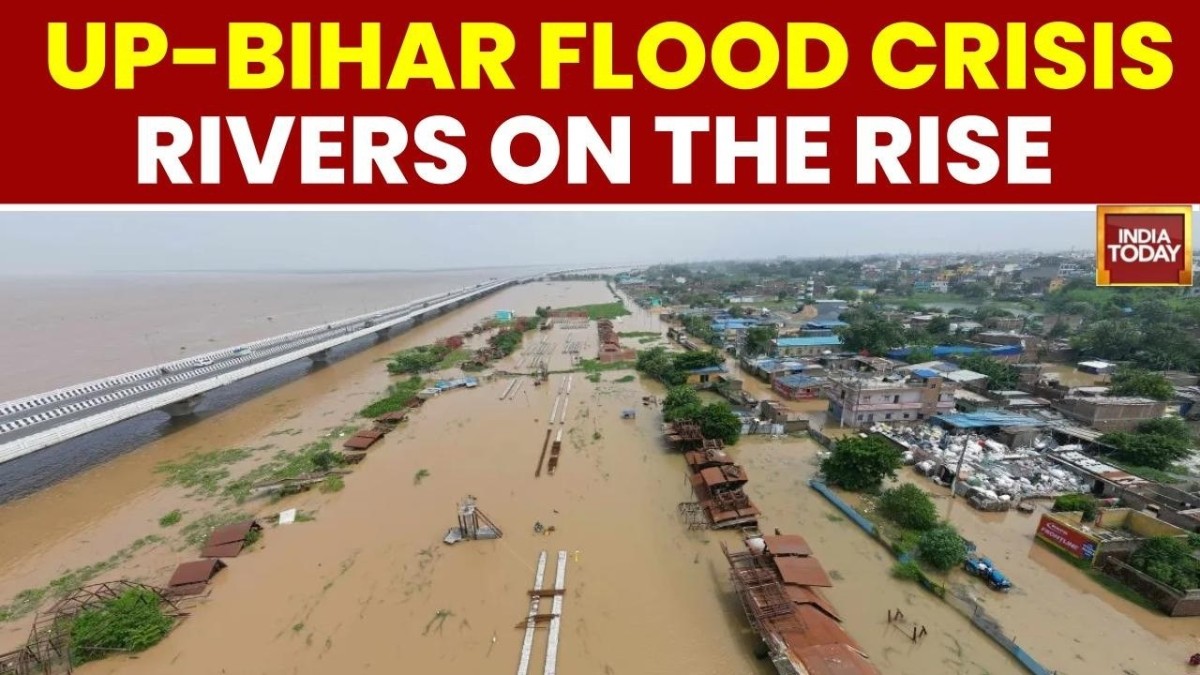
The swollen Ganga has submerged villages across Uttar Pradesh and Bihar. (Source: India Today)
Ganges Basin Under Pressure: Uttar Pradesh and Bihar Flooding
Even as Nepal reels from the disaster, the Ganges basin in India is facing a parallel emergency of its own. In Uttar Pradesh, the Relief Commissioner’s office reports that around 353,000 people across 26 districts are affected by flooding after days of heavy monsoon rain and dam releases. The state has evacuated 17,544 people, with 4,847 currently housed in relief shelters. Authorities have deployed 1,634 flood outposts, 1,697 boats and motorboats, 1,068 medical teams and established 1,312 flood shelters to manage the crisis.
The Ganga is above the warning level in Varanasi and flowing above the danger level in Ballia, where the Ghaghra river is also above the danger mark. Twelve dams in Lalitpur district have opened their gates to discharge excess water, adding to the flow downstream. Swelling Ganga and Yamuna waters have inundated colonies in Prayagraj and brought levels close to danger marks in Varanasi. In Kanpur, authorities closed a bridge over the Pandav River as a precaution. The India Meteorological Department has forecast more rain and thundershowers in western Uttar Pradesh, threatening to exacerbate the situation.
In Bihar, eight districts are on alert as the Ganga has submerged large areas of Danapur Diara in Patna, parts of Begusarai and areas along the Kosi river, leaving hundreds of families cut off and prompting State Disaster Response Force rescue operations. The Hindu reported that the Ganga reached a dangerous level at Hatidah in Mokama, Patna district, on Thursday. JD(U) working president and Rajya Sabha member Sanjay Jha said the water level had not been this dangerous in a decade, since 2016. Earlier in the week, officials in Uttar Pradesh reported at least three rain-related deaths, including an 18-month-old child in Pratapgarh and two people in Amroha’s Gajraula area.
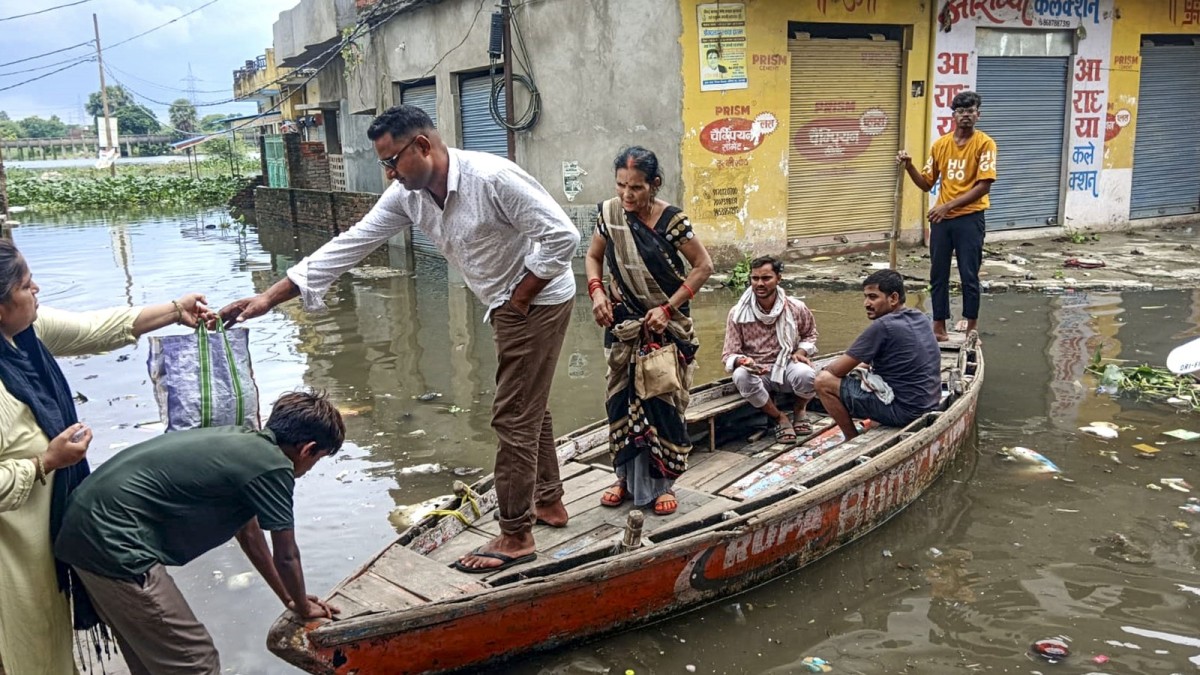
Residents use a boat to move through a waterlogged street in Varanasi, Uttar Pradesh. (Source: PTI)
What Comes Next: Rain Forecasts, Recovery and Identification
The immediate forecast offers little respite. The IMD has predicted continued rain and thundershowers across western Uttar Pradesh, and river levels in Bihar are expected to remain elevated for days. In Nepal, the focus is shifting from rescue to recovery, with 21,421 security personnel deployed — including 9,287 from the Nepali Army, 7,931 from Nepal Police and 4,203 from the Armed Police Force. The Army has flown 881 helicopter sorties, with private operators adding 129 flights from Kathmandu.
The identification of the dead remains one of the most daunting tasks. With more than 5,000 people still missing, forensic teams from India and other nations are working to match recovered remains against missing-person lists. The process is slow, and officials acknowledge that some bodies may never be found, swept away by rivers that continue to run high and fast.
For the survivors, the road ahead is long. Thousands have lost their homes, their schools and their livelihoods. The destruction of 55 kilometres of roads and more than 100 bridges has isolated communities, complicating the delivery of aid and the return of displaced families. Reconstruction will take years, and the psychological scars of a disaster that killed more than 1,295 people in a matter of hours will linger far longer.
As the region braces for more rain, the crisis has laid bare how closely South Asia’s river systems and seasonal extremes are intertwined. In Nepal, a glacier collapse turned a hydropower corridor into a killing zone; in India, relentless monsoon rain and dam releases have pushed the Ganga and its tributaries toward danger levels in the country’s most populous states. The result is a trail of death and displacement across the region — and the response, from Nepali soldiers digging through mud to Indian air crews landing in Kathmandu, has been defined by a shared determination to save as many lives as possible.
By Jessica Ali, Staff Writer
This article was produced with AI-assisted research and editorial support. Sources: Nepal Police, Nepal NDRRMA, India's Ministry of External Affairs, Reuters, Al Jazeera, The Guardian, India Today, The Hindu, PTI (via National Herald and Deccan Chronicle).
What's Your Reaction?
 Like
0
Like
0
 Dislike
0
Dislike
0
 Love
0
Love
0
 Funny
0
Funny
0
 Wow
0
Wow
0
 Sad
0
Sad
0
 Angry
0
Angry
0

Editor-in-Chief at Global1.News. Atlanta-based journalist who cuts through the BS and tells it like it is. Lead anchor, host, and the voice you hear when the spin stops and the truth starts.














Comments (0)