
Nepal-China Border Floods Kill at Least 163, Hundreds Missing After Ice Avalanche Triggers Wall of Water
Catastrophic flash floods on the Nepal-China border killed at least 163 people and left hundreds missing after an ice-rock avalanche triggered a landslide dam burst. Rescue operations continue with international aid, as scientists warn climate change is increasing glacial flood risks.
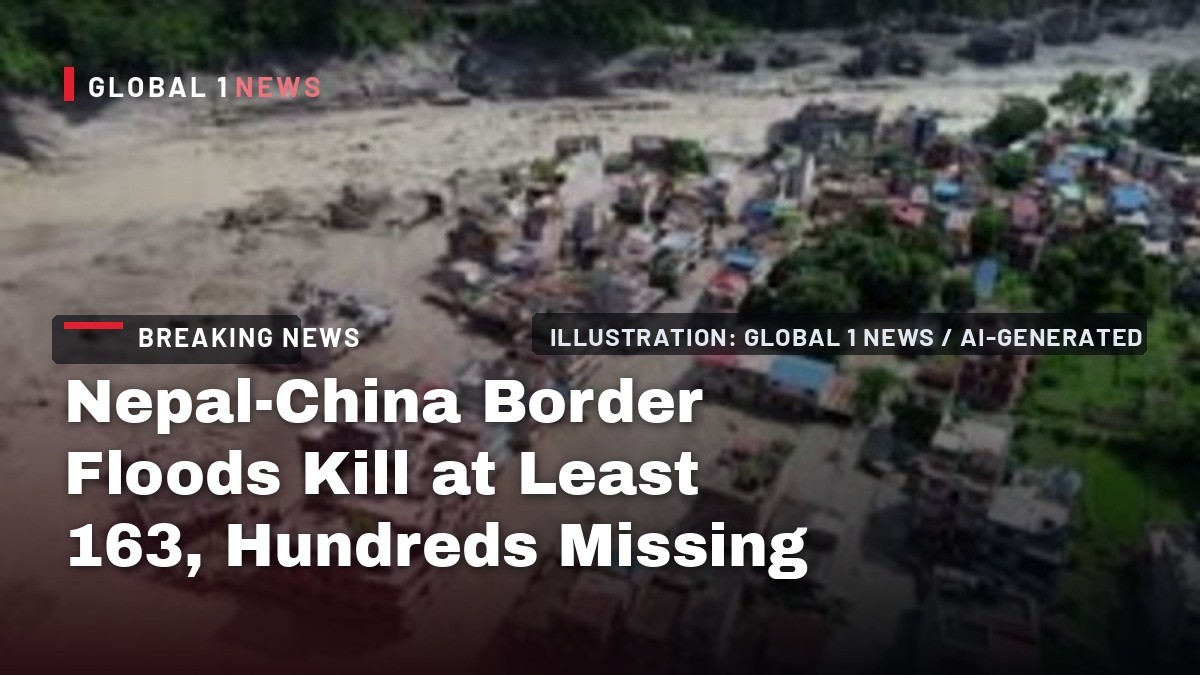
The death toll from catastrophic flash floods that tore through the Bhote Koshi gorge on Nepal's border with China has climbed to at least 163, with hundreds more missing, as rescue teams on both sides of the frontier race against time to reach survivors trapped in the debris of obliterated villages.
Nepal Police reported 157 bodies recovered within Nepal as of early Thursday, August 27, while Chinese state media confirmed three deaths in Gyirong County. The surge of water, sediment, and boulders struck without warning at approximately 8:37 a.m. local time Wednesday, August 26, following a 4.4 magnitude earthquake recorded by the US Geological Survey along the border north of Kathmandu.
The flood wiped out the Rasuwagadhi border post, swept away bridges and entire stretches of the only overland highway linking Kathmandu to Tibet, and destroyed at least 15 hydropower projects along the river corridor. Affected settlements include Syaprubesi, Timure, and Devighat in Nepal's Rasuwa and Nuwakot districts, as well as Gyirong Port of Entry on the Chinese side—a critical gateway for cross-border trade.
Glacier Collapse and Landslide Blockage Point to Climate-Driven Cause
An international team of scientists believes a massive chunk of glacier sheared off a mountain and plunged into the Lhende Khola River, a tributary of the Bhote Koshi, triggering a landslide that temporarily dammed the waterway before releasing a catastrophic torrent downstream from China into Nepal. Officials caution it will take weeks to establish the exact sequence of events.
Glaciologists, including Rijan Bhakta Kayastha of Kathmandu University, have largely ruled out heavy rainfall as the primary cause. Instead, they point to a sudden burst of water from an upstream blockage, with some suspecting a glacial lake outburst flood (GLOF)—a phenomenon increasingly linked to rising temperatures across the Hindu Kush Himalaya.
The International Centre for Integrated Mountain Development (ICIMOD) said an ice-rock avalanche originating from a high-altitude area was likely behind the floods. ICIMOD Director General Pema Gyamtsho stated: "We are deeply saddened by this tragic disaster, which struck so suddenly and unexpectedly." The event underscores a grim scientific reality: warming temperatures are increasing the frequency of glacial-origin floods and ice-rock avalanches across the region.
Foreign Nationals Among Missing as Pilgrimage Route Turns Deadly
Nepal's Tourism Board spokesperson Sunil Sharma told the Associated Press that 341 foreign nationals are among the missing, a figure that has sent shockwaves through diplomatic missions worldwide. The affected corridor is a popular overland route to Mount Kailash, a Tibetan mountain revered by Hindu, Buddhist, Jain, and Bonpo pilgrims, with a roughly 30-mile high-altitude circuit trail that draws hundreds of visitors each summer.
At least 133 Indians—mostly Hindu pilgrims heading to Mount Kailash—are unaccounted for, along with at least 90 Italians, 53 Ukrainians (including a group of 46 Ukrainian tourists), and 47 Americans. Australia's Prime Minister Anthony Albanese confirmed at least 34 Australians are missing. The list also includes at least 9 South Koreans, 4 Russians, 3 Belgians, and 2 Portuguese nationals.
The human toll extends beyond international visitors. At least 62 Nepalis traveling for the Janai Purnima festival are missing, as are 85 security personnel—44 from the Nepali Army, 28 from Nepal Police, and 13 from the Armed Police Force. Approximately 60 people associated with hydropower projects remain unaccounted for. The Guardian reported that a 13-year-old British girl is among missing British citizens, adding a deeply personal dimension to the tragedy.
Rescue Operations Intensify as Helicopters Reach Remote Villages
Nepal's Prime Minister Balendra Shah convened an emergency government meeting and said search operations are ongoing. The PM's office reported that 11 ground teams worked through the night, with additional airlifts launched Thursday morning, including rescuing people trapped in tunnels. The Nepali Army mobilized between 12 and 15 helicopters, established a temporary hospital in the flood zone, evacuated at least 25 seriously injured people to Kathmandu, and rescued more than 250 people.
Rescue helicopters struggled to land at Syaprubesi and Timure until water levels receded, complicating early efforts. The treacherous terrain and ongoing instability in the gorge have made ground access perilous, forcing responders to rely heavily on aerial operations. Officials warn the death toll is expected to rise as teams reach more remote settlements cut off by the flood.
China has activated a Level-II emergency response, with more than 100 additional responders from Beijing and Sichuan due to arrive Thursday. The Chinese military dispatched drones Wednesday evening to assess damage across Gyirong County, where state media reported more than 250 people unaccounted for. The scale of the missing—some reports suggest more than 750, possibly nearing 1,000 across both sides of the border—presents an unprecedented challenge for search teams.
International Aid Pours In as India and US Mobilize Support
India's Prime Minister Narendra Modi spoke with Shah and said India is ready to provide humanitarian assistance. New Delhi has already sent 10 tonnes of humanitarian aid, deployed National Disaster Response Force (NDRF) teams, and placed Bihar and Uttar Pradesh on high alert for possible downstream flooding along the Trishuli River. Five Nepali districts remain on high alert as authorities monitor water levels.
The United States State Department announced a Disaster Assistance Response adviser is being sent to Nepal, along with $500,000 in assistance delivered via Catholic Relief Services. The funding will support emergency shelter, relief items, and water, sanitation, and hygiene interventions for affected families. The US commitment reflects the scale of the disaster and the need for coordinated international response.
The European Union's Copernicus satellite service has been activated to map affected areas, according to EU Commission President Ursula von der Leyen. World leaders expressing support include Canada's Prime Minister Mark Carney, Australia's PM Anthony Albanese, UK Foreign Secretary Ed Miliband, and UN Secretary-General Antonio Guterres. The diplomatic response highlights the international dimension of a disaster that has touched citizens of at least a dozen nations.
Hydropower Corridor Suffers Devastating Blow
The destruction of at least 15 hydropower projects along the Bhote Koshi gorge represents a significant economic setback for Nepal, which relies heavily on hydroelectric generation for domestic consumption and export revenue. The same corridor suffered major damage in a devastating 2016 flood event, raising questions about the resilience of infrastructure built in one of the world's most geologically volatile regions.
Engineers and disaster management experts have long warned that the Bhote Koshi gorge is particularly vulnerable to glacial-origin floods. The river's steep gradient and narrow canyon amplify the destructive power of sudden water surges, transforming what might be a manageable flood elsewhere into a wall of water carrying boulders and debris capable of leveling concrete structures.
The loss of the Rasuwagadhi border post and key highway sections will disrupt trade between Nepal and China for months, potentially affecting supply chains and local economies that depend on cross-border commerce. Reconstruction efforts will require significant investment and careful planning to mitigate future risks in a region where climate change is making extreme events more frequent.
Climate Scientists Warn of Escalating Glacial Flood Threats
ICIMOD and other research institutions have documented a troubling trend across the Hindu Kush Himalaya: as temperatures rise, glaciers are retreating and glacial lakes are expanding, increasing the risk of catastrophic outburst floods. The August 26 event fits a pattern of ice-rock avalanches and GLOFs that scientists say will become more common in coming decades.
Nepal is one of the most disaster-prone countries in the world, with monsoon rains from June to September regularly triggering floods and landslides. But the timing of this event—outside the peak monsoon period and with no significant rainfall—points to a glacial mechanism that experts say demands urgent attention from regional governments and the international community.
Kayastha and other glaciologists are calling for expanded monitoring of high-altitude glacial lakes and unstable slopes, arguing that early warning systems could have provided precious minutes of advance notice to communities in the flood path. The challenge is immense: the region's remote, high-altitude terrain makes instrumentation difficult, and the unpredictable nature of ice-rock avalanches defies simple prediction models.
Recovery Efforts Face Daunting Challenges in Remote Terrain
As search operations enter their second day, responders face formidable obstacles. The flood has left a landscape of mud, boulders, and debris where villages once stood, with roads washed out and bridges destroyed. The Nepali Army's temporary hospital in the flood zone is treating survivors, while airlifts continue to evacuate the most seriously injured to Kathmandu for advanced care.
Officials have not provided a timeline for when the search for missing persons might conclude, acknowledging that some bodies may never be recovered given the force of the flood and the difficulty of accessing the gorge. Families of the missing have gathered in Kathmandu and at the border, desperate for information about loved ones who were traveling for pilgrimage, work, or tourism when disaster struck.
The psychological toll on survivors is immense. Many lost homes, livelihoods, and family members in a matter of minutes. Local authorities are working to provide shelter, food, and clean water to displaced populations, while international aid organizations prepare to scale up their response. The road to recovery will be long, but the immediate priority remains finding the missing and caring for the living.
By Jessica Ali, Staff Writer
This article was produced with AI-assisted research and editorial support. Sources: CNN, Associated Press, Reuters, The New York Times, The Guardian, France24, Al Jazeera, The Hindu, Kathmandu Post, ICIMOD.
What's Your Reaction?
 Like
0
Like
0
 Dislike
0
Dislike
0
 Love
0
Love
0
 Funny
0
Funny
0
 Wow
0
Wow
0
 Sad
0
Sad
0
 Angry
0
Angry
0

Editor-in-Chief at Global1.News. Atlanta-based journalist who cuts through the BS and tells it like it is. Lead anchor, host, and the voice you hear when the spin stops and the truth starts.














Comments (0)