
Military Flight Plan Blamed as Nats Chief Fights for His Job
A UK military aircraft's “spurious” flight data reportedly triggered the Nats meltdown that cancelled more than 2,000 flights, leaving Nats chief executive Martin Rolfe fighting for his job.
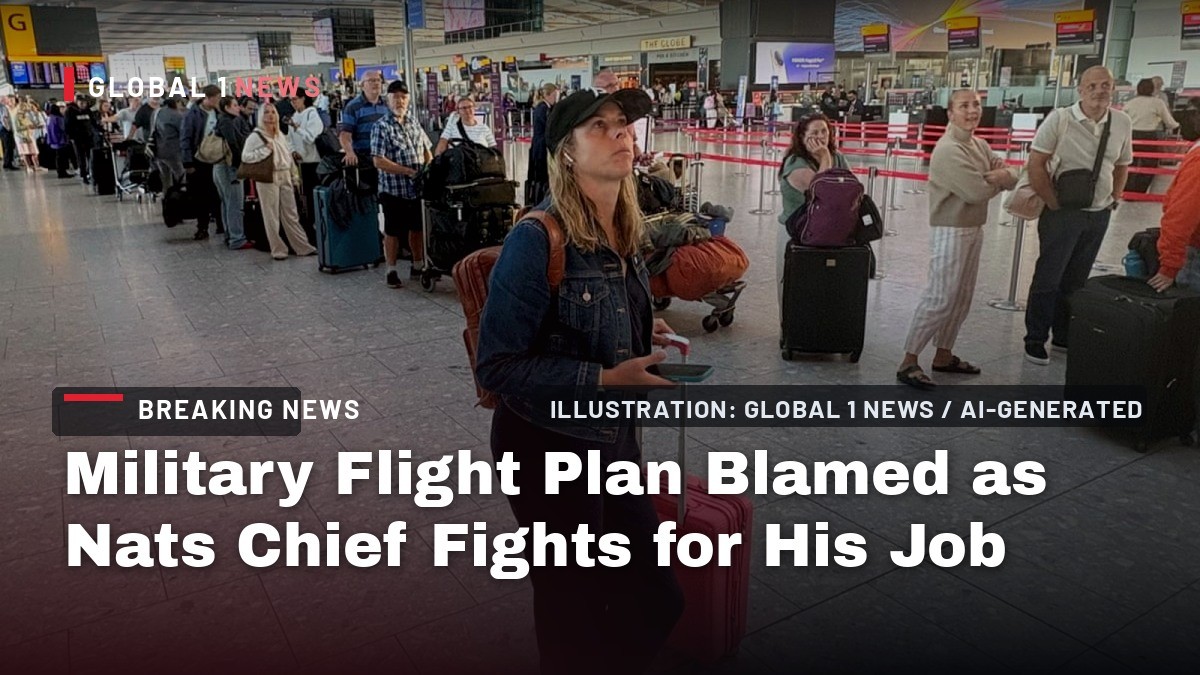
A single military flight plan reportedly triggered the meltdown of Britain's air traffic control system earlier this week, and the chief executive of Nats is now fighting to keep his job. Martin Rolfe, who has led the air navigation service provider for 11 years, faces mounting calls to resign after the four-hour shutdown on Tuesday cancelled more than 2,000 flights. On Friday, Transport Secretary Heidi Alexander repeatedly declined to say whether Rolfe should stay in post.
Military Flight Plan Blamed as Nats Chief Fights for Job
London — A flight plan submitted by a UK military aircraft introduced "spurious" data into Nats' flight processing system and set off the chain of events that closed British airspace for several hours on Tuesday, according to a Financial Times report based on accounts from four people briefed on the incident. The entry caused a meltdown across the wider air traffic control system that took hours and several attempts to restart, the people said. More than 2,000 flights were cancelled and hundreds of thousands of passengers were affected. Nats has not confirmed that a military flight plan was the trigger, and the Ministry of Defence denies any military error. The inquiry now threatens Rolfe's position, with Ryanair and Wizz Air calling for him to resign or be sacked and the government refusing to guarantee its support.
What Actually Happened
Warnings flashed up inside the Nats control centre just outside Southampton before 1pm on Tuesday. Within two minutes, take-offs were suspended from airports surrounding London. One executive in an airline operations room said: "Nobody knew what it was, but within the space of two to three minutes everything was shutting down."
Within half an hour, Nats convened its crisis response network, the air traffic incident communication and co-ordination cell. More than 100 people joined, including airlines, airports, the UK regulator, the Department for Transport and air traffic control directors from neighbouring airspaces such as France and Ireland. It was the first of about half a dozen such calls over the afternoon. Shortly after 1.30pm, flights started to move, then ground to a halt again. By 2pm, delays to flights sitting on the tarmac reached five hours, and incoming planes were diverted to airports as far away as Bonn and Düsseldorf in Germany.
'You Cannot Be Serious'
Tensions boiled over during a call on Tuesday evening between Nats operations director Kathryn Leahy and operations managers from airports and airlines. On the call, Leahy informed them that flight plan data entry had sparked the problem, and that the flight processing system did not have a dedicated backup. Some executives were flabbergasted. "You cannot be serious," said one, according to three people with knowledge of the call. Ryanair's operations boss Neal McMahon called it "a complete clusterfuck".
Nats said the problem sat within the flight processing system, described as a vast technical labyrinth that coordinates the thousands of flight plans it receives each day. The company remains adamant the underlying problem is not a repeat of the 2023 outage, which was caused when the system confused two locations entered as part of a plan. Two people briefed on the matter said the fact the flight plan came from a military aircraft had no specific bearing on the problems that followed.
The Backup That Wasn't There
The flight processing system has no dedicated backup, partly because Nats is in the middle of a complete overhaul of its systems, and partly because its size means a duplicate service would cost "vast amounts", according to people briefed on the outage. The fix on Tuesday required a complete reboot of the Nats system, which happened just after 4pm. It was not until after 5pm that airlines were able to begin flying some aircraft, and even then progress was painfully slow.
Nats said the fix was a "very complex recovery and has created difficulties for the whole aviation network, from which it will take time to recover." The glitch occurred at Nats' Swanwick Centre in Hampshire, one of its two air traffic control centres. The other is in Prestwick, Ayrshire. Doug Maclean, Nats' former air traffic control manager, told the BBC: "You've got a world-leading system where the wheels fall off every now and again."
Ten Hours on the Tarmac
By 5.30pm, delays for grounded planes hit 10 hours, some airlines said. Some aircraft full of passengers were stuck waiting for information for more than four hours.
According to the analysts Cirium, nearly 2,100 flights in and out of UK airports were cancelled because of the failure, including 1,750 on Tuesday out of 5,800 scheduled flights. Of those 1,750, 541 were at Heathrow. More than 300 flights were cancelled on Wednesday in the continuing fallout. Industry estimates put about 330,000 passengers with travel disrupted and delayed, more than 155,000 passengers with flights cancelled, and flights delayed for more than 180,000 passengers. The worst-affected airports according to FlightRadar24 were Heathrow, Gatwick, Manchester and Birmingham. Stansted, Luton, Bristol, Belfast City and East Midlands were also affected.
Nats first confirmed it was investigating a "technical issue" at 13:46 BST. Around 90 minutes later it said the issue was with its flight processing system. By 19:30 it said the system issue had been resolved and it was working to clear the backlog. easyJet chief commercial officer Sophie Dekkers said: "They said it would be another 40 minutes but after another hour or so passed it still wasn't resolved... the time that they gave us wasn't actually met in reality, so it was very difficult to plan because it was a live ongoing situation."

Rolfe's Future
Rolfe has led Nats since May 2015 and was paid £1.4m for the year ended 31 March, including a £343,000 bonus. Transport Secretary Heidi Alexander summoned him to a meeting on Wednesday and said she did "not believe the issue was unavoidable". She gave him one week to report on the causes and commissioned an independent review by the Civil Aviation Authority, reporting in six months. On Friday she repeatedly declined to say whether he should stay in his post, telling BBC Breakfast: "What I want to do is look at the report that's going to be on my desk next Wednesday very carefully."
Downing Street had said on Wednesday the government still had confidence in Rolfe. He can only be fired by the Nats board, led by former Rolls-Royce boss Warren East. The government owns 49 per cent and can withdraw its support for him. One person with knowledge of the process said: "It would be wrong to fire anyone from a job when you don't know what has happened." Another person close to the process said Rolfe is "toast": "This is the beginning of the end."
The 2023 Precedent
It is the third major technical fault at Nats in three years. In 2023, a computer shutdown over the August bank holiday weekend caused chaos for 700,000 passengers. It took an engineer, who had been unable to correct the fault from home, three hours to get to work. The CAA set out 34 recommendations to improve its systems; all were said to have been fully implemented. One airline executive told the FT: "We were told the [recommendations after 2023] had been fully implemented, but to tell you the truth, we never saw the evidence." In 2025, another, smaller Nats outage caused 150 cancellations.
Ryanair chief executive Michael O'Leary accused Rolfe of "telling lies to save his own skin" and said his position was "untenable". He said Nats and Rolfe had given two contrasting explanations, and claimed they had told Parliament in 2023 there would be an effective backup system: "We've learned this week that there was no backup system. Your assurances are worthless." The Independent noted this claim could not be independently verified. O'Leary also said: "That's like asking a failed student to mark his own exam paper."

Who Pays
The CAA said passengers are "unlikely to be entitled to compensation for delays or cancellations" because the disruption is "likely to be considered the result of 'extraordinary circumstances'". It reminded airlines of their responsibilities to look after passengers whose flights were delayed or cancelled. Rail passengers affected by flight disruption could use booked tickets on a different date or to a different airport if needed, or apply for a refund, the Rail Delivery Group said.
British Airways cancelled almost 550 flights, affecting more than 85,000 customers. A BA spokesperson said: "Tuesday's air traffic control issue has forced us into cancelling almost 550 of our flights, affecting more than 85,000 of our customers. We're incredibly sorry for the experience they've endured because of an issue that has been entirely out of our control." Ryanair said more than 65,000 of its passengers were disrupted, it cancelled more than 250 flights, and costs would run into millions. Airlines UK chief executive Tim Alderslade said the industry body had written to Alexander to "register serious concerns over yesterday's technical failure at Nats — the third major system failure in three years". He said: "The result is a system where airlines pick up the bill for the mistakes of others, while the organisations responsible face little or no financial consequence."
Three Strikes
Airlines argue the pattern, not just the single incident, is the problem. Yvonne Moynihan, managing director of Wizz Air UK, told BBC Radio 4's Today programme: "In any industry when you've had three failures, you need to consider three strikes and you're out... What we need to see from leadership is accountability." Foreign Secretary Ed Miliband said the outage was "unacceptable".
Luke Petherbridge, director of public affairs at the travel association Abta, said: "While the immediate priority is supporting customers... the industry and the public will want answers as to what has gone wrong." NATS provides services to 15 UK airports. NATS is a public-private partnership: the government holds 49 per cent and the controlling stake, with the rest split between UK airlines including BA, easyJet and Virgin Atlantic, Heathrow, and Nats staff.
What Happens Next
Nats is due to report to the Secretary of State for Transport and the Civil Aviation Authority next week. The CAA's independent review will present an update in six months. The FT's account rests on four people briefed on the incident; Nats has not confirmed that a military flight plan was the trigger. The MoD denies any military error but says it cannot comment further during the live investigation. Rolfe told BBC Radio 4's Today programme: "We will be doing a very thorough and full investigation. We have at this point ruled out a cyber-attack... This will be something we haven't seen in more than 50 years of operation."
What to watch next: Rolfe's report to the Transport Secretary and the CAA, due next Wednesday; whether the Nats board, led by Warren East, moves against him; and the CAA's independent review, which will present an update in six months.
By Jessica Ali, Staff Writer
This article was produced with AI-assisted research and editorial support. Sources: The Guardian, Financial Times, BBC News, The Independent, The Telegraph, GB News.
What's Your Reaction?
 Like
0
Like
0
 Dislike
0
Dislike
0
 Love
0
Love
0
 Funny
0
Funny
0
 Wow
0
Wow
0
 Sad
0
Sad
0
 Angry
0
Angry
0

Editor-in-Chief at Global1.News. Atlanta-based journalist who cuts through the BS and tells it like it is. Lead anchor, host, and the voice you hear when the spin stops and the truth starts.















Comments (0)