
Eleven Dead on the Trakia Motorway, and the Warning System Bulgaria Never Installed
Eleven people are dead after 86 vehicles piled into each other in dense fog on Bulgaria's Trakia motorway near the Zimnitsa junction. Fifty-one were hospitalised and the country is in national mourning as investigators examine why no electronic warning boards were in place.
Bulgaria woke up on Wednesday to flags at half-mast, a motorway still half-closed, and a death toll the government had to correct. Eleven people are dead after 86 vehicles piled into each other in fog on the Trakia motorway. The country is in national mourning. The harder question is why nobody warned the drivers in time.
Eleven Dead on the Trakia Motorway, and the Warning System Bulgaria Never Installed
Sofia, Bulgaria - The first emergency call came at 07:10 on Tuesday morning. By the time the fog thinned, the country's main road to the Black Sea had become the scene of one of the deadliest crashes in its modern history.
Seven in the Morning, Two Carriageways, Eighty-Six Vehicles
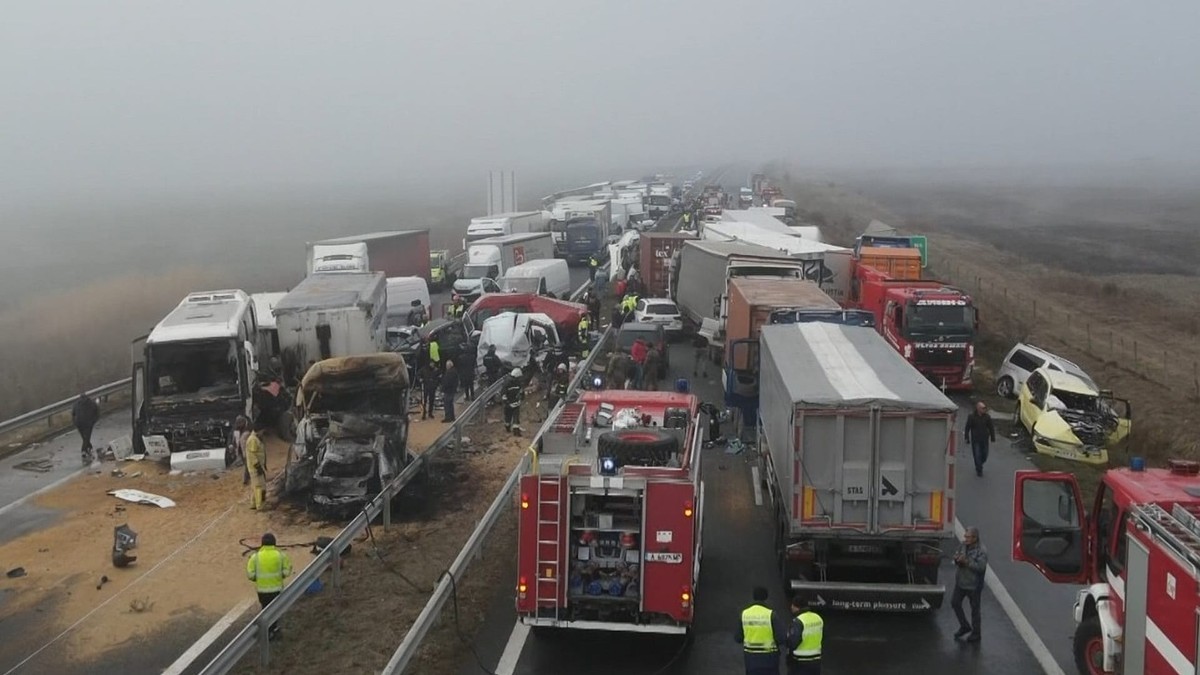
The crashes happened near the Zimnitsa junction in Yambol Region, in southeastern Bulgaria, shortly before 7 a.m. on Tuesday. There were two of them, on opposite carriageways, at almost the same spot: one at kilometre 289 on the Burgas-bound side, the other at kilometre 294 on the Sofia-bound side.
The Interior Ministry puts the total at 86 vehicles - 63 travelling towards Burgas and 23 towards Sofia. Sliven regional governor Mihail Kasherov, standing at the scene, said more than 70 vehicles were involved and that what he saw "defied description". He told reporters he had never seen anything like it.
Visibility is the fact everything else turns on. Drivers had roughly 70 to 80 metres of clear road, according to the acting secretary general of the Interior Ministry, Lyubomir Nikolov. Then the fog thickened, and the same witnesses described visibility collapsing to about 10 metres in moments. One eyewitness quoted by Bulgarian media put it at 30 metres.
A Count That Went Up, and Then Came Down
The toll on Tuesday moved in both directions, which is what happens when identities have to be established before a number can be confirmed. Early reports spoke of five dead. By midday the figure was eleven, with 48 injured. Mid-afternoon it was twelve. Then, at its 5 p.m. update, the Health Ministry revised it down to eleven.
Ten people died at the scene. The eleventh died after being admitted to St. Panteleimon Hospital in Yambol. The ministry said the earlier figure of twelve was preliminary information, corrected once the dead had been identified and the data verified.
Fifty-one injured people were admitted to hospitals: 33 in Sliven, 11 in Yambol and seven in Burgas. Thirteen were in a serious condition. The Health Ministry has not released the names of the dead, and a Romanian citizen is among the wounded, a fact confirmed by Romania's president and prime minister. Nikolov said there were no reports of children among the dead or injured.
How the First Collision Unfolded
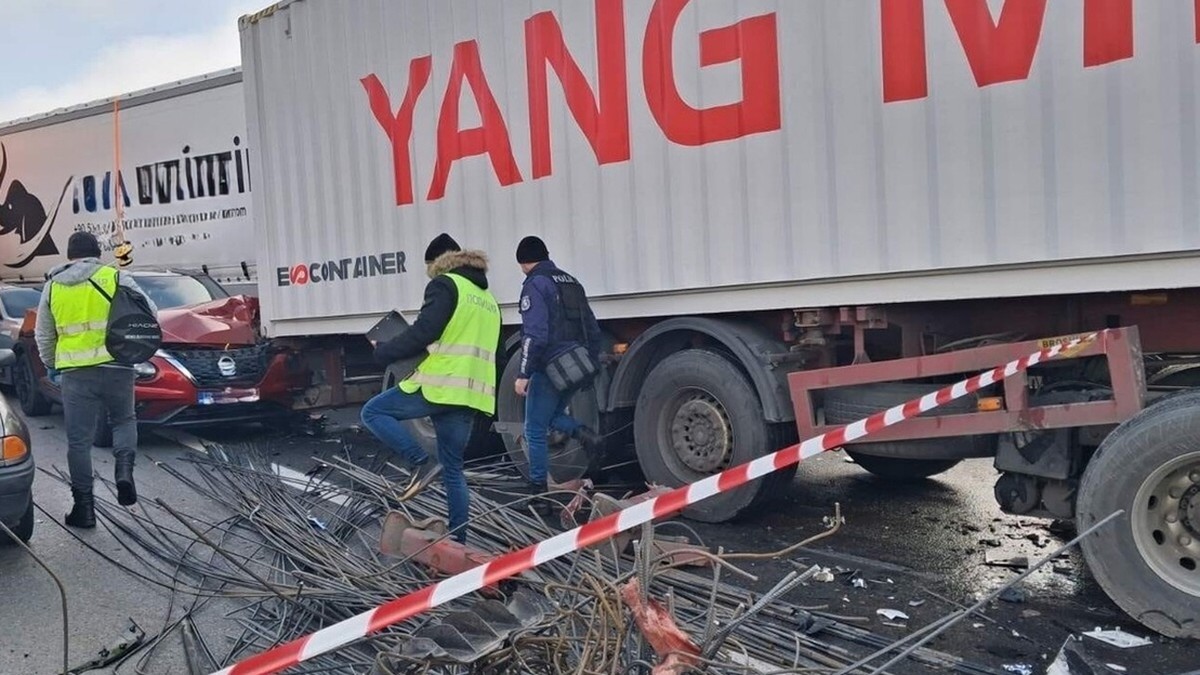
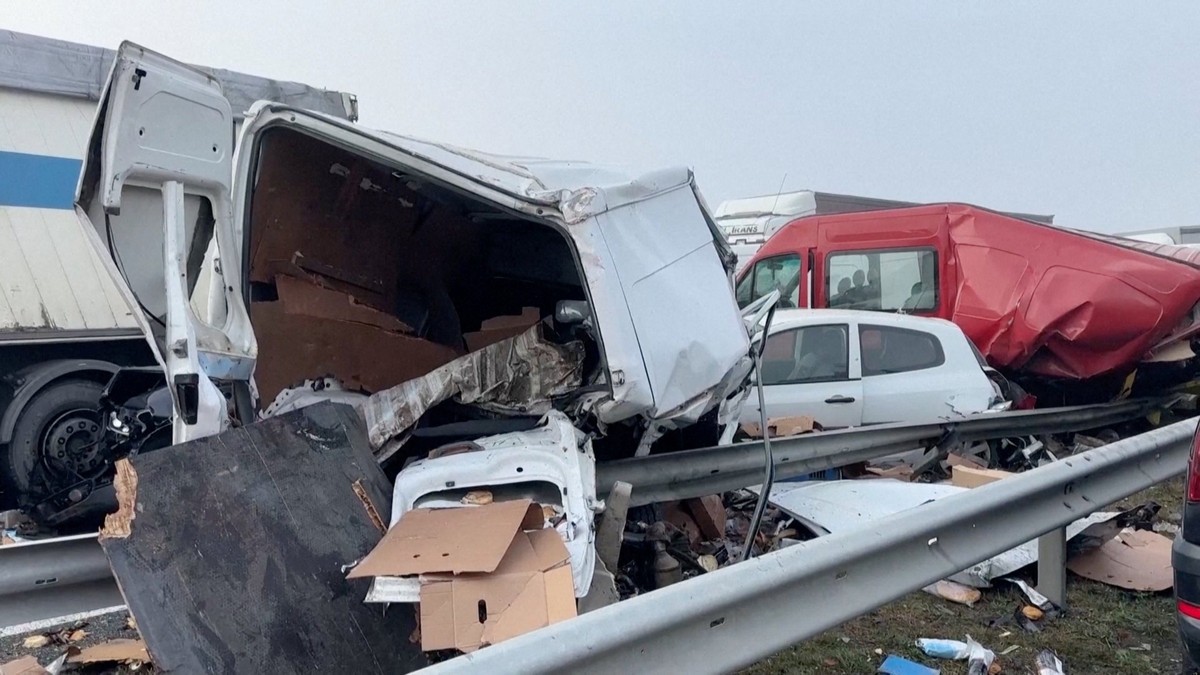
According to Nikolov, the first crash began when a heavy goods vehicle blocked the path of a passenger bus carrying a group of people. A lorry carrying wheat then hit the bus from behind, and a passenger car crashed into the rear of the wheat lorry. Everything after that was chain reaction. All of the dead were on the Burgas-bound carriageway.
The opposite carriageway is a separate tragedy with its own logic. Investigators believe drivers heading for Sofia slowed to look at the wreckage on the other side, and that distraction built a second pile-up behind them. Interior Minister Ivan Demerdzhiev said that was the most likely explanation.
The police's initial assessment names three factors: "reduced visibility due to fast-forming dense fog, wet road surface and speeds unsuitable for the conditions". Galin Kostov, who runs the road administration, said the same thing more plainly - the speeds were wrong for the weather.
The Rescue: Cutting Through Metal by Hand
The Interior Ministry launched an operation it called "Save". Fifteen fire engines went, along with hundreds of police officers, rescue teams and ambulances pulled in from Yambol and the neighbouring regions; the state news agency counted 17 fire and rescue crews at the site.
Reaching people was the problem. Crews had to remove sections of the crash barrier to get at the injured. Demerdzhiev said rescuers carried casualties out by hand on stretchers because ambulances could not get to the centre of the wreckage. Todor Mishinev, who heads traffic police in Yambol, said firefighters cut through metal to free people trapped in their vehicles, including tanker lorries.
A medical helicopter took off from Sliven and could not land, because of the same fog that caused the crash. Its crew was driven to the scene in police cars. Prime Minister Rumen Radev ordered two Spartan military transport aircraft with stretchers and medical teams into the region, and put the government aircraft at the disposal of the emergency services. Yambol's governor declared a partial state of emergency in three municipalities.
The Investigation Moves to the National Service
Because there were two crashes, there are two pre-trial proceedings, the Yambol district prosecutor, Doychin Doychev, confirmed. The National Investigation Service has taken both over on the grounds of exceptional complexity.
Ten investigators, three forensic specialists and a mobile forensic laboratory were sent to the motorway. They have carried out the urgent inspections and begun witness interviews, mapped the scene by drone, ordered forensic medical examinations and commissioned the vehicle technical examination that is expected to establish the precise sequence of events.
Its acting director, Marian Marinov, said the absence of a fog warning sign is not currently part of the inquiry, and described the fog as "a contributing factor - reduced visibility, as at night". The Road Infrastructure Agency has started taking asphalt samples; its board member Ventsislav Angelov said differences in colour and signs of deformation had been observed, but that laboratory results were needed. The lane had been resurfaced two years earlier and the section was recorded as being in good condition. No conclusion on criminal responsibility has been announced.
Half the Motorway Reopened This Morning
On Wednesday morning the road authorities reopened the Sofia-bound carriageway between the Zimnitsa and Karnobat interchanges, a stretch running from kilometre 289 to kilometre 323.
The Burgas-bound carriageway is still shut. Specialised tow trucks are still lifting the wreckage out of it, and once the metal is gone the surface has to be treated for spilled oil and fuel. Traffic heading for Burgas is being sent around through Karnobat and Petolachkata, and nobody has promised a time for the full reopening.
That is the practical shape of the next few days: one lane of national life restored, the other still a crime scene and a salvage yard at the same time. The Road Infrastructure Agency has warned that the closure could run for an extended period, because of the number of damaged vehicles and the investigation still running beside them.
A Day of Mourning, and a Country Asked to Behave
The Council of Ministers declared Wednesday 11 November a day of national mourning. Flags on state institutions are at half-mast. Sofia's mayor, Vassil Terziev, cancelled every public, cultural and entertainment event organised by the city, its districts and its cultural institutions, and the Central Election Commission called off a ceremony at which certificates were to be handed to the country's newly elected president and vice president.
The Bulgarian Red Cross and the national transfusion centre opened a blood donation drive in Sofia from 8 a.m. to 2 p.m., with campaigns announced in regional cities. Parliament's budget committee observed a minute's silence.
There was also an instruction that says a lot about how bad this was. The Council for Electronic Media, the broadcast regulator, urged television and radio to avoid sensationalism and to respect the dignity of the dead, the injured and their families, and opened extraordinary monitoring of the coverage.
Cameras That Talk to Nobody
The political argument began before the motorway was cleared, and it is not really about fog.
Demerdzhiev said there is no connection between the Road Infrastructure Agency's cameras and the traffic police, and no electronic information boards on the gantries to tell drivers what is coming. "We have plans to install this equipment by next year," he said. Then he asked the question that will follow this government: why did the people who diverted money meant for crash barriers and road markings never fund the warning boards?
Radev, who had been hosting European Commission President Ursula von der Leyen in Varna when the news broke, called it "a black day for all of Bulgaria". He questioned why the country's motorways still lack modern warning systems, referred to National Audit Office reports that found acceptance certificates issued for road works despite problems, and said he expected prosecutors to act on those findings themselves. He promised compensation for the families and a unified road information centre running around the clock from 2027. Transport Minister Georgi Peev cut short a climate summit in Antalya and flew home; an emergency road-safety meeting is due on Wednesday.
The Deadliest Roads in Europe
None of this lands in a vacuum. Bulgaria recorded 71 road deaths per million inhabitants in 2025, the highest rate in the European Union, against an EU average of 43 per million, according to European Commission figures. Euronews states it flatly: Bulgaria's roads are ranked the most dangerous in the union.
That is the context in which a single morning can put 86 vehicles into a pile and take eleven lives. It is not a country that lacks the institutional language for road safety - it has a road agency, a road-safety reform group, a national strategy and, apparently, plans for warning boards. What it has not had is the boards.
The grieving is real and it is national. The accountability, so far, is a set of questions being asked into microphones at the side of a closed motorway.
What Bulgaria Is Left Asking
Condolences came from across Europe within hours. Von der Leyen said "Europe stands in solidarity with you"; Roberta Metsola, the European Parliament president, said Europe "shares Bulgaria's pain"; the United States embassy in Sofia offered its sympathies. On the same visit, the Commission announced 10 million euro for Bulgaria to strengthen search and rescue in the Black Sea, a separate problem on a separate coast.
What comes next is concrete and checkable. Whether the toll of eleven holds once the last vehicles are lifted. What the vehicle technical examination says about the first impact and the speed behind it. Whether anyone is held responsible beyond the weather. And whether the warning boards promised for next year exist by the time the next fog bank forms over the Thracian plain, because that is the part of this that repeats.
Folks, that is the test. Not the speeches on Wednesday, but the boards on the gantries in 2027 - and the speed limits Bulgaria is willing to enforce before then.
By Jessica Ali, Staff Writer
This article was produced with AI-assisted research and editorial support. Sources: Bulgarian News Agency (BTA), BGNES, The Sofia Globe, The Independent, BBC News, Associated Press, Euronews, DW, Balkan Insight and Fakti.bg. Photographs: Euronews; Bulgarian Interior Ministry; Reuters via The Independent. Cover: Global 1 News editorial image.
What's Your Reaction?
 Like
0
 Dislike
0
 Love
0
 Funny
0
 Wow
0
 Sad
0
 Angry
0

Editor-in-Chief at Global1.News. Atlanta-based journalist who cuts through the BS and tells it like it is. Lead anchor, host, and the voice you hear when the spin stops and the truth starts.











Comments (0)