
N. Korean Landmines Wash Ashore, Closing Ganghwa Beaches
The confluence of seasonal weather and geopolitical tension has produced a uniquely hazardous phenomenon on South Korea's northwestern frontline. Since late July 2026, the monsoon rains that annually deluge the Korean Peninsula have not only swollen rivers but have also dislodged decades-old ordnance from North Korean border fortifications, carrying it downstream into the waters of Ganghwa County, Incheon.
The confluence of seasonal weather and geopolitical tension has produced a uniquely hazardous phenomenon on South Korea's northwestern frontline. Since late July 2026, the monsoon rains that annually deluge the Korean Peninsula have not only swollen rivers but have also dislodged decades-old ordnance from North Korean border fortifications, carrying it downstream into the waters of Ganghwa County, Incheon. The result is a slow, unpredictable drift of antipersonnel landmines onto the very beaches that serve as both a tourist destination and a stark reminder of the peninsula's unresolved conflict. For residents and military authorities alike, the discovery of these wooden-box mines transforms a summer of leisure into a season of vigilance, underscoring the enduring volatility of a border that has been technically at war for over seven decades.
The Discovery Along Ganghwa's Coast
The first indications of the threat emerged on July 24, 2026, when a landmine was discovered along the coast of Seodo-myeon in Ganghwa County. On the same day, closed-circuit television (CCTV) footage captured a mine drifting along the shoreline of nearby Gyodong-myeon, confirming that this was not an isolated incident but the beginning of a broader pattern. The situation escalated on July 27, when a fisherman reported a suspicious object floating near a boat landing at Hwangcheon Port. Military authorities subsequently recovered three wooden boxes from the water—one empty case and two confirmed to be capable of exploding. The devices were detonated on site by explosive ordnance disposal teams. The frequency of discoveries has since continued unabated. According to the *Korea JoongAng Daily*, by August 6, a total of 12 landmines had been found across Ganghwa County since July 24. A broader accounting from Yonhap via *The Korea Herald* indicates that between July 23 and August 10, 16 mines were recovered across 14 separate incidents along the islands of Ganghwado, Gyongdongdo, Jumundo, and Boreumdo. The most recent find occurred on August 10, when a village chief discovered an antipersonnel mine on Jokaegol Beach on Boreumdo. This steady trickle of ordnance has prompted the South Korean Marine Corps' 2nd Division to launch extensive search operations across Ganghwa Island and its western islands, focusing on major beaches, ports, harbors, and coastal areas open to civilian access.
A Distinctive Ordnance: North Korea's Wooden-Box Mines
The mines washing ashore are not standard-issue modern munitions; rather, they are a distinctive and somewhat antiquated piece of military engineering. These are wooden-box antipersonnel mines, constructed with a pine wood casing that houses an explosive charge and a detonator. The triggering mechanism is pressure-activated: when sufficient weight is applied to the lid of the box, the detonator fires the charge. This design is simple, cost-effective, and difficult to detect with standard metal detectors, making it a persistent hazard in the Demilitarized Zone (DMZ) and along North Korea's coastal fortifications. The presence of these mines in South Korean waters is attributed to the torrential monsoon rains of late July 2026. The heavy precipitation is believed to have eroded the soil and embankments in North Korean border areas, dislodging the mines from their buried positions. Once freed, they were carried downstream through the Han River estuary and into coastal waters by ocean currents. The Han River, which flows through Seoul and forms part of the inter-Korean border near its estuary, serves as a natural conduit for debris from the North. The fact that these mines are surfacing in civilian areas highlights the unpredictable nature of the border environment, where even the weather can become a vector for military hazards.Military and Municipal Response
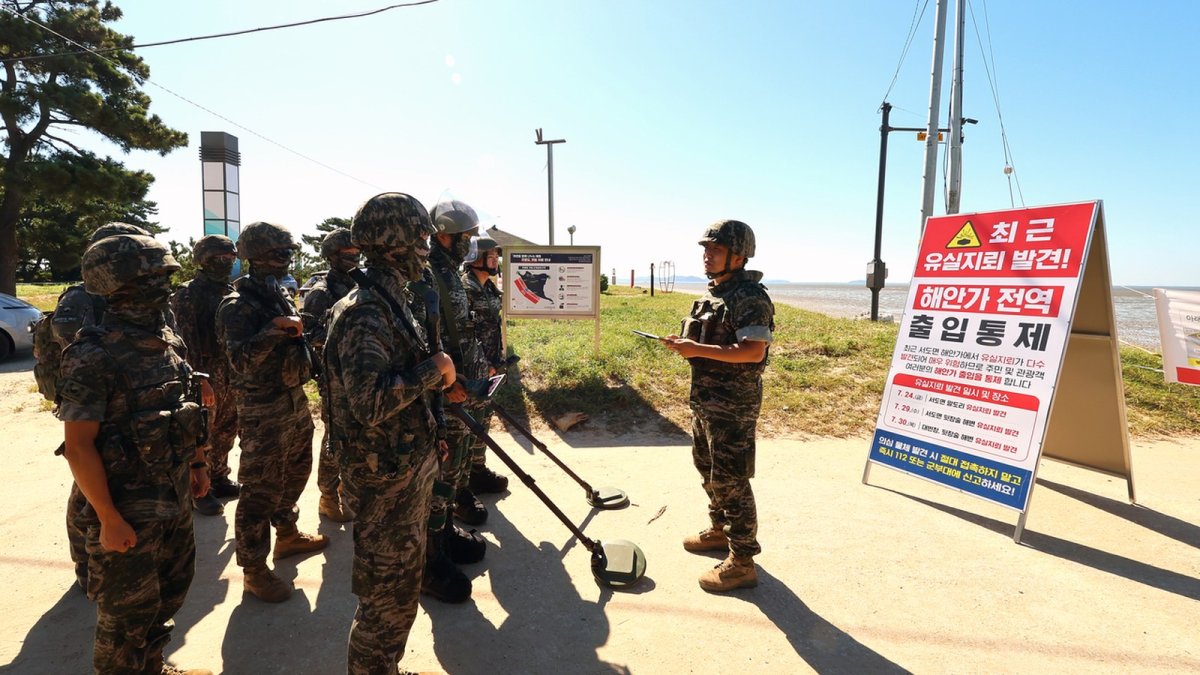
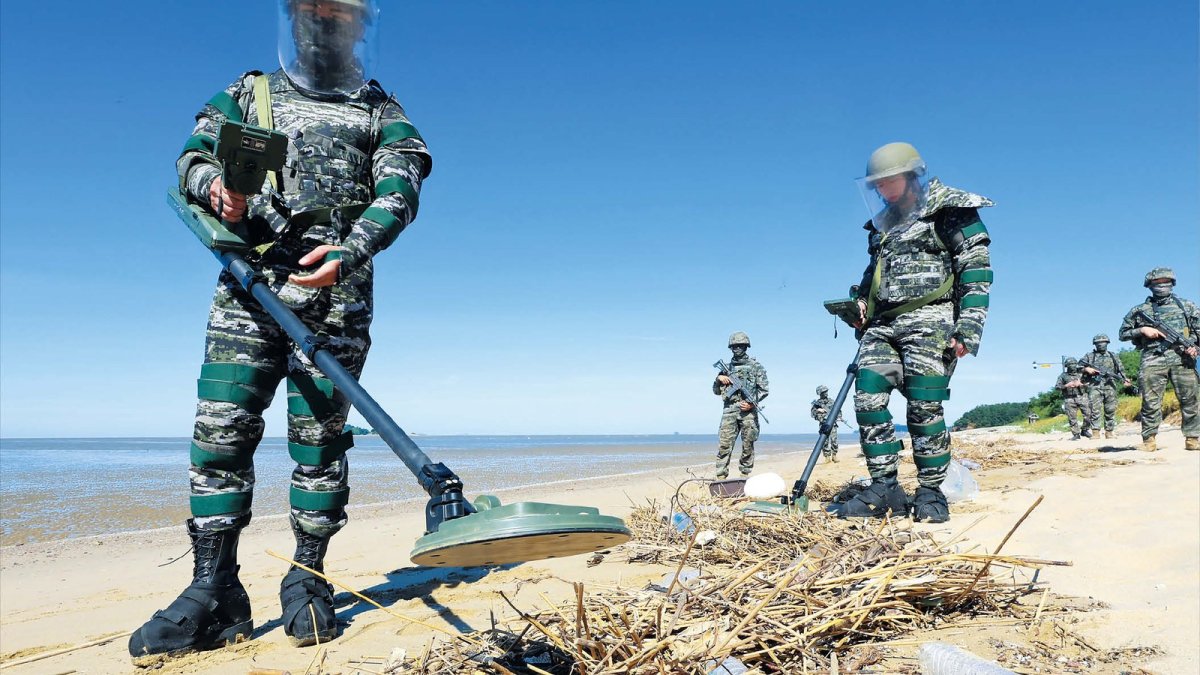
The response to this unusual threat has been coordinated between military and civilian authorities. The Marine Corps 2nd Division has initiated intensive day and night search operations across Ganghwa Island and its western islands. These operations cover not only the major beaches but also ports, harbors, and other coastal areas that are typically open to civilians. Explosive ordnance disposal teams have been dispatched to the region, tasked with detonating any found mines remotely in a controlled manner to ensure public safety. On August 12, Marines assembled at the entrance of a bathing beach on Ganghwa Island to begin detection and removal operations. A notice reading "Access to all coastal areas prohibited" was posted at Dwittjangsul Beach on Jumundo island in Seodo-myeon, signaling the seriousness of the threat. In parallel, Ganghwa County has taken proactive measures to warn the public. The county has installed warning banners at 42 locations across coastal tourist sites and ports and is broadcasting safety announcements through village public address systems. A county official emphasized the need for caution, stating, "As land mines continue to be found, we ask tourists and residents visiting coastal tourist sites to never approach or touch any suspicious object and to report it immediately. We will do our best to work with military authorities to create a safe tourism environment." It is important to note that the access restrictions are not legally enforced. They are advisory in nature, relying on public cooperation rather than legal compulsion. This distinction is significant, as it places the onus on individual judgment and community awareness. The military's search operations, while thorough, cannot guarantee that every mine has been recovered, particularly given the challenging terrain of tidal flats and the potential for mines to be buried in sediment.Local Impact: Livelihoods and Summer Tourism
The economic and social impact on Ganghwa County has been immediate and severe, arriving at the worst possible time—the peak summer holiday season. The advisory restrictions have effectively shut down access to the coastline, devastating the local tourism industry. Guesthouses and tidal-flat experience tourism, which are major draws for visitors to the region, have seen a wave of cancellations. Families who had planned summer vacations at the beach have been forced to make alternative arrangements, dealing a significant blow to businesses that rely on the short summer window for a substantial portion of their annual revenue. Perhaps even more concerning is the impact on residents who depend on the tidal flats for their livelihoods. The surf clam harvesting season is currently underway, and local harvesters have traditionally ventured onto the exposed mudflats during low tide to collect these valuable shellfish. However, the fear of encountering a buried mine has brought this work to a halt. One resident expressed the prevailing anxiety, stating, "There could be mines buried in the tidal flats, so I'm too anxious to go in." This statement encapsulates the dilemma facing the community: the economic necessity of continuing their work is pitted against the very real risk of serious injury or death. The halt in harvesting not only affects the harvesters themselves but also ripples through the local supply chain, affecting wholesalers, restaurants, and markets that depend on the seasonal catch.Geopolitical Context: The Border That Never Sleeps
The incident on Ganghwa's beaches must be understood within the broader context of the Korean Peninsula's unresolved conflict. Ganghwa Island sits near the Han River estuary, in close proximity to the inter-Korean border and North Korean territory. The Demilitarized Zone has split the Koreas since the 1950-53 Korean War ended in an armistice, not a peace treaty, leaving the two sides technically still at war. North Korean minefields along border fortifications have been a recurring concern for decades, a legacy of the Cold War that continues to pose a threat to this day. There is a chilling precedent for the current situation. In August 2015, two South Korean soldiers were seriously injured by North Korean wooden-box landmines in the DMZ. That incident prompted South Korea to resume loudspeaker broadcasts along the border, a psychological warfare tactic that escalated tensions dramatically. The situation was eventually defused through high-level inter-Korean talks, but it demonstrated how a single mine can trigger a significant diplomatic and military crisis. The current washing ashore of mines is a lower-intensity version of the same threat, but it serves as a potent reminder that the border is not a static line on a map. It is a living, dynamic environment where the detritus of war can resurface at any time, carried by natural forces beyond human control.
Looking Ahead
The immediate future of Ganghwa's coastline hinges on the vagaries of the tide. Ganghwa County plans to reassess the threat level depending on whether additional mines surface during the spring tide period from Friday, August 14, through Sunday, August 16, when sea levels are at their highest. This period represents a critical window: the higher water levels could dislodge and carry more mines ashore, or they could signal the end of the influx. If no further mines are discovered during this period, fishing and beach access are expected to resume, offering a glimmer of hope for the local economy. However, uncertainty remains the defining feature of this situation. The ROK Ministry of National Defense and the Marine Corps have not released a public statement on the total number of mines expected to wash ashore. Authorities acknowledge that they simply do not know how many more may arrive with monsoon flows and tidal movements. This lack of certainty complicates planning for both the military and the county government. For the residents of Ganghwa, the coming days will be a tense waiting game, balancing the desire to return to normalcy against the prudence required by an invisible threat. The wooden-box mines of the Korean War era have, once again, proven that the past is never truly buried—it can wash up on the shore at any moment.By Prof. David Park, Staff Writer
This article was produced with AI-assisted research and editorial support. Reporting is based on sources cited in the article.
What's Your Reaction?
 Like
0
Like
0
 Dislike
0
Dislike
0
 Love
0
Love
0
 Funny
0
Funny
0
 Wow
0
Wow
0
 Sad
0
Sad
0
 Angry
0
Angry
0

Prof. David Park
East Asia/Technology Correspondent at Global1.News. Seoul-based voice covering Korean politics, technology, business, and culture. Analyzes how technology and geopolitics intersect across East Asia.













Comments (0)