
Myanmar Using Fake Paperwork to Conceal Shipments of Iranian Jet Fuel, Reports Claim
Recent investigations by Reuters and the activist group Justice for Myanmar (JFM) have revealed a sophisticated scheme by Myanmar’s military junta to import Iranian jet fuel under the guise of diesel.
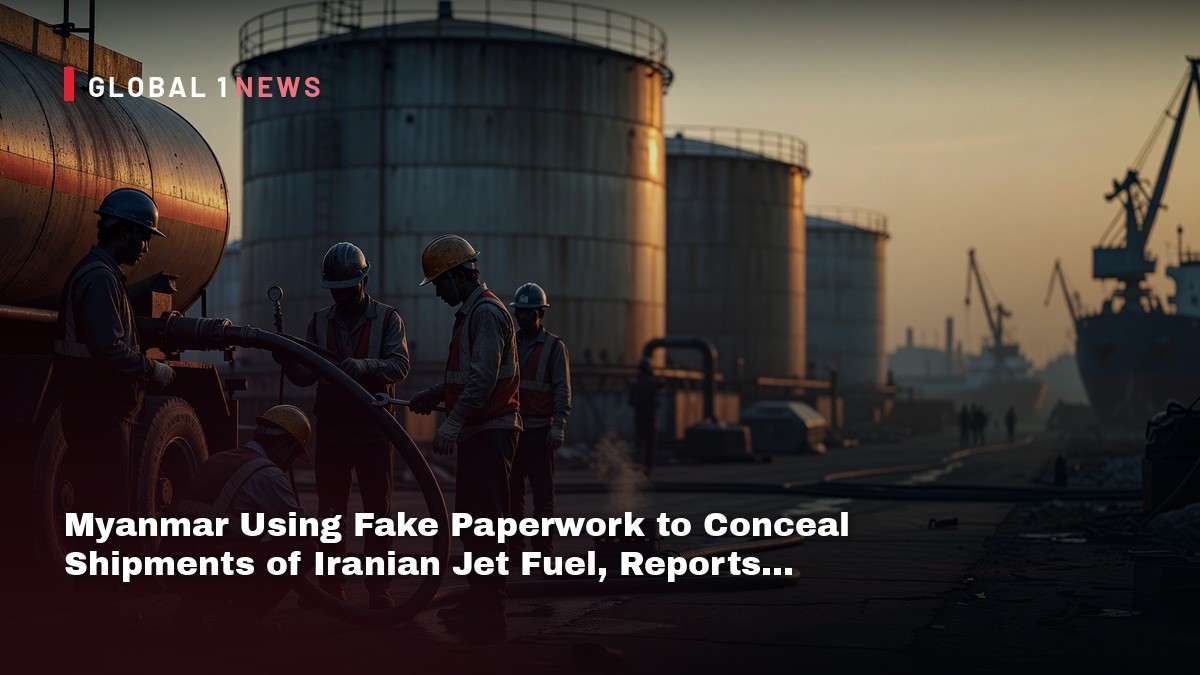
Recent investigations by Reuters and the activist group Justice for Myanmar (JFM) have revealed a sophisticated scheme by Myanmar’s military junta to import Iranian jet fuel under the guise of diesel. By falsifying paperwork and exploiting loopholes in international sanctions, the regime has secured a steady supply of aviation fuel that fuels its ongoing air campaign against opposition forces and civilian populations. The findings, based on shipping records, satellite imagery and leaked documents from Myanmar’s foreign exchange regulator and Ministry of Commerce, expose a network of junta‑linked businesses spanning Myanmar, Thailand and the United Arab Emirates, and highlight the challenges faced by the United States and its allies in enforcing sanctions on complex fuel supply chains.
How the deception was orchestrated
The core of the scheme involved “sham paperwork” that re‑labelled jet fuel as diesel. According to a copy of a November 30 letter from Myanmar’s foreign exchange regulator, the regulator instructed the client of the energy broker Dynamic Wave to issue import documentation that listed the cargo as diesel rather than jet fuel. This deliberate misclassification allowed the shipment to pass customs inspections and evade the U.S. sanctions that target both Iranian fuel exports and Myanmar’s military procurement.
Dynamic Wave, a Myanmar‑based broker, signed a sales contract with Thailand’s Tawan‑Oil Trading for a volume equivalent to the shipment. While the contract described the cargo as South African diesel, the vessel in question – the U.S.-sanctioned tanker Reef – actually carried Iranian jet fuel. Satellite imagery and documentary evidence supplied by SynMax Intelligence confirmed the tanker’s route from the Iranian port of Bandar Abbas to Southeast Asia, contradicting the declared origin.
The scale of the illicit fuel flow
JFM’s analysis identified six shipments between December 2024 and November 2025 that together amounted to more than 843,000 barrels of aviation fuel. Reuters also reported a continuation of the flow into 2026, noting that a tanker arrived in Myanmar waters in September of this year. These volumes represent a substantial portion of the fuel needed to sustain the Myanmar Air Force’s operations.
The shipments were not isolated incidents but part of a broader pattern involving Iran’s “shadow fleet” of tankers. Previous reporting has shown that these vessels frequently switch off location signals and engage in multiple transshipments to obscure the origin of their cargoes. The use of such tactics underscores the difficulty of tracking and interdicting fuel shipments that are deliberately masked through a series of opaque transactions.
Sanctions and their limited impact
Since March 2023, the U.S. Treasury Department has imposed sanctions on individuals and entities linked to Myanmar’s jet‑fuel supply chain, citing the military’s “deadly bombing campaign against civilian targets.” Similar measures have been adopted by the United Kingdom, the European Union, Canada and Australia. Despite these efforts, the continued flow of Iranian jet fuel demonstrates the porous nature of sanctions regimes when faced with coordinated fraud and the involvement of multiple jurisdictions.
The sanctions have targeted specific companies and persons, but the JFM report highlights a network that includes businesses in Thailand and the UAE, as well as vessels registered under flags that are not subject to the same level of scrutiny. The report calls on authorities in these countries to investigate the trade fraud and to prevent their territories from being used as conduits for illicit fuel shipments.
The humanitarian toll of the fuel supply
Access to jet fuel has enabled the Myanmar military to intensify its air operations, which have had a devastating impact on civilians. The United Nations Human Rights Office recorded a rise of more than 50 percent in civilian deaths from airstrikes in 2025, increasing from 641 in 2024 to 982 in the most recent year. Among the casualties were 232 children, a number that exceeds the total child deaths from airstrikes in the preceding four years combined.
Recent attacks in Rakhine State illustrate the lethal use of air power. Bombings of internally displaced persons (IDP) camps in Ponnagyun township killed at least eight people, while a larger strike in Kyauktaw township on September 28 resulted in 50 deaths and dozens of injuries. These operations are part of a broader strategy by the junta to regain territory lost to the Arakan Army, a Rakhine nationalist group that has controlled much of the state since late 2023.
Regional complicity and the role of intermediary firms
The JFM report identifies a “network of junta‑linked businesses” operating across Myanmar, Thailand and the United Arab Emirates. These firms facilitated the procurement and transport of fuel by providing false documentation and acting as intermediaries that obscured the true nature of the cargo. The involvement of Thai firm Tawan‑Oil Trading, for example, was essential to the veneer of legitimacy that allowed the shipment to be presented as a commercial diesel purchase.
Such cross‑border arrangements complicate enforcement, as they require coordinated action among multiple jurisdictions. The report urges Thai, Singaporean and Emirati authorities to investigate the companies operating within their territories and to tighten controls on trade documentation that could be used to disguise prohibited shipments.
Implications for future sanctions policy
The revelations about Myanmar’s fuel procurement strategy suggest that sanctions must evolve to address not only direct suppliers but also the ancillary networks that enable evasion. Targeting the entire supply chain—including brokers, shipping firms, and the financial institutions that process payments—could increase the cost of illicit procurement for the junta.
Moreover, the use of satellite monitoring and intelligence analysis, as demonstrated by SynMax Intelligence’s tracking of the Reef tanker, offers a valuable tool for early detection of suspicious movements. Integrating such open‑source and commercial satellite data into sanctions enforcement frameworks could help authorities identify and interdict shipments before they reach their destination.
Calls for coordinated international action
JFM’s concluding appeal stresses the need for a unified response. The group recommends that the United States and other Western powers expand sanctions to cover the full aviation‑fuel supply chain, naming the companies and individuals identified in the investigation. It also calls for urgent investigations by Thailand, Singapore and the UAE to dismantle the trade fraud that underpins the fuel flow.
In the broader context, the case illustrates how entrenched supply‑chain networks can undermine sanction regimes, especially when they involve multiple state and non‑state actors. A coordinated diplomatic effort, combined with enhanced intelligence sharing and the use of satellite surveillance, may be required to curtail the junta’s access to the fuel that powers its air campaign and, by extension, its capacity for widespread human rights violations.
This article was produced with AI-assisted research and editorial support. Reporting is based on the source material cited below. Sources: The Diplomat; thediplomat.com; Global1.News (27 October 2026).
By Kenji Tanaka, Staff Writer
What's Your Reaction?
 Like
0
 Dislike
0
 Love
0
 Funny
0
 Wow
0
 Sad
0
 Angry
0

Japan Correspondent at Global1.News. Tokyo-based voice covering Japanese politics, technology, economy, and culture. Tracks the intersection of tradition and innovation in one of the world's most dynamic societies.













Comments (0)