
Israeli airstrike on southern Lebanon kills seven people, Lebanese state media say
An Israeli airstrike on a building on the outskirts of the village of Ansar in southern Lebanon has killed at least seven people and wounded three others, according to Lebanon's state-run National News Agency (NNA). The strike, which took place early on Saturday morning, is being described as one of the deadliest attacks on Lebanon since the precarious truce between Israel and Hezbollah took effect in June.

Israeli airstrike on southern Lebanon kills seven people, Lebanese state media say
An Israeli airstrike on a building on the outskirts of the village of Ansar in southern Lebanon has killed at least seven people and wounded three others, according to Lebanon's state-run National News Agency (NNA). The strike, which took place early on Saturday morning, is being described as one of the deadliest attacks on Lebanon since the precarious truce between Israel and Hezbollah took effect in June.
The NNA reported that rescue teams and paramedics were still searching through the rubble on Saturday, clearing debris, retrieving bodies and transporting the injured to hospitals. The agency said Israel had "escalated its attacks on the south", a phrase that underscores the fragility of the truce that was supposed to end the conflict.
Deadliest attack since the June ceasefire
The village of Ansar sits in the Nabatieh Governorate, a region that has borne the brunt of Israeli military operations throughout the current hostilities. Saturday's strike marks a significant escalation, surpassing the July attack in which three women were killed, which had previously been described as the deadliest Israeli attack since the ceasefire took effect. The NNA reported that intense Israeli airstrikes early on Saturday also hit the strategic Ali Taher hill, which overlooks parts of the southern city of Nabatieh and the main roads leading to it.
The casualty figures have been attributed to the Lebanese state-run National News Agency, with AP News, Reuters and the BBC all reporting the same strike. The Lebanese health ministry says Israeli attacks in Lebanon have killed at least 4,319 people since the current round of hostilities began, a figure that continues to rise as incidents like Saturday's are recorded.
The strike comes amid a pattern of ongoing violence that has continued despite the formal ceasefire agreement. On 5 August, Israeli strikes on southern Lebanon killed one person and injured 11. On 11 August, an Israeli drone strike near Nabatieh wounded two civilians. And between 11 and 12 August, Israeli artillery and aviation hit villages across southern Lebanon while incendiary drones set fire to orchards in the Western Beqaa.
A ceasefire that never fully took hold
The war between Israel and Hezbollah began on 2 March 2026, amid regional tensions linked to the wider Iran war that was initiated by the United States and Israel on 28 February 2026. The conflict has exacted a heavy toll on southern Lebanon, with entire villages depopulated and infrastructure reduced to rubble.
On 26 June 2026, Israel and Lebanon announced a trilateral framework agreement brokered by the United States. Under the terms of that deal, Israel would withdraw from southern Lebanon and be replaced by units of the Lebanese Armed Forces, who would oversee the disarmament of Hezbollah's armed units. Hezbollah refused direct talks and was not party to the deal, rejecting it outright, and the agreement's provisions have largely remained unimplemented.
Despite the accord, Israel has continued to occupy swathes of southern Lebanon as a so-called security zone, continued bombing parts of the area, and has warned residents living south of the Litani river to leave. The Litani river, which runs roughly 30 kilometres north of the Israeli border, has become a de facto dividing line, with Israeli forces operating freely in the territory south of it. Earlier this month, two Israeli soldiers were killed in an explosion in southern Lebanon — the first Israeli deaths since the shaky truce. Hezbollah did not comment on the blast.
Diplomatic efforts and the UK's potential role
Ceasefire talks were held in Rome earlier this month — the seventh round of negotiations between the two countries — but they have yet to produce a durable arrangement. The discussions have focused on mechanisms to verify Hezbollah's disarmament, a key demand of Israel and the United States, and one that Hezbollah has consistently refused to accept.
In a development with direct relevance to the United Kingdom, Reuters has reported that Israel and Lebanon have agreed on Britain, Italy, Switzerland and Indonesia as potential contributors to a proposed mechanism that could see foreign troops deployed to southern Lebanon to verify Hezbollah's disarmament. A Lebanese official told Reuters that the United States would decide which countries take part.
For Whitehall, this represents a delicate diplomatic balancing act. The Foreign Office has long maintained that a durable peace in southern Lebanon requires the Lebanese state to extend its authority over all its territory, a position that aligns with UN Security Council Resolution 1701, which ended the 2006 war between Israel and Hezbollah. But the prospect of British troops being deployed to a region where Hezbollah retains significant armed capacity carries obvious risks, and any decision to participate would require careful parliamentary scrutiny.
The proposal also raises questions about the viability of the broader framework agreement. If Hezbollah has rejected the deal outright, as it has, then the deployment of foreign troops to verify disarmament would appear to be a solution in search of a problem that the parties themselves have not agreed to solve.
Humanitarian toll and the search for accountability
The humanitarian situation in southern Lebanon continues to deteriorate. The NNA's reporting on Saturday described rescue teams working through the rubble in Ansar, a scene that has become tragically familiar to residents of the region. The agency's language — "escalated its attacks on the south" — reflects a growing sense among Lebanese officials that the ceasefire is being honoured more in the breach than in the observance.
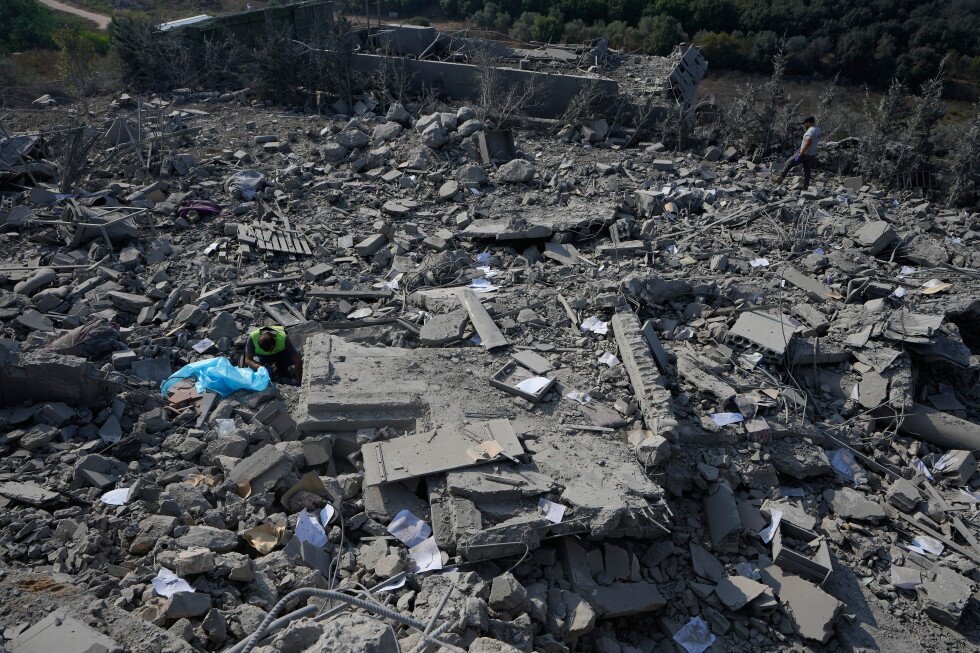
Rescue workers search for victims under the rubble of a home hit by an Israeli airstrike in Ansar village, southern Lebanon (AP)
The Lebanese health ministry's figure of 4,319 deaths since the current round of hostilities began is a stark reminder of the human cost of the conflict. That number includes combatants and civilians alike, and it does not capture the full scale of displacement, injury and trauma that the war has inflicted on southern Lebanon's civilian population. On the Israeli side, about 40 soldiers and three civilians — including a military contractor — have been killed since the conflict erupted, according to reporting by The Independent and the Associated Press.
For the residents of Ansar and surrounding villages, the immediate concern is survival. The Israeli military has warned residents living south of the Litani river to leave, but for many, there is nowhere to go. The Lebanese Armed Forces, tasked under the framework agreement with overseeing Hezbollah's disarmament, have been largely absent from the areas where Israeli forces continue to operate.
What happens next
The Rome talks in early August were intended to breathe life into the ceasefire framework, but the continued Israeli strikes suggest that the parties remain far apart. The United States, which brokered the original agreement, has yet to publicly pressure Israel to halt its operations in southern Lebanon, and Hezbollah's outright rejection of the deal leaves the Lebanese government in an impossible position.
The proposed foreign troop deployment, which could involve British personnel, is still at an early stage. A Lebanese official told Reuters that the United States would decide which countries take part, but no timeline has been announced and no formal request has been made to London.
What is clear is that Saturday's strike in Ansar has raised the stakes. If this is indeed one of the deadliest attacks since the ceasefire, then the framework agreement that was supposed to end the conflict is failing in its core purpose. The question now is whether the United States and its allies, including Britain, are prepared to invest the political capital needed to salvage it — or whether southern Lebanon is headed back toward full-scale war.
For the families of the seven people killed in Ansar on Saturday, that question is not academic. It is a matter of life and death, and it is being asked in villages across southern Lebanon as the rubble continues to be cleared and the bodies continue to be counted.
This article was produced with AI-assisted research and editorial support. Sources: The Independent, AP News, Reuters, Lebanon's National News Agency.
By Erica Thornton, Staff Writer
What's Your Reaction?
 Like
0
Like
0
 Dislike
0
Dislike
0
 Love
0
Love
0
 Funny
0
Funny
0
 Wow
0
Wow
0
 Sad
0
Sad
0
 Angry
0
Angry
0

US Politics and Policy Correspondent at Global1.News. Based in Washington DC, covering American politics, policy, elections, and the courts. Knows how the system works and tells you what it actually means.











Comments (0)