
Iran Sets Its Price for Reopening Hormuz as Missile Hits UAE Tanker
Iran demands U.S. concessions including lifted blockades and sanctions relief before fully reopening Hormuz, while a missile hit an ADNOC vessel on August 8. The Iran-Oman framework stays temporary and partial amid ongoing strikes and U.S. rejection, with Brent at $82 and war premiums elevated.
What Iran Is Actually Demanding
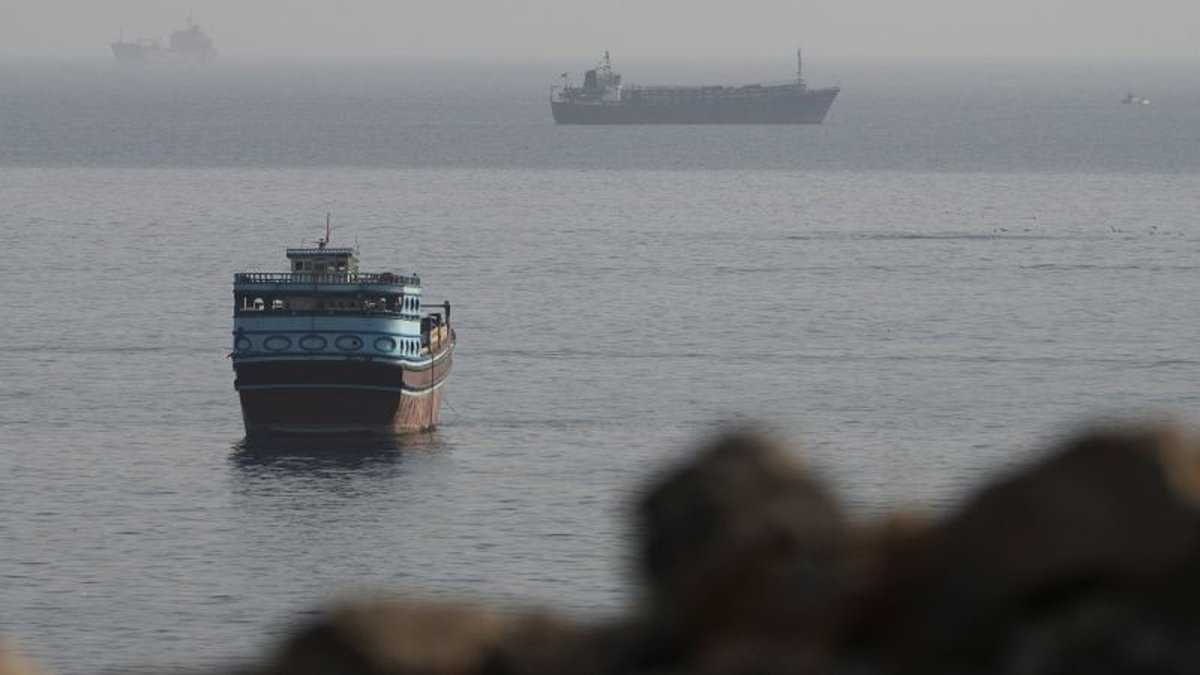
The Revolutionary Guard made clear Saturday that any reopening of the Strait of Hormuz hinges on concrete U.S. concessions rather than the Iran-Oman talks. Those conditions include lifting the naval blockade on Iranian ports, addressing reimposed oil-sector sanctions, resuming talks on frozen assets, and resolving what Tehran calls the U.S. failure to ensure stability in Lebanon under the June memorandum. Deputy Foreign Minister Kazem Gharibabadi stressed the proposed route remains temporary for two to four months and does not signal a full reopening.
Iran's parliament is reviewing a bill that would bar U.S. and Israeli ships from the waterway while imposing a fee structure framed as covering insurance and environmental costs. The draft also requires compensation from hostile states before transit resumes. Supreme Leader Mojtaba Khamenei has yet to confirm approval, and President Masoud Pezeshkian described the current period as Iran's most difficult since the Islamic Revolution.
Negotiations with Oman produced broad agreement on inbound and outbound routes plus a proposed joint coordination center after more than three weeks of talks. Committee member Saeed Ajorlu told state broadcaster IRIB the goal is temporary arrangements of one to three months where Iran holds dominance. Parts of the routes near Larak Island would close under the plan.
Missile Strike on ADNOC Vessel
An ADNOC vessel came under missile attack while transiting the Strait of Hormuz in the early hours of Saturday, August 8. The UAE state oil company confirmed no injuries and said the situation was brought under control, according to an official WAM statement. The UAE condemned the strike on the carrier linked to its state oil firm.
Iran's Revolutionary Guard has previously threatened action against vessels tied to Tehran's adversaries or those failing to follow Iranian directives. The attack occurred on day 161 of the U.S.-Iran war and follows a similar strike on the Liberia-flagged Minoan Pioneer on August 3, about 20 nautical miles northeast of Khasab, Oman.
Explosions were also reported on Iran's Qeshm Island near the strait entrance on the night of August 6, though a provincial official denied any strike took place. The episode remains unresolved amid the broader conflict.
The Iran-Oman Framework Details
A joint statement from Tehran and Muscat on a proposed shipping route is under final review, Iranian Foreign Ministry spokesman Esmail Baghaei said Wednesday. The framework still requires Supreme Leader Mojtaba Khamenei's assent, and he has not been seen publicly since succeeding his father. Gharibabadi described the route as temporary and active for two to four months, with significant traffic passing through Iran's territorial waters.
The arrangement reflects a new strategy for exercising effective sovereignty over the strait, Gharibabadi added, while noting Iran does not intend to routinely close the waterway in peacetime. Nearly 20 percent of global oil and liquefied natural gas supplies flow through the strait, underscoring the stakes.
Iran's conditions for full reopening also tie into ending the U.S. naval blockade and addressing sanctions reimposed after the truce collapsed. Gharibabadi rejected claims that Iran was implementing Article 5 of the June agreement, calling it only guiding principles.
US Rejection and Vance's Stance
The United States quickly rejected the draft plan. Secretary of State Marco Rubio warned that allowing a nation state to control an international waterway, charge tolls, and strike nonpaying ships would set a dangerous precedent. Eight of the world's largest shipping associations urged the UN on August 3 to oppose any toll regime as a violation of navigational norms.
Vice President JD Vance told Fox News on Saturday that the United States and Iran are in the middle of the game, with progress in talks but the war continuing. He said the administration is pressing Tehran while applying a host of tools, as senior military officials including Joint Chiefs Chairman Gen. Dan Caine seek an off-ramp.
President Trump stated on August 6 that the war has got to end pretty soon due to high domestic gasoline prices and reaffirmed that Iran would not possess a nuclear weapon. Earlier Truth Social posts demanded the immediate, complete, and total opening of the Hormuz Strait and an end to Iran's nuclear threat, with Israel joining the commitment.
Oil Market and Shipping Impacts
Brent crude traded about $82 a barrel on August 6, up from a four-week low of $79.45 the prior day, while WTI rose above $78 with a nearly 3 percent gain. Crude has hovered near $80 as the Iran-Oman deal nears, though WTI lost 11 percent in the first three sessions earlier in the week on deal optimism.
War-risk premiums for shipping remained at 7.5 to 10 percent of hull value, compared with 1 to 3 percent before the war. CENTCOM blockade enforcement has redirected 49 commercial vessels as of August 6, with two disabled and two boarded, while observed transits have fallen below 10 vessels on some days versus a pre-war norm above 120.
Trump canceled what he described as the largest attack since World War II after appeals from Saudi Arabia, the UAE, Qatar, and Iran, though Iran denied requesting the halt. No U.S. or Israeli strike inside Iran was confirmed by CENTCOM in the August 6-7 window, marking an eighth consecutive night of pause.
Military and Human Costs
The U.S. military has recorded 18 killed in action since February 28, with 687 wounded, according to the Defense Casualty Analysis System updated August 4. Roughly 80 percent of THAAD interceptor stocks and about half of Patriot stocks have been expended, while nearly all offensive Army Tactical Missile System and Precision Strike Missile inventories are burned through.
CSIS estimates Patriot interceptors fell from about 2,300 before the war to fewer than 827. Iran reports 1,221 military deaths per HRANA, with 3,636 total deaths pending reconciliation and Iran's Foundation of Martyrs confirming 3,468 killed overall.
Houthis claimed attacks on a Saudi oil tanker in the Gulf of Aden on August 5 and wounded 11 civilians in Najran, Saudi Arabia on August 6, including a woman and a four-year-old child. Saudi intelligence warned of coordinated Iraqi-militia and Houthi attacks on Saudi ports, airports, and energy infrastructure.
Regional Reactions and Next Steps
The UAE, Bahrain, and Kuwait condemned the Houthi attacks on Saudi Arabia on August 8. Iraq is in talks with Iran to allow Iraqi oil through Hormuz, while Saudi Arabia, Pakistan, and Turkey signed a joint defense pact. The seventh round of U.S.-mediated Rome talks on Israel-Lebanon concluded August 6, with State Department spokesman Tommy Pigott saying the sides were much closer to an agreement.
Israeli strikes in the Tyre district wounded at least eight people overnight. Trump warned Tuesday that if Iran does not make a deal it will be too bad and that Iran will be hit very hard if the strait is not open soon, calling Iranian leadership unbelievably duplicitous.
Negotiations have produced a joint coordination center proposal, yet the shooting continues and Iran's parliament review plus Supreme Leader approval remain outstanding. The framework's temporary nature and dominance requirements signal Tehran's intent to maintain leverage.
Why This Matters for Energy and Politics
The combination of the ADNOC strike, Iran's explicit conditions, and the U.S. rejection keeps global energy markets on edge with Brent near $82 and war-risk premiums elevated. Nearly 20 percent of world oil and LNG supplies remain vulnerable, and any prolonged disruption would push prices higher ahead of November midterms.
Trump faces pressure to deliver an off-ramp without appearing weak, especially after canceling major strikes and citing domestic gasoline costs. The gap between announced frameworks and actual terms demanded by Tehran shows the conflict remains far from resolved despite six months of fighting.
By Jessica Ali, Staff Writer
This article was produced with AI-assisted research and editorial support. Reporting is based on sources cited in the article.
What's Your Reaction?
 Like
0
Like
0
 Dislike
0
Dislike
0
 Love
0
Love
0
 Funny
0
Funny
0
 Wow
0
Wow
0
 Sad
0
Sad
0
 Angry
0
Angry
0

Editor-in-Chief at Global1.News. Atlanta-based journalist who cuts through the BS and tells it like it is. Lead anchor, host, and the voice you hear when the spin stops and the truth starts.












Comments (0)