
Invasive Blackchin Tilapia Caught in Large Numbers Off Chonburi Coast
A Fisherman's Shocking Catch Off Chonburi Raises Alarms Over Invasive Species CHONBURI — A local fisherman in the eastern Thai province of Chonburi received the surprise of his life this week when he hauled in a net almost entirely filled with blackchin tilapia, a highly invasive species that has plagued central Thai waterways for years.
A Fisherman's Shocking Catch Off Chonburi Raises Alarms Over Invasive Species
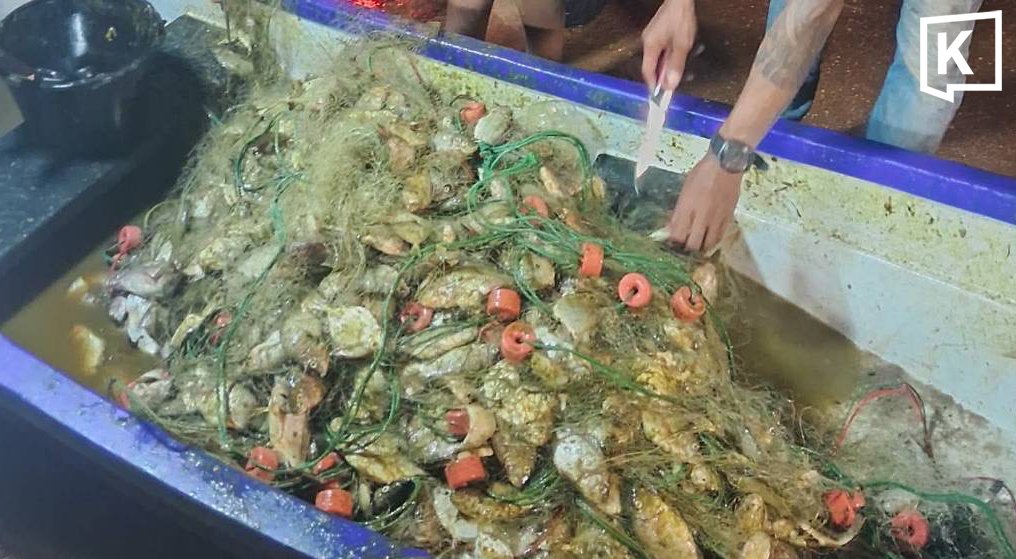
CHONBURI — A local fisherman in the eastern Thai province of Chonburi received the surprise of his life this week when he hauled in a net almost entirely filled with blackchin tilapia, a highly invasive species that has plagued central Thai waterways for years. The incident, which occurred off the coast of Rong Po in Bang Lamung district, has sent ripples of concern through the local fishing community, who now fear for the health of their marine ecosystem and their valuable mussel farms.
The catch, estimated at a staggering 200 kilogrammes, was made on 12 August by 27-year-old Natthakorn Suea-iam, known locally as "Tai Nut." He had set out from the Ban Rong Po beach fishing community near the mouth of the Bang Lamung Canal in Moo 4, Bang Lamung subdistrict, with the simple intention of catching grey mullet for his family's dinner. Instead, he found his boat filled to the brim with the unwanted invasive fish, a sight that shocked a man who has spent his entire life on the sea.
A First-Hand Encounter with a National Problem
For years, the blackchin tilapia (Sarotherodon melanotheron) has been a well-documented scourge in Thailand's central provinces, spreading through river systems and canals, devastating local aquatic life, and prompting large-scale government eradication campaigns. However, its appearance in such massive numbers in the eastern coastal waters off Chonburi marks a significant and worrying expansion of the problem. Natthakorn told reporters who visited Ban Rong Po beach on Friday that he had heard about the fish's destructive path in other parts of the country but had never witnessed it firsthand until now.
"I went out to catch fish for dinner… but look what I found," he wrote in a Facebook post accompanying a video of the catch, which quickly attracted the attention of concerned local residents. The video shows Natthakorn pulling up his net, which is visibly teeming with the dark, oval-shaped fish. The sheer volume of the catch is what makes this incident particularly alarming; it is not just the presence of the fish, but the complete dominance of the catch by a single invasive species.
Concerns for the Local Ecosystem and Mussel Farms
While Natthakorn was initially shocked, his concern has since deepened. He noted that during the entire fishing trip, not a single other species was caught in his net. This complete absence of native fish is a red flag for local fishermen, who fear the blackchin tilapia may be outcompeting or consuming local species, thereby disrupting the delicate balance of the coastal ecosystem. The fishermen of Rong Po, many of whom operate mussel farms alongside their coastal fishing activities, are particularly worried. They fear the invasive fish could have a direct impact on their livelihoods by preying on juvenile mussels or degrading the water quality in the farming areas.
The local fishermen are now calling on fisheries officials and relevant government agencies to urgently survey the area. They are demanding a formal assessment of the fish population and its distribution, as well as a thorough investigation into any potential environmental impacts. The community is seeking concrete answers and a coordinated response, rather than relying on the anecdotal evidence of local fishermen, however alarming it may be.
From Shock to the Frying Pan: A Community Response
In a display of typical Thai community spirit, Natthakorn did not let the unexpected catch go to waste. After bringing the fish ashore, he posted a video inviting local residents who needed food to come and take some of the blackchin tilapia. Many residents subsequently arrived at the beach to collect the fish, turning a potential ecological disaster into a free community meal. Natthakorn himself kept a portion of the catch to experiment with in the kitchen, trying his hand at frying the fish and making sun-dried blackchin tilapia, a popular Thai preservation method.
He reported that the taste was surprisingly similar to the common Nile tilapia, though the meat was noticeably fattier. This culinary curiosity, however, does little to assuage the deeper concerns of the community. While the fish may be edible, its presence in such numbers signals a serious ecological imbalance. The fact that it is palatable could even create a perverse incentive for some to see the fish as a resource, rather than the threat it poses to the biodiversity of the region.
The National Context: A Long and Difficult Battle
The blackchin tilapia is not a new problem for Thailand. The species, native to West Africa, has been found in Thai waters for over a decade, but its population exploded in recent years, particularly in the central plains. The fish is a prolific breeder, highly tolerant of varying salinity levels, and adaptable to a wide range of environments, from freshwater canals to brackish coastal waters. This adaptability is precisely what makes its arrival in Chonburi's coastal zone so concerning. The fish can thrive in the mix of fresh and saltwater found near river mouths, like the Bang Lamung Canal, making the entire eastern seaboard potentially vulnerable.
The Thai government has launched several high-profile eradication campaigns in response to the crisis, including offering bounties for captured fish and encouraging the public to consume them. The Department of Fisheries has been working on various methods to control the population, from promoting commercial fishing of the species to researching biological controls. However, these efforts have had mixed results, and the fish continues to spread. The appearance of a 200-kilogramme catch in Chonburi suggests that despite these efforts, the species is not only surviving but thriving and expanding its territory into new regions.
What This Means for Thailand's Eastern Seaboard
The arrival of the blackchin tilapia in significant numbers off the coast of Chonburi is a major cause for concern for several reasons. Chonburi is a key economic hub, home to major industrial estates, a thriving tourism sector, and a significant fishing and aquaculture industry. The province's coastal waters are vital to the local economy, and an unchecked invasive species could have severe consequences. The mussel farms in the Rong Po area are a prime example of a vulnerable industry. If the tilapia disrupt the food chain or degrade the habitat, it could lead to significant economic losses for the families who depend on these farms for their income.
Furthermore, the location is strategically important. Chonburi is part of the Eastern Economic Corridor (EEC), a flagship government initiative designed to transform the region into a leading economic zone. A healthy marine environment is essential for the sustainability of the coastal communities and the industries that rely on them. The presence of a destructive invasive species could be seen as a threat to the region's long-term environmental and economic stability. The fact that the fish were found near the mouth of a canal suggests they may have been flushed out from inland waterways by recent heavy rainfall, highlighting the interconnectedness of Thailand's water systems and the difficulty of containing the species once it establishes a foothold.
A Call for Urgent Action and Scientific Investigation
Natthakorn was quick to stress that his speculation about the fish moving from the canal into the sea following heavy rain was merely a local fisherman's assumption. He rightly pointed out that authorities would need to investigate the source and establish the facts. This is a crucial point. While the anecdotal evidence is compelling, a scientific survey is needed to understand the scale of the infestation, its origin, and its potential trajectory. The fishermen of Rong Po are not asking for speculation; they are demanding a formal, data-driven response from the Department of Fisheries and other relevant agencies.
The urgency of the situation cannot be overstated. The longer the authorities wait, the more time the blackchin tilapia has to breed and spread further along the coast, potentially impacting other provinces and marine protected areas. The community's call for an urgent survey is not just about protecting their immediate livelihoods; it is about safeguarding the entire coastal ecosystem of the eastern seaboard for future generations. The incident in Rong Po Bay serves as a stark reminder that the battle against invasive species is a continuous one, requiring vigilance, rapid response, and a coordinated effort between local communities and government agencies.
As the sun sets over Ban Rong Po beach, the fishermen are left with more questions than answers. They have a boatload of fish, a viral video, and a growing sense of unease. Their next hope is that their voices will be heard in Bangkok, and that the necessary steps will be taken to prevent a local anomaly from becoming a regional catastrophe. The story of the 200-kilogramme catch is far from over; it is, in many ways, just the beginning of a new chapter in Thailand's ongoing struggle with this resilient and destructive invader.
By Ann Srisawat, Staff Writer
This article was produced with AI-assisted research and editorial support. Sources: Khaosod English
What's Your Reaction?
 Like
0
Like
0
 Dislike
0
Dislike
0
 Love
0
Love
0
 Funny
0
Funny
0
 Wow
0
Wow
0
 Sad
0
Sad
0
 Angry
0
Angry
0

Southeast Asia Correspondent at Global1.News. Based in Bangkok, covering Thai and Southeast Asian politics, economy, technology, and culture. Deep regional perspective on one of the world's most dynamic regions.















Comments (0)