
FMGE Pass Rate Collapse Sparks Standoff: NBEMS Holds the Line, Proposes Third Annual Exam
The National Board of Examinations in Medical Sciences (NBEMS) has formally rejected demands to lower the qualifying bar for the Foreign Medical Graduate Examination (FMGE), a decision that leaves thousands of Indian students who studied medicine abroad in professional limbo. The exam body, responding to a week of sustained protests in New Delhi, instead proposed exploring a third annual examination session while maintaining the current 50% qualifying standard.
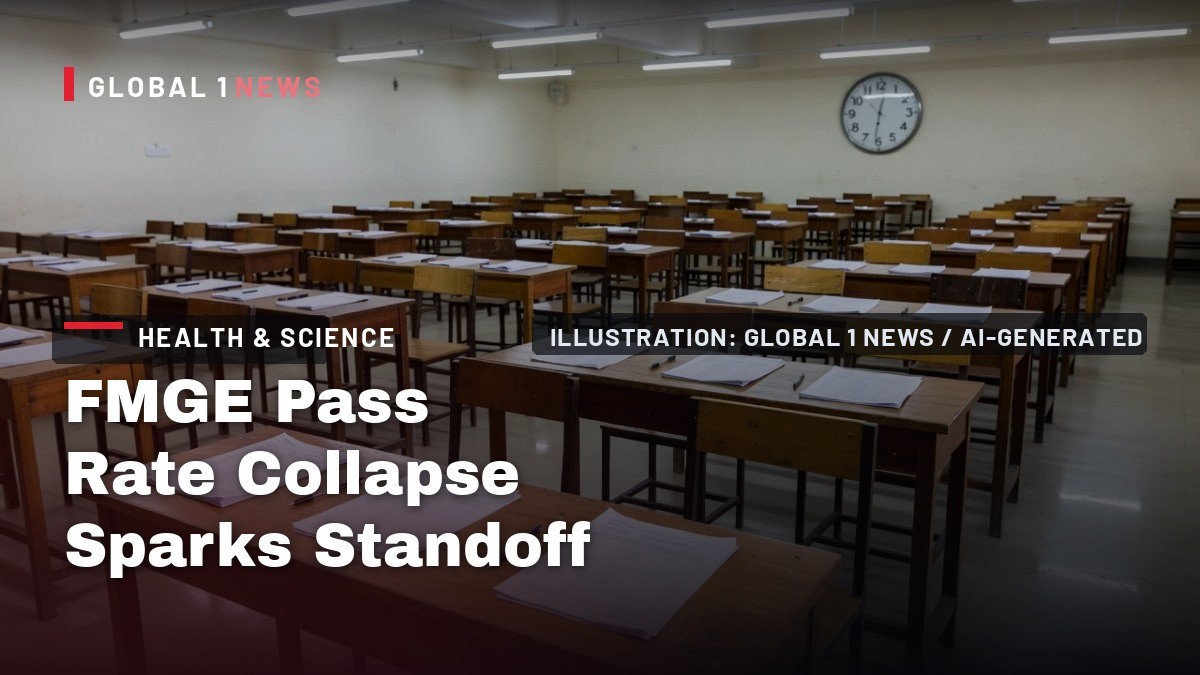
The National Board of Examinations in Medical Sciences (NBEMS) has formally rejected demands to lower the qualifying bar for the Foreign Medical Graduate Examination (FMGE), a decision that leaves thousands of Indian students who studied medicine abroad in professional limbo. The exam body, responding to a week of sustained protests in New Delhi, instead proposed exploring a third annual examination session while maintaining the current 50% qualifying standard. The announcement comes after only 4,635 of 37,448 candidates — a pass rate of approximately 12.4% — cleared the June 2026 FMGE, triggering one of the most intense medical education protests in recent memory.
FMGE Pass Rate Collapse Sparks Standoff: NBEMS Holds the Line, Proposes Third Annual Exam as Protests Enter Second Week
New Delhi, India – August 26 — The National Board of Examinations in Medical Sciences (NBEMS) has rejected demands to lower the qualifying standard of the Foreign Medical Graduate Examination, saying the bar must remain at 150 marks out of 300. Instead, the exam body proposed exploring a third annual examination session — the FMGE is currently held twice a year, in June and December — while committing to review exam fees and formally record responses to protesters' other demands. The decision, communicated on Tuesday, does not address the core grievance of the thousands of candidates who failed the June 2026 sitting.
The Numbers Behind the Crisis
The June 2026 FMGE result, declared on 7 July 2026 on natboard.edu.in, delivered a seismic shock to India's foreign-trained medical graduate community. Of the 37,448 candidates who appeared, only 4,635 qualified — a pass rate of roughly 12.4%, a figure NDTV's own reporting characterised as "Just 12% Of Foreign MBBS Graduates Pass Screening Test." This represents a dramatic collapse from historical averages, which have typically hovered between 20% and 30% over the past decade.
The qualifying cut-off is a fixed 150 marks out of 300 — a flat 50% — with no category-wise relaxation. The FMGE is a qualifying examination, not a ranking examination; candidates either clear the bar or they do not. The sheer scale of the failure — nearly 33,000 candidates — has transformed what might have been a routine result announcement into a national policy flashpoint.
Protests Escalate in Delhi
The collapse in the pass rate triggered sustained protests that have now entered their second week. Demonstrations have been concentrated at the NBEMS office in Gautam Nagar and at Jantar Mantar, with some candidates resorting to hunger strikes. The protest movement, which began in mid-August, has been spearheaded by the All India Medical Students' Association-Foreign Medical Students' Wing (AIMSA-FMSW) and the Academy of Foreign Medical Graduates (AFA), alongside other student associations.
The protesters' demands are specific and data-driven. They are seeking a one-time reduction of the 50% qualifying cut-off for the June 2026 session, grace or compensatory marks for unusually difficult or disputed questions, release of the answer key, a comprehensive review of exam difficulty, and an investigation into reported shortcomings at examination centres. Some candidates have alleged identical or near-identical scores across multiple attempts — including one candidate who reportedly scored 149 marks in consecutive examinations — raising questions about the consistency and fairness of the testing process.
NBEMS Response: A Timeline of Deflection
The NBEMS response has been methodical but, in the protesters' view, insufficient. After the 7 July result, the board received a formal memorandum from AIMSA-FMSW on approximately 12 July. It subsequently constituted a three-member expert committee and held a meeting on 3 August 2026 with FMG representatives and the committee. On 4 August, the board agreed to release the answer key after review, stating it would take about three weeks to evaluate the answer key and candidate concerns. It also began reviewing CCTV footage and test-centre reports (TCS reports).
That three-week window has now closed, and the expert committee's findings are unambiguous. According to reporting from India Today, the committee found "no objective or statistical evidence of any material impact on the examination" and has rejected any change to results or the award of compensatory marks. The Supreme Court has issued notice in the matter, but no interim relief has been granted to the candidates.
What This Means for Indian Medical Education
The FMGE standoff is not an isolated administrative dispute; it sits at the intersection of India's acute doctor shortage and its reliance on foreign-trained physicians. Tens of thousands of Indian students pursue MBBS degrees abroad every year — primarily in Russia, China, Bangladesh, the Philippines, Kyrgyzstan, Georgia, Kazakhstan, Nepal and Ukraine — largely because of the acute shortage of domestic medical seats relative to the number of applicants. India has roughly 1.3 million registered allopathic doctors, a figure that falls short of the WHO-recommended doctor-to-population ratio.
The FMGE pipeline is therefore a significant source of future physicians. A pass rate of 12.4% does not merely inconvenience individual candidates; it constrains the supply of doctors at a time when India's healthcare system is already stretched. The NBEMS's decision to hold the line on the qualifying standard, while statistically defensible, carries a human and systemic cost that the board's expert committee appears not to have fully weighed.
The Quality Question: A Long-Running Debate
Country-wise NBE data has long shown stark differences in FMGE pass rates among Indian medical graduates from different nations. Graduates from Russia, Georgia, Kazakhstan, the Philippines, China, Ukraine and Nepal have historically performed at markedly different levels, feeding a long-running debate about the quality of medical education abroad. Some institutions in these countries are known to have lax admission standards, inadequate clinical training and limited exposure to Indian disease patterns and healthcare protocols.
The NBEMS's refusal to lower the bar is, in one reading, a defence of professional standards. The board's position is that the FMGE exists to ensure that foreign-trained graduates meet the same minimum competency threshold as their domestically trained counterparts. Lowering the cut-off, the argument goes, would compromise patient safety and devalue the examination's purpose. But the protesters counter that the June 2026 paper was unusually difficult, that the answer key contained disputed questions, and that the examination process itself was flawed.

The NExT Framework: A Future Without FMGE?
The broader policy context adds another layer of complexity. The Union Health Ministry has earlier proposed a National Exit Test (NExT) as a future common licensing framework for medical graduates. Once implemented, NExT is expected to subsume or reshape entry-to-practice assessment for both domestic and foreign-trained graduates. The FMGE, in its current form, may eventually be phased out or substantially reformed.
This creates a peculiar dynamic: the NBEMS is defending the integrity of an examination that may not exist in its current form in a few years. For the candidates currently protesting, however, the future framework is cold comfort. They need to clear the FMGE now to register as medical practitioners, and the NBEMS's decision offers them no immediate path forward beyond the proposed third annual exam — a proposal that, even if implemented, would not be held until late 2026 or early 2027.
The Bottom Line
The NBEMS's rejection of the demand to lower the qualifying bar, coupled with its proposal for a third annual exam, represents a holding action rather than a resolution. The board has conceded process points — reviewing fees, releasing the answer key, recording responses — but has refused the substantive concession that protesters seek. With the Supreme Court having issued notice and protests continuing at Gautam Nagar and Jantar Mantar, the standoff is far from over. The 4,635 candidates who cleared the June 2026 FMGE will proceed to registration; the nearly 33,000 who did not must now decide whether to wait for the December sitting, pin their hopes on a possible third exam, or pursue legal remedies. For India's healthcare system, the cost of this impasse is measured not just in careers deferred but in doctors who will not enter the workforce at a time when the nation needs them most.
— By Dr. Raj Patel, Staff Writer
This article was produced with AI-assisted research and editorial support. Sources: NDTV, Indian Express, Times Now, Medical Dialogues, India Today, Telegraph India.
What's Your Reaction?
 Like
0
Like
0
 Dislike
0
Dislike
0
 Love
0
Love
0
 Funny
0
Funny
0
 Wow
0
Wow
0
 Sad
0
Sad
0
 Angry
0
Angry
0

India/South Asia Correspondent at Global1.News. Analytical voice with a background in science and health journalism. Based in New Delhi, covering Indian politics, education, healthcare, technology, and policy. Breaks down complex data into clear, actionable reporting.














Comments (0)