
Flash Flood in Nepal's Rasuwa District Kills at Least 17, Hundreds Missing Near Tibet Border
A flash flood in Nepal's Rasuwa district near the Tibet border killed at least 17 and left hundreds missing, including foreign tourists and Kailash Mansarovar pilgrims. Triggered by an earthquake-induced landslide, the disaster also caused major casualties in Tibet's Gyirong port.
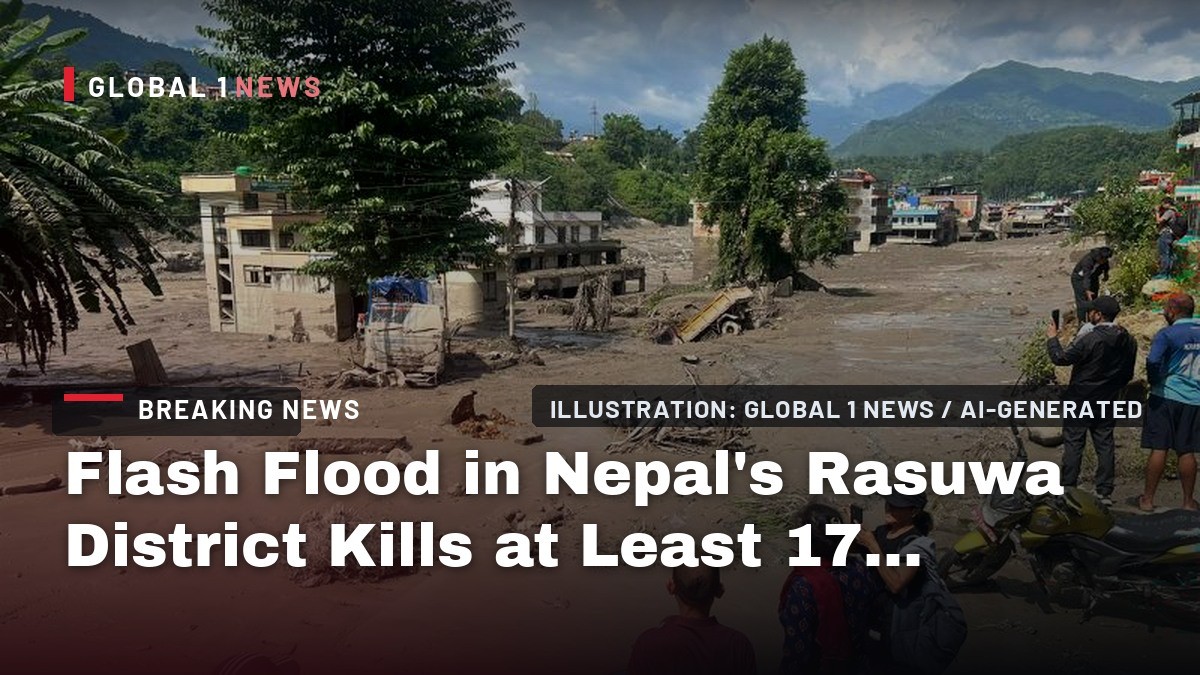
At least 17 people have been confirmed dead and hundreds remain missing after a massive flash flood swept through northern Nepal's Rasuwa district near the Nepal-China (Tibet) border early Wednesday morning, according to local police. The torrent, which tore through the Bhotekoshi River valley at approximately 8:37 a.m. local time, destroyed multi-storey buildings, swept away vehicles, and left a trail of devastation that authorities fear will yield a significantly higher death toll as rescue operations continue.
Video footage circulating on social media shows a wall of brown water bursting the river's banks and engulfing riverside settlements, with several structures collapsing into the churning current within seconds. Nepal's Foreign Minister Khanal told the House of Representatives that the flood was triggered by a chain of geological events: "An earthquake occurred at 8:37 a.m. today, and due to it, a large landslide occurred, blocking the river, which appears to have caused the flood." The United States Geological Survey registered a 4.4-magnitude earthquake in the region at the same time, corroborating the sequence described by the minister.
Climate expert Saswata Sanyal, a disaster risk reduction specialist, told the Associated Press that the flood on the Lhende Khola River, a tributary of the Bhote Koshi, was "triggered by an ice rock avalanche from a glacier on the Nepal side that blocked the river and released a sudden surge downstream." The Bhote Koshi River flows from China into Nepal through deep gorges before eventually joining the Ganges in India. Last year, flooding on the same river killed nine people and left 24 missing, according to Reuters, underscoring the region's vulnerability to such events.
Casualty Figures Expected to Rise as Rescue Teams Reach Remote Areas
Local police in Rasuwa district have confirmed at least 17 deaths, though Reuters reported at least eight confirmed dead earlier in the day, with the extreme force of the floodwaters suggesting the toll will climb substantially. The discrepancy between early and later figures reflects the difficulty of accessing the rugged, mountainous terrain where many settlements are isolated and communication lines have been severed. Twelve people had been rescued so far, according to the BBC, a number that rescue officials describe as tragically low given the scale of the disaster.
The confirmed death toll includes residents of riverside villages in Rasuwa municipality, where the flood struck with little to no warning. Eyewitness accounts describe a sudden roar followed by a surge of water that rose several meters within minutes, leaving residents with no time to evacuate to higher ground. Search and rescue teams are now combing through debris along the river's course, but the sheer volume of water and the instability of the terrain are hampering efforts to reach affected areas.
Nepal's Prime Minister Balendra Shah addressed the nation, confirming that police and military forces have been deployed to join rescue teams. "Instructions have been given to move the people living in the lower areas to safer places," Shah said in a statement. "People along the river are advised to exercise extra caution and remain alert." The Nepal Army has deployed helicopters and disaster response personnel, though pilots report difficulty landing amid high floodwaters and unstable ground conditions. The army released video footage of a helicopter hovering above a muddy outcrop beside the raging water, illustrating the challenges facing rescue operations.
Hundreds of Foreign Nationals and Pilgrims Among the Missing
Nepal's tourism board has posted a preliminary agency-wise record identifying 384 travellers, including 291 foreign nationals and 93 Nepali nationals, reported missing from the affected areas. The nationalities include citizens of India, Australia, The Netherlands, South Africa, the United Kingdom and Malaysia. Officials stress that the information is being verified and cross-checked with travel agencies, guides, local authorities and security agencies, and that some individuals may simply be out of communication due to damaged infrastructure.
Nearly 400 Kailash Mansarovar-bound pilgrims were reported out of contact in Rasuwagadhi, the border crossing town, according to the Kathmandu Post. The annual Kailash Mansarovar Yatra is a Hindu pilgrimage to Mount Kailash and Lake Manasarovar in Tibet, and the overland route runs from Kathmandu through Rasuwa, crossing into Tibet at Rasuwagadhi. The timing of the disaster, during the peak pilgrimage season, has raised concerns that many of the missing may be elderly pilgrims who were particularly vulnerable to the sudden flood.
The missing also include 60 employees at the under-construction 20 MW Langtang Khola Hydroelectric Project in Rasuwa municipality, according to RSS, Nepal's state news agency. "The project was carrying out concrete construction work inside a tunnel. The flood caused severe damage to the project," the agency reported. Additionally, nine Armed Police Force personnel deployed at Timure, near the border, were reported missing, according to the Kathmandu Post. The loss of security personnel highlights the sudden and indiscriminate nature of the disaster, which struck without regard for the status or location of those in its path.
Rescue Operations Underway as Nepal Mobilizes Full Disaster Response
Nepal Police, the Armed Police Force and the Nepal Army have all been mobilized in a coordinated response, according to the Himalayan Times. The Nepal Army has deployed helicopters to conduct aerial reconnaissance and evacuate survivors from isolated areas, while ground teams are working to clear blocked roads and establish communication links with affected villages. The Red Cross has activated emergency response teams, mobilized volunteers and is deploying an emergency team with relief supplies, while the International Federation of Red Cross (IFRC) said it is ready to support the national society's efforts.
High-alert warnings have been issued for communities along the Bhote Koshi and Trishuli rivers, particularly in the districts of Rasuwa, Nuwakot, Dhading, Gorkha and Chitwan, according to a ReliefWeb/IFRC situation report. The floodwaters are moving downstream, and authorities are urging residents in low-lying areas to evacuate proactively. Dhading Chief District Officer Laxmi Pandey Gautam said the flood had merged into the Trishuli River and was moving downstream from Malekhu toward Kurintar, increasing risk to riverside settlements. Galchhi in Dhading district and Trishuli Bazar in Nuwakot district have already suffered flooded roads and partially submerged houses.
The downstream threat is a major concern for disaster managers, as the Trishuli River passes through several densely populated districts before joining the Ganges system in India. Authorities are monitoring water levels at key points and have established evacuation centers in safer areas. The Nepal Army's helicopter operations are focused on the hardest-hit areas near the border, where the flood's impact was most severe, but resources are being stretched as the scope of the disaster becomes clearer.
China Reports Major Casualties in Tibet as Mudslide Hits Gyirong Port
On the Chinese side of the border, state media warned of "major casualties" in Tibet. A mudslide hit Gyirong port at approximately 10:30 a.m. local time, cutting off roads, communications and power, according to Xinhua. CCTV footage from Gyirong captured a wall of mud and water sweeping through a valley near the border, and the building seen in the visuals housed the immigration office for pilgrims undertaking the Mansarovar yatra. The timing of the mudslide, roughly two hours after the initial earthquake, suggests a cascading series of geological failures triggered by the same seismic event.
Gyirong port sits more than 1,800 meters above sea level and typically sees hundreds of millions of dollars in annual two-way trade, with flows accounting for nearly a third of China-Nepal trade volume in 2024, according to Xinhua. The port has been a focal point of Chinese infrastructure investment in the region, and its disruption will have significant economic implications for both countries. In July 2025, floods swept away the bridge connecting Gyirong with Nepal's Rasuwa Port, suspending goods trade for roughly six months. An economic cooperation zone has since been built as China pushes to turn the crossing into a modern logistics hub, making the current damage particularly costly.
Chinese leader Xi Jinping was quoted by Xinhua around 3:30 p.m. Beijing time calling for search and rescue efforts, resettlement of affected people and attention to "secondary disasters." Premier Li Qiang issued instructions to central agencies, and Vice Premier Zhang Guoqing was dispatched to Tibet to oversee the response. Disaster relief agencies were allocating 30,000 items of central disaster-relief supplies, including tents, heating stoves, clothing, bedding, folding beds and moisture-proof mats, according to state media reports.
Chinese Emergency Response Mobilizes Specialized Teams and Equipment
China's Ministry of Emergency Management and the state-backed China Energy Engineering Corporation have deployed responders under a joint mechanism, according to CCTV. An initial team of 200 geological, engineering and emergency personnel equipped with reconnaissance drones, 3D laser scanners, life detectors and rescue equipment has been mobilized to the affected area. The specialized equipment will be critical for locating survivors buried under debris and assessing the stability of slopes that may pose further risks of landslides.
Authorities have announced that roads leading to Gyirong port will be closed to non-emergency vehicles for seven days, a measure designed to facilitate rescue operations and prevent additional casualties. The closure will further disrupt trade and travel between the two countries, though officials say the priority is saving lives and stabilizing the situation. The Chinese response has been characterized by a rapid mobilization of resources, reflecting the strategic importance of the border region and the scale of the disaster.
Search operations are under way on both sides of the border, according to the BBC, with the destruction of roads and communication infrastructure complicating coordination. Officials have warned that a full assessment of the damage will take days. The focus, for now, remains on locating survivors and providing immediate relief to those affected.
Rasuwa's History of Disaster and the Region's Growing Vulnerability
Rasuwa district, home to around 50,000 people, is no stranger to catastrophe. The district was devastated by the 7.8-magnitude earthquake that hit Nepal in 2015, killing more than 9,000 people nationwide, including hundreds in Langtang National Park who were buried by a landslide that wiped a trekking village off the map. The region's steep valleys and fragile geology make it particularly susceptible to landslides and flash floods, and the 2015 earthquake weakened slopes that remain unstable to this day.
The area is also a major destination for trekkers and pilgrims. Langtang National Park is a popular trekking destination, and Gosaikunda, a sacred alpine lake more than 4,300 meters up, is a major Hindu pilgrimage site. The Bhote Koshi River is popular with white-water rafters, and Timure, located on the Trishuli River, is the last settlement on the road to China, taking around 5-6 hours by jeep from the border to Kathmandu. The presence of so many visitors in the affected area has complicated rescue efforts and raised the stakes for authorities trying to account for all those who were in the region when the flood struck.
The Himalayan region is prone to flash floods and landslides, with experts clear that extreme weather is becoming more frequent and intense as the human-caused climate crisis escalates. Recent history provides a sobering context: in August 2025, a surge of flood water tore through a mountain village in northern India, leaving several dead and dozens missing; in September 2024, days of heavy monsoon rains in Nepal triggered widespread flooding killing around 200 people; in October 2023, more than 100 people went missing in India's northeast after heavy rain caused a glacial lake to burst, flooding the Himalayan state of Sikkim; in October 2021, rains and heavy flooding killed at least 150 people in India and Nepal; and in September 2014, massive flooding in Pakistan-administered Kashmir and Punjab killed more than 400 people.
Climate Experts Point to Glacial Instability as a Growing Threat
Climate expert Saswata Sanyal's assessment that the flood was triggered by an ice rock avalanche from a glacier highlights a growing concern among scientists studying the Himalayas. As global temperatures rise, glaciers across the region are retreating and becoming more unstable, increasing the risk of glacial lake outburst floods and ice avalanches that can block rivers and cause sudden, catastrophic flooding downstream. The 4.4-magnitude earthquake may have been the immediate trigger, but the underlying vulnerability of the region's glaciers is a product of long-term climate change.
The Bhotekoshi River valley has experienced repeated flooding events in recent years, and each event has caused significant damage to infrastructure and loss of life. The under-construction Langtang Khola Hydroelectric Project, where 60 employees are missing, is one of many infrastructure projects in the region that are exposed to such risks. Engineers and disaster planners are increasingly calling for stricter building codes and land-use regulations in high-risk areas, but the economic pressures to develop hydropower and tourism infrastructure often override safety considerations.
The disaster has also raised questions about early warning systems. While Nepal has invested in some flood monitoring infrastructure, the sudden nature of this event, triggered by an earthquake-induced landslide, made it nearly impossible to provide advance warning. Experts argue that a more comprehensive network of seismic and hydrological sensors, combined with automated alert systems, could provide precious minutes of warning in future events. However, such systems require significant investment and coordination across international borders, which remains a challenge in the region.
Recovery Begins as Families Await Word on the Missing
Countries with citizens among the missing — including India, Australia, the Netherlands, South Africa, the United Kingdom and Malaysia — are watching the rescue effort closely as Nepal's tourism board works to verify who among the 384 listed travellers are safe. The board has stressed that the preliminary record is being cross-checked with travel agencies, guides, local authorities and security agencies, and that some individuals may simply be out of communication because of damaged infrastructure.
The Red Cross and other humanitarian organizations are preparing to deploy additional resources once access to the affected areas is restored. The IFRC said it is ready to support the Nepal Red Cross Society's response, which includes emergency medical teams, shelter kits and clean water supplies. The immediate priority is rescuing survivors and providing medical care to the injured, but the longer-term challenge of rebuilding homes, roads and livelihoods will require sustained international support.
For the families of the missing, the wait for information is agonizing. Nepal's tourism board has stressed that its preliminary list of 384 missing travellers is expected to change as communication is restored and individuals make contact. Officials in both Nepal and China say search and rescue operations are continuing around the clock, and the coming days will be critical for determining the final toll of this disaster and beginning the long process of recovery.
This article was produced with AI-assisted research and editorial support. Sources: CNN, Reuters, Associated Press, BBC, Kathmandu Post, The Guardian, Al Jazeera, Xinhua, ReliefWeb.
By Jessica Ali, Staff WriterWhat's Your Reaction?
 Like
0
Like
0
 Dislike
0
Dislike
0
 Love
0
Love
0
 Funny
0
Funny
0
 Wow
0
Wow
0
 Sad
0
Sad
0
 Angry
0
Angry
0

Editor-in-Chief at Global1.News. Atlanta-based journalist who cuts through the BS and tells it like it is. Lead anchor, host, and the voice you hear when the spin stops and the truth starts.














Comments (0)