
Netanyahu Rules Out Iran Deal as Tehran Warns of Regional War
On the same day Israeli Prime Minister Benjamin Netanyahu declared that an agreement with Iran's leadership is impossible, calling them "savages," the Iranian army warned that any future war with the United States would spread across the entire region, targeting energy and communications infrastruct
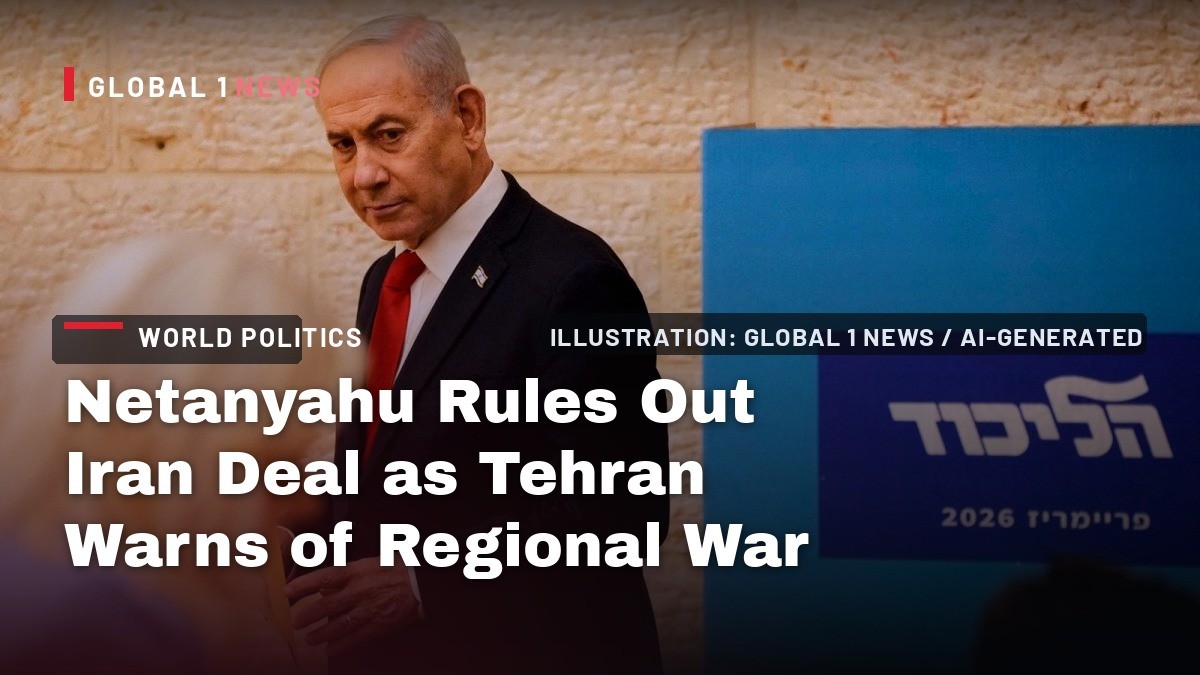
Diplomacy in tatters: Netanyahu rules out Iran deal as Tehran warns of regional war and the true cost of February's conflict emerges
The diplomatic track between Washington and Tehran is collapsing in plain sight. On the same day Israeli Prime Minister Benjamin Netanyahu declared that an agreement with Iran's leadership is impossible, calling them "savages," the Iranian army warned that any future war with the United States would spread across the entire region, targeting energy and communications infrastructure. Meanwhile, a new NBC News report has revealed the staggering cost of the February-March conflict: "unprecedented damage" — running into billions of dollars — to U.S. intelligence facilities across the Middle East.
These three developments, reported within hours of each other on Aug. 26, 2026, paint a coherent picture: the June 18 memorandum of understanding brokered by Qatar and Pakistan is effectively moribund, both sides are escalating their rhetoric, and the region is bracing for the possibility that the ceasefire that halted the Feb. 28 war will not hold.
Netanyahu's "no deal" declaration
Speaking late Tuesday at an event in Jerusalem for Israeli settlers in the occupied West Bank, Netanyahu was unambiguous. Recounting his July 28 meeting with President Donald Trump at the White House, the Israeli leader said they had discussed the possibility of diplomacy with the Islamic Republic. His conclusion was blunt.
"I doubt, however, that an agreement can be reached with that group there, with those savages," Netanyahu said, according to AFP. "I tell you — an agreement cannot be reached."
The remarks are consistent with Netanyahu's long-standing opposition to any diplomatic engagement with Iran. He campaigned openly against the 2015 nuclear deal brokered by then-President Barack Obama, and has spent years pushing for U.S. military action against Iran's Shiite cleric-run state, which supports armed groups like Hezbollah and Hamas — the latter responsible for the Oct. 7, 2023 incursion into Israel.
What is notable is the timing. Israel faces elections on Oct. 27, and Netanyahu is trailing in some polls. His audience — settlers in the occupied West Bank — represents a core constituency that has long favored maximalist positions on Iran. By ruling out diplomacy entirely and positioning himself as the leader who pushed Trump toward economic warfare, Netanyahu is consolidating his right flank ahead of the vote.
The "economic D-Day" strategy
Trump, for his part, has shown reluctance to resume full-scale military action against Iran, even as he grows frustrated with Tehran's refusal to accept his demands. On Monday, the U.S. president declared "economic D-Day" — a campaign aimed at destroying Iran's economy, which has already endured years of crippling sanctions.
Netanyahu voiced strong support for this approach and took partial ownership of it, saying he had presented Trump with this "third option" — neither full-scale war nor a negotiated settlement, but economic strangulation. He praised the U.S. president for pursuing the economic path "in a very, very, very strong way."
Crucially, Netanyahu said Trump had decided not only to target Iran itself but also to tighten "the siege on those who assist this regime, this terrible dictatorship." This is a significant escalation in scope: it signals that Washington and Jerusalem are prepared to pressure regional actors — likely including Qatar, which has hosted Iranian assets, and potentially Iraq and Syria — that maintain economic or logistical ties to Tehran.
The Israeli leader also revealed that the two leaders discussed renewing military action against Iran. "I told him: We are there, we will defend ourselves, and we will not allow Iran to attack us," Netanyahu said. "And if, God forbid, they attack us, they will suffer a blow they never dreamed of — much stronger than anything they have suffered so far."
Adding a personal dimension, Netanyahu revealed Monday that Iran had attempted to kill one of his sons. Newsmax, citing an anonymous U.S. law enforcement source, reported that the target was Yair Netanyahu, his 35-year-old son who has long resided in the Miami area.

Iran's regional-war warning
Iran's military responded to the escalating rhetoric with a warning of its own. Brig. Gen. Mohammad Akraminia, an army spokesperson, told the semi-official Mehr News Agency that any "possible future war" with the United States could spread across the region and hit energy and communications infrastructure.
Akraminia pointed to the Bab el-Mandeb Strait and a U.S. base in Syria as evidence that the conflict's geographical scope had already expanded beyond its original parameters. "Today, threats exist across the entire region and we have the capabilities to confront and deal with them," he said.
The general's most striking statement concerned future targets. He said a possible war could involve "energy and communications infrastructure across the region — specifically energy infrastructure and communications links that largely run along the seabed in waters off Iran and the Arabian Peninsula and through the Gulf of Oman."
This is a direct threat to the undersea cables that carry much of the world's internet traffic between Europe, the Middle East, and Asia, as well as to the energy export routes that pass through the Strait of Hormuz. "Wherever the enemy has interests, in the event of aggression, they could fall within the framework of legitimate targets of the armed forces of the Islamic Republic of Iran," Akraminia said.
The spokesperson also urged Qatar to step up efforts to determine the fate of three Iranian pilots missing since an Iranian air operation against a U.S. base in Qatar on March 2. Two Iranian Sukhoi aircraft struck the base before being shot down on their return flight. The body of one of the four pilots, Majid Kazemi, was later recovered; the other three remain missing. Qatar has denied holding them.
The cost of the war: unprecedented damage to U.S. intelligence
The stakes of any renewed conflict are now clearer thanks to a report from NBC News, citing four people with knowledge of the matter. U.S. intelligence facilities and surveillance systems across the Middle East suffered "unprecedented damage" — worth billions of dollars — in Iranian missile and drone strikes during the February-March war.
The report said the attacks damaged buildings and intelligence-gathering equipment used by the CIA and other U.S. spy agencies. The scale of the destruction is described as greater than any damage previously sustained by U.S. intelligence agencies, the sources said.
This revelation has profound implications. It means that Iran's retaliatory strikes — launched after the U.S.-Israeli joint attack on Feb. 28 — were far more effective against U.S. intelligence infrastructure than previously acknowledged. It also means that the United States' ability to monitor Iranian activities, regional proxy networks, and maritime traffic in the Strait of Hormuz has been degraded at precisely the moment when tensions are rising again.
The cost of repairing or replacing this equipment runs into the billions — a financial burden that comes as Washington is also managing the economic fallout of the war, which sent oil prices spiraling before the April ceasefire.
Historical context: from Feb. 28 to the present
The current crisis has its roots in the Feb. 28 outbreak of war, when the United States and Israel launched joint strikes on Iran. In the opening salvo, Israel killed Iran's then-Supreme Leader Ayatollah Ali Khamenei, along with much of his family. His son Mojtaba, one of Khamenei's six children, was named the new supreme leader a week later and has not been seen in public since.
Iran retaliated against U.S. military positions across the region, drawing in several regional fronts and disrupting maritime traffic. The conflict expanded to include the Bab el-Mandeb Strait and a U.S. base in Syria — areas that had previously been outside the geographical scope of the fighting.
In April, Trump agreed to a ceasefire in the face of widespread U.S. public opposition to the war. Then, on June 18, Iran and the United States signed a memorandum of understanding through Qatari and Pakistani mediation, aimed at ending the fighting and setting the stage for negotiations.
Those negotiations have since broken down. Tehran accuses Washington of failing to fully implement the memorandum, and the two sides remain at odds over its terms and over navigation through the Strait of Hormuz — the critical chokepoint for global energy exports.
Strategic calculus: what each side wants
The current trajectory suggests both sides are preparing for the possibility of renewed conflict, even as neither appears eager to initiate it.
Netanyahu wants to cement his legacy as the leader who neutralized the Iranian threat, and he faces an election in two months. His calculation is that a hardline posture on Iran — combined with the "economic D-Day" campaign — will rally his base and position him as the indispensable leader in a time of crisis. He has long believed that only military action, or the credible threat of it, can roll back Iran's nuclear program and its regional proxy network.
Trump wants to avoid a full-scale war that proved deeply unpopular with the American public, but he also wants a diplomatic victory that has so far eluded him. The "economic D-Day" campaign is his attempt to force Iranian capitulation without committing U.S. troops to another Middle Eastern conflict. The question is whether economic pressure alone can achieve what military strikes could not.
Iran, under the untested leadership of Mojtaba Khamenei, wants to survive. The regime has been decapitated, its economy is in ruins, and its military has demonstrated both its capabilities and its limitations. Tehran's warning about future wars spreading across the region is a signal of deterrence — an attempt to raise the cost of renewed U.S. or Israeli action to a level that Washington finds unacceptable.
Regional implications and the risk of miscalculation
The collapse of the diplomatic track has profound implications for the Gulf states, which have been caught between their security relationships with Washington and their geographic proximity to Iran. Qatar's mediation role — which produced the June 18 memorandum — is now in question, and Doha's denial of holding the three missing Iranian pilots adds another layer of tension to an already fraught relationship.
The energy markets remain the most sensitive barometer. Any renewed conflict that threatens the Strait of Hormuz or the undersea communications infrastructure in the Gulf of Oman would have immediate global consequences, sending oil prices soaring and potentially disrupting the digital backbone of the international economy.
The risk of miscalculation is acute. Both sides have drawn red lines, and both have demonstrated a willingness to cross them. Netanyahu's declaration that no agreement is possible, combined with Iran's warning that any future war would spread across the region, suggests that the window for a negotiated settlement is closing — if it has not already slammed shut.
The Feb. 28 war has already exacted a terrible cost: the killing of a supreme leader, billions in damage to U.S. intelligence infrastructure, and a humanitarian and economic toll that continues to mount. The question now is whether the lessons of that conflict will deter a second round — or whether the collapse of diplomacy makes it inevitable.
By Malik Hassan, Staff Writer
This article was produced with AI-assisted research and editorial support. Sources: Daily Sabah, AFP, Anadolu Agency, NBC News, Mehr News Agency.
What's Your Reaction?
 Like
0
Like
0
 Dislike
0
Dislike
0
 Love
0
Love
0
 Funny
0
Funny
0
 Wow
0
Wow
0
 Sad
0
Sad
0
 Angry
0
Angry
0

Middle East Correspondent at Global1.News. Based in Beirut, covering politics, conflict, energy, and society across the Middle East. Brings context and depth to a region often reduced to headlines.















Comments (0)