
Dead Whale on a Tijuana Beach: A Grim Herald of the Pacific's Gray Whale Crisis
The body of a roughly 12-metre whale on a Tijuana beach this week has become the latest, most visceral symbol of a crisis unfolding across the Pacific. NOAA has counted 145 gray whale strandings in 2026 alone, and the nursery lagoons of Baja California are emptying season by season. For the communities of Mexico's Pacific coast, the question is no longer whether the whales are in trouble — it is whether the ocean can still feed them.
The body of a roughly 12-metre whale on a Tijuana beach this week has become the latest, most visceral symbol of a crisis unfolding across the Pacific. NOAA has counted 145 gray whale strandings in 2026 alone, and the nursery lagoons of Baja California are emptying season by season. For the communities of Mexico's Pacific coast, the question is no longer whether the whales are in trouble — it is whether the ocean can still feed them.
Dead Whale on a Tijuana Beach: A Grim Herald of the Pacific's Gray Whale Crisis
Tijuana, Baja California – Mexico, August 26, 2026 — The Pacific coast has a new and troubling visitor, and it is not alive. A whale roughly the length of a bus came ashore at Playas de Tijuana this week, and for the scientists and communities watching the gray whale population collapse, the stranding is more than a local curiosity — it is a warning from the deep.
A 12-Metre Visitor from the Deep
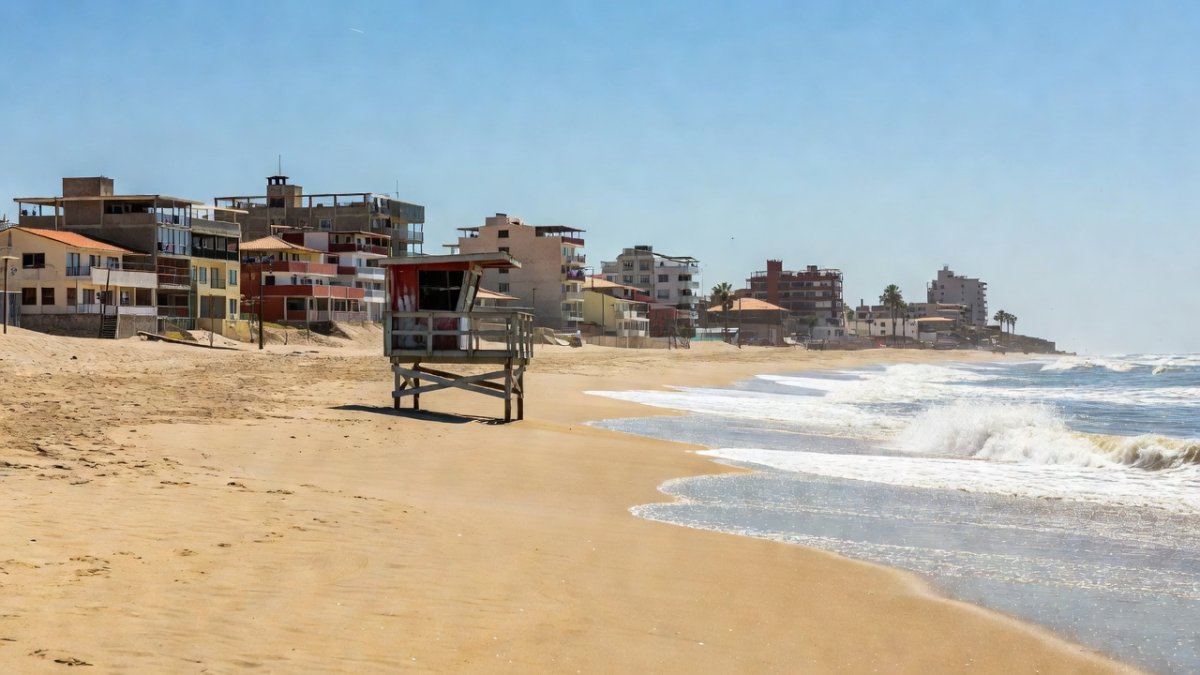
The Pacific Ocean gave up one of its dead on a Monday morning in late August, and the beachgoers of Tijuana woke to a sight that stopped them cold. A roughly 12-metre-long whale was found dead Monday, August 24, 2026, on Playas de Tijuana beach in Baja California, Mexico — the beach district right on the US-Mexico border, across from Imperial Beach, San Diego. It was not a small animal, not a juvenile that had wandered off course. This was a full-grown leviathan, its body heavy with the weight of a life that had ended somewhere out in the gray-green water, only to be delivered to the sand by the indifferent tide. The whale appeared at the height of the Océano 21 residential buildings, a stretch of coastline where families gather on weekends, where vendors sell elotes and raspados, where the border wall runs down to the sea like a scar. And now, a dead whale lay there, drawing crowds of the curious and the concerned.
Authorities said the whale appears to have died at sea before being carried ashore by the tide; it was buried in the sand on Tuesday, August 25. The burial was quick, pragmatic, a way to manage the public health risk and the smell. Al Jazeera English published the report August 26, 2026, and within hours, the story was circulating across the hemisphere. The species was not publicly confirmed, but the size — roughly 12 metres — and the timing are consistent with the eastern Pacific gray whale (Eschrichtius robustus), whose annual migration passes the Baja California coast. These are the whales that have become a symbol of the region, the gentle giants that approach small boats in the lagoons of Baja California Sur, the ones that have made Guerrero Negro and San Ignacio famous around the world. And now, one of them was dead on a Tijuana beach, a grim herald of a much larger catastrophe.
The civil-society organization Kilómetro Uno — coordinator of the Comité de Playas Limpias (Clean Beaches Committee), which includes agencies from all three levels of government — called for a scientific analysis before any cause is attributed. This is not the time for speculation, they insisted. Osmar Leopoldo San Miguel Lugo of Kilómetro Uno said authorities should carry out the proper procedures and subject the specimen to scientific analysis; he noted vessels can collide with whales, so each case must be examined; he said a protocol must exist for whale strandings because marine mammals can transmit diseases, and the public should not touch specimens, only notify authorities. His words were measured, careful, the voice of a man who has seen too many hasty conclusions. But even he could not ignore the larger pattern. This was not an isolated incident. This was a symptom.
145 Deaths and Counting: A Catastrophic Year
The numbers are staggering, and they demand our attention. NOAA Fisheries counted 145 gray whales stranded dead in 2026 across their range in Mexico, Canada and the United States (data through July 6, 2026), including 13 deaths in Alaska. That is not a normal year. That is not even a bad year. That is a catastrophe unfolding in slow motion, one carcass at a time, on beaches from the Baja peninsula to the Bering Sea. And the tragedy is that 2026 is not an anomaly — it is part of a terrifying trend. In 2025, 179 gray whales were found dead. Between 2019 and 2023, federal officials declared an "unusual mortality event" with 690 strandings and decreased birth rates. We are not looking at a single bad season. We are looking at a decade of decline, a population that is hemorrhaging individuals faster than it can replace them.
Let me put this in perspective for you, because the raw numbers can feel abstract. The eastern North Pacific gray whale population peaked near 27,000 in 2016, fell to about 14,500 by 2023, and is now below 13,000 — the lowest since the 1970s. The Guardian reported it fell from 20,000 in 2019 to fewer than 13,000 this year. That is a loss of more than half the population in a single decade. These are not just statistics; these are mothers and calves, matriarchs and juveniles, individuals with their own histories and migrations. Rick Steiner, Alaska marine ecologist and chair of Public Employees for Environmental Responsibility (PEER), said the whales are in "very, very serious trouble" and "The stranding numbers last year and this year are enormous compared to their annual average." And here is the most chilling part: Steiner told KTOO Alaska Public Media that "the ones that wash ashore are only maybe 10 percent of the whales that are dying." Ten percent. That means the true death toll could be in the thousands.
John Calambokidis, biologist and co-founder of Cascadia Research Collective, has been studying these whales for decades. He said "All of them are thin. Some are extremely emaciated" and that he feels something "catastrophic" is happening. These are not the words of an alarmist; they are the words of a scientist who has watched a species he loves slip toward the edge. Miyoko Sakashita, oceans program director at the Center for Biological Diversity, called the migration route "almost a deadly maze." And David Weller, NOAA marine biologist, offered a sobering assessment: "The environment may now be changing at a pace or in ways that is testing the time-honored ability of the population to rapidly rebound while it adjusts to a new ecological regime." The whales are not failing. The ocean is changing beneath them.
Why Are the Whales Dying? Climate Change Hits the Food Chain
The science is clear, and it is not comforting. Scientists link the crisis to climate change-driven decline of amphipods (the crustaceans gray whales filter from seafloor sediment), driven by dramatic reduction in sea ice around Alaska. These tiny creatures are the bread and butter of the gray whale diet. A gray whale feeds by diving to the seafloor, taking in a mouthful of sediment, and filtering out the amphipods and other small organisms. It is a strategy that has worked for millions of years, but it depends on a stable, productive Arctic ecosystem. As sea ice retreats and ocean temperatures rise, the amphipod populations are crashing. The whales are literally running out of food. They arrive in the Baja lagoons thin, exhausted, and starving. They give birth to calves that cannot survive. They die on the migration route, their bodies washing up on beaches from Alaska to Mexico.
But climate change is not the only killer. Other contributing factors: ship strikes and propeller wounds, entanglement in fishing gear, ocean noise, microplastic pollution, algal blooms, and Russian harvesting. Each of these is a separate wound, a separate threat, and together they form a gauntlet that the whales must run every single year. Some hungry whales are detouring into dangerous places like San Francisco Bay, where they are fatally struck by ships or entangled. They are searching for food, driven by desperation into waters that are not safe for them. The irony is devastating: the whales are trying to survive, and we are making it impossible. Gray whales were hunted to near-extinction in the commercial whaling era, recovered after the global moratorium, and were delisted from the US Endangered Species Act in 1994 — a decision Steiner called a "colossal mistake." Environmental groups have petitioned NOAA to relist the species, but so far, the federal government has not acted.
There is some good news, if you can call it that. Ship-strike mitigation programs in some regions (voluntary speed reductions, whale spotters) have reduced whale ship-strike deaths by about 50%; Oregon, Washington and Alaska have not implemented similar programs. And there is cautious hope: gray whales have been spotted in growing numbers near Kodiak and Sitka, Alaska, possibly switching from amphipods to small fish like Arctic cod. This suggests that the whales are adaptable, that they are trying to find new food sources in a changing ocean. But adaptation takes time, and time is not something these whales have. The question is whether we can act quickly enough to give them a chance.
Baja California's Lagoons: A Nursery Under Pressure
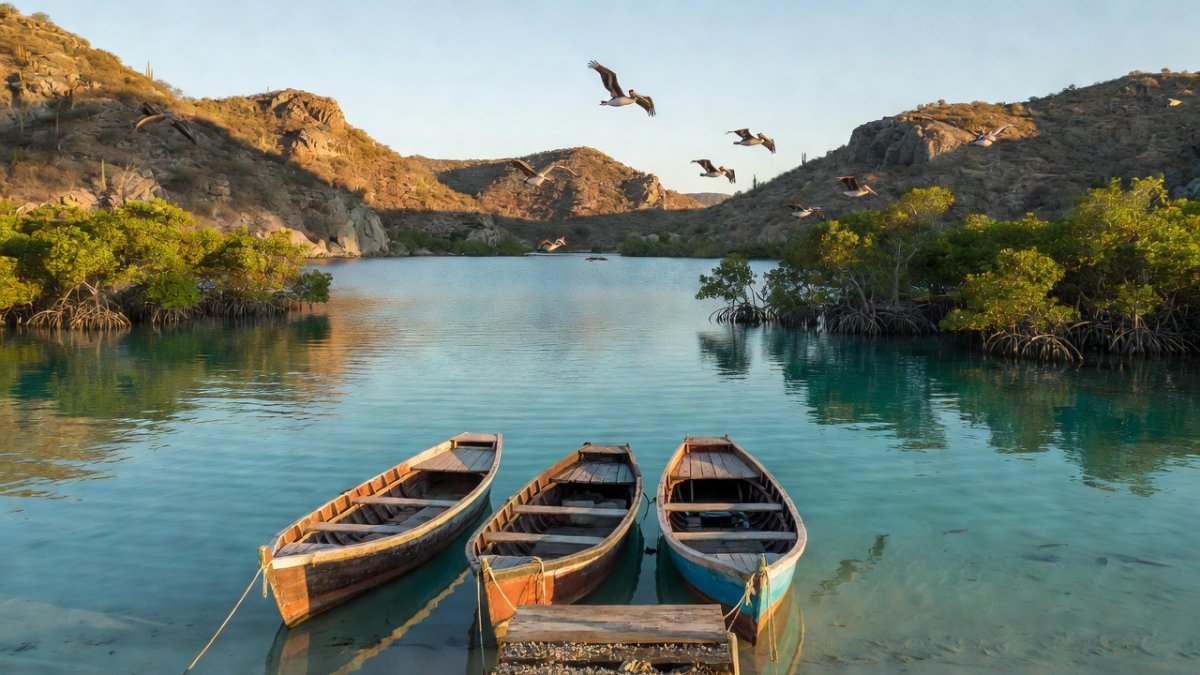
For the people of Baja California, the gray whale is not just an animal — it is a part of their identity, their economy, their way of life. Gray whales make a roughly 10,000-mile round-trip migration each year between Arctic feeding grounds and the warm lagoons of Baja California, Mexico, where they mate, give birth and raise calves — one of the longest annual migrations of any mammal. These lagoons are the nurseries, the safe havens where the next generation is born. And they are under pressure. Baja California Sur's breeding lagoons: 568 whales recorded in Ojo de Liebre Lagoon (Scammon's Lagoon) and just 90 in San Ignacio Lagoon during the 2025-2026 winter — about 658 total, down from 883 counted across the same lagoons in 2023-2024. The 2024-2025 season was worse: only 513 gray whales counted across both lagoons, and more than 80 were found stranded in a state of starvation. Researcher Bermúdez, who has worked the Vizcaíno lagoons for nearly 30 years, called it "truly difficult and critical."
The 2025-2026 season showed a modest rebound in total numbers but continued high entanglement: 57 entanglement cases in Ojo de Liebre Lagoon alone and 7 more in San Ignacio. A humpback whale was found dead near San Evaristo, north of La Paz, with fishing net still wrapped around it. The nets are everywhere, ghost gear from the fishing industry that continues to kill long after it has been abandoned. El Niño conditions add another layer of risk: warmer Pacific waters can push breeding activity farther north, toward northern Baja California and even the coast of California. The Whale Sanctuary of El Vizcaíno — a UNESCO World Heritage site since 1993, within Mexico's El Vizcaíno Biosphere Reserve (created 1988, the largest protected area in Mexico) — protects the lagoons of Ojo de Liebre and San Ignacio, the primary breeding and calving area for the eastern Pacific gray whale. Each lagoon is also a Ramsar wetland. These are protected areas, but protection on paper does not always translate to protection in practice.
The Gray Whale Research Mexico program (BMAG) conducted its 2026 monitoring in the Bahía Magdalena-Almejas and López Mateos lagoon complex, Baja California Sur, from January 18 to March 18, 2026, with four boat surveys. They are on the front lines, documenting the decline, counting the dead, trying to understand what is happening. Whale watching drives the winter economy of Baja lagoon towns — Guerrero Negro, San Ignacio, Puerto López Mateos — with gray whales arriving from late December, peaking February-March, departing by mid-April. The famous "friendly whales" of San Ignacio approach boats on their own terms. These are the whales that have made the region famous, that have brought tourists from around the world to witness one of the great spectacles of the natural world. If the whales disappear, so does the economy. In Mexico, stranding response falls to agencies including Profepa (Federal Attorney for Environmental Protection) and SEMARNAT, with local civil protection; the public is urged not to touch carcasses.
What This Means for Latin America
This is not just an environmental story. This is a story about Latin America, about the communities that depend on the ocean, about the future of a region that is already feeling the impacts of climate change more acutely than most. The gray whale die-off is a warning sign, a canary in the coal mine, and the coal mine is the entire Pacific Ocean. For Mexico, the loss of the gray whale would be a cultural and economic catastrophe. The lagoons of Baja California are not just tourist attractions; they are sacred spaces, places where humans and whales have coexisted for generations. The local communities — the fishermen, the tour operators, the families who have lived on these shores for centuries — are watching their livelihood disappear. And they are not alone. Across Latin America, from the fishing villages of Peru to the coastal communities of Chile, people are seeing the same patterns: warming waters, declining fish stocks, dying marine life.
The gray whale is a sentinel species. Its health reflects the health of the entire ocean ecosystem. When the whales are starving, it means the ocean is in trouble. When the whales are dying, it means the ocean is dying. And when the ocean dies, so do we. The countries of Latin America are particularly vulnerable because so many of them depend on the ocean for food, for jobs, for their very survival. The Pacific coast of Latin America is one of the most productive fishing regions in the world, but it is also one of the most threatened. Climate change is altering ocean currents, warming waters, acidifying the seas. The fish are moving, the whales are dying, and the communities that depend on them are being left behind. This is not a problem that Mexico can solve alone. This is a problem that requires regional cooperation, international action, and a fundamental shift in how we treat the ocean.
But there is also hope. Latin America has a history of environmental leadership, of communities coming together to protect what they love. The creation of the El Vizcaíno Biosphere Reserve was a landmark achievement, a testament to what is possible when people work together. The gray whale has become a symbol of that hope, a reminder that we can make a difference. The question is whether we have the will to do it. The whales are telling us something, and we need to listen. They are telling us that the ocean is in crisis, that our actions have consequences, that we cannot continue to exploit the natural world without paying a price. The question is whether we are ready to hear it.
Voices from the Ground
I have spent time in the lagoons of Baja California, talking to the people who live and work there. They are not detached scientists or distant policymakers; they are people who have dedicated their lives to the whales. Researcher Bermúdez, who has worked the Vizcaíno lagoons for nearly 30 years, described the 2024-2025 season as "truly difficult and critical." He has seen the whales arrive thin and starving, has watched mothers struggle to nurse their calves, has counted the dead. Local observers who work alongside the survey teams say the suffering is unlike anything they have recorded in decades — whales arriving with ribs showing, calves too weak to keep up with their mothers, and strandings that leave communities grieving an animal they consider part of the family.
Osmar Leopoldo San Miguel Lugo of Kilómetro Uno, speaking about the Tijuana stranding, was more measured but no less concerned. He said authorities should carry out the proper procedures and subject the specimen to scientific analysis; he noted vessels can collide with whales, so each case must be examined; he said a protocol must exist for whale strandings because marine mammals can transmit diseases, and the public should not touch specimens, only notify authorities. His words are a reminder that even in the midst of crisis, we must maintain our standards, our scientific rigor, our commitment to understanding before we act. But behind his careful language, there is urgency. He knows that every dead whale is a loss, and that the losses are mounting.
Rick Steiner, the Alaska marine ecologist, was blunt: "The stranding numbers last year and this year are enormous compared to their annual average." He has been studying these whales for decades, and he has never seen anything like this. John Calambokidis, the biologist from Cascadia Research Collective, said he feels something "catastrophic" is happening. These are not alarmists; they are scientists who have spent their careers studying the ocean. When they say something is wrong, we should listen. And Miyoko Sakashita, from the Center for Biological Diversity, called the migration route "almost a deadly maze." She is right. The whales are navigating a gauntlet of threats, and too many of them are not making it through. The voices from the ground are clear: this is a crisis, and we need to act now.
The Bottom Line — What Comes Next
The bottom line is that we are running out of time. The gray whale population is at its lowest level in decades, and the trend is not reversing. The 2026 die-off is not an anomaly; it is the new normal. If we do not act, we could see the eastern Pacific gray whale population collapse to the point of no return. The whales need food, and the food is disappearing. They need safe migration routes, and the routes are becoming more dangerous. They need protection, and the protection is not coming fast enough. The petition to relist the gray whale under the US Endangered Species Act is a step in the right direction, but it is not enough. We need a comprehensive approach that addresses the root causes of the crisis: climate change, overfishing, pollution, and habitat destruction.
For Latin America, this is a moment of decision. The gray whale is a shared resource, a species that belongs to all of us. The lagoons of Baja California are a shared heritage, a place where the natural world still works as it should. We have a choice: we can continue on the path we are on, watching the whales disappear one by one, or we can change course. We can invest in renewable energy, reduce our carbon emissions, protect our oceans, and create a future where both whales and people can thrive. It will not be easy, and it will not happen overnight. But it is possible. The whales have survived for millions of years; they have survived ice ages and whaling fleets. They can survive this, if we give them a chance.
To the readers in Latin America, I say this: the ocean is our lifeblood, and the gray whale is its soul. When the whales die, we all lose something. But when they recover, we all gain. Let us work together, across borders and across ideologies, to protect what we love. Let us demand action from our leaders, and let us take action ourselves. The whales are counting on us. The future is not written yet. Let us write a better one.
This article was produced with AI-assisted research and editorial support. Sources: Al Jazeera English, NOAA Fisheries, The Guardian, Smithsonian Magazine, Baja Daily News, El Imparcial.
By Elena Vasquez, Staff Writer
What's Your Reaction?
 Like
0
Like
0
 Dislike
0
Dislike
0
 Love
0
Love
0
 Funny
0
Funny
0
 Wow
0
Wow
0
 Sad
0
Sad
0
 Angry
0
Angry
0

Latin America Correspondent at Global1.News. Based in Mexico City, covering politics, economics, energy, and culture across the region. Brings an on-the-ground perspective to stories spanning from the Rio Grande to Patagonia.













Comments (0)