
Colombia Earthquake: 265 Dead as Rescuers Race to Find Survivors
The Quake and Its Toll Western Colombia is reeling after the most powerful earthquake to strike the country this century tore through the Andes and Pacific lowlands on Monday morning.
The Quake and Its Toll
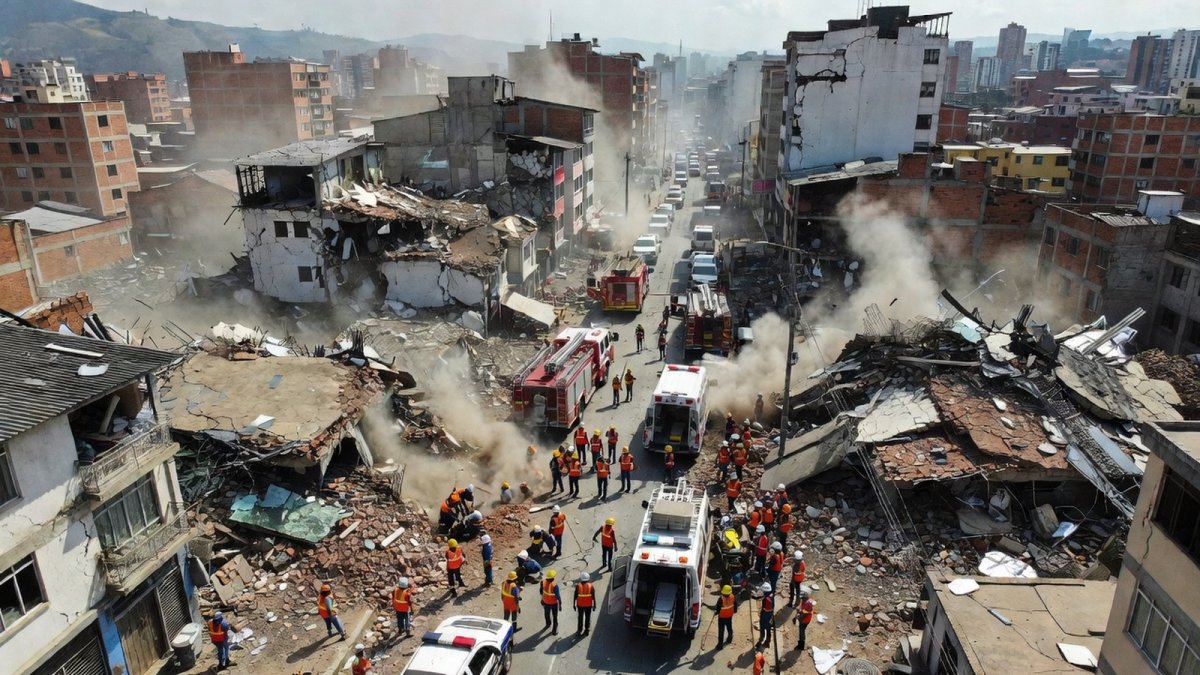
Western Colombia is reeling after the most powerful earthquake to strike the country this century tore through the Andes and Pacific lowlands on Monday morning. The magnitude-7.4 tremor hit at 07:34 local time, with its epicentre near the village of San José del Palmar in the rugged, jungle-clad province of Chocó. Seismometers closest to the rupture registered shaking that lasted between 90 seconds and two minutes — an eternity for those caught inside collapsing structures from the coffee belt to the Caribbean coast.
The human cost is staggering. Colombian President Abelardo de la Espriella confirmed at least 265 people dead, with 496 others still missing as of Tuesday evening. The city of Cali, Colombia's third most populous urban centre, recorded the highest death toll at 95, according to the Association of Colombian Capital Cities (Asocapitales). Pereira, a city of 500,000 in the heart of the country's coffee-growing region, reported 79 dead and at least 92 buildings collapsed. In Cali, more than 200 people remained trapped beneath rubble as of 16:00 local time on Tuesday, prompting Mayor Alejandro Eder to declare a night-time curfew and deploy soldiers to patrol the worst-hit neighbourhoods.
The scale of destruction has overwhelmed local emergency services. In Pereira alone, officials confirmed 15 people known to be trapped and 37 missing. Rescue teams from Bogotá have been dispatched to supplement local firefighters, but the sheer breadth of the disaster zone — spanning multiple departments across western Colombia — has stretched resources thin. The quake was felt across a vast area, from the Pacific port of Buenaventura to the highland capital, a reminder that seismic events in this region do not respect municipal boundaries.
A Rescue That Gave a Nation Hope
Amid the devastation, one story has pierced through the grief and given Colombians a reason to hold their breath. Daniela Largo, a 32-year-old woman, was pulled alive from the wreckage of a collapsed building in Pereira on Tuesday evening — 36 hours after the earth first began to shake. Her rescue came after a gruelling 10-hour operation that involved local firefighters, colleagues deployed from Bogotá, and the national police disaster response team.
The operation was a feat of engineering and endurance. Rescuers dug two tunnels to reach Largo: one from above to supply oxygen to her confined space, and a second from below to free her from the grip of four collapsed concrete slabs. A local resident had first heard her cries for help, and emergency workers used a small camera to locate her position precisely before beginning the delicate excavation. The rescue teams worked in shifts, aware that every passing hour reduced her chances of survival.
President de la Espriella celebrated the rescue on social media as "news which fills us with hope" — a rare moment of optimism in a week defined by loss. Largo's mother, speaking to reporters outside the hospital where her daughter was being treated, delivered the line that has resonated across the nation: "At home, her 12-year-old son is waiting for her." The boy had been at school when the quake struck, and had spent the intervening hours in a state of suspended terror, unsure whether his mother was alive or dead. Her survival is a testament to the skill of the rescue teams, but also to the thin margin between life and death in earthquakes of this magnitude.
Trauma That Follows Survivors Across Borders
For some survivors, Monday's earthquake was not a singular catastrophe but the latest chapter in a recurring nightmare. Two Venezuelan teenage brothers, 15-year-old Deivi and his 17-year-old brother Winder, now living in Cali with their father, found themselves once again running from collapsing buildings — just months after surviving twin quakes that killed three members of their family in their homeland.
Back in late June, the brothers had been at the beach on Venezuela's Caribbean coastline. As they headed home on the evening of 24 June, earthquakes of magnitude 7.2 and 7.5 struck just 39 seconds apart. Their 12-storey apartment building in La Guaira — the area hardest hit by the Venezuelan quakes — collapsed, trapping their mother Yusmani, grandmother Carmen, and 10-year-old brother Moissés under a mountain of concrete. The Venezuelan government reported more than 6,300 dead from those quakes, though no clear official figure exists for the missing.
The brothers joined rescue efforts immediately, but for three days had nowhere to sleep and nothing to eat. Their father Deivid, who was working in Colombia at the time, searched for them for three days before they were reunited. Together, the family combed through the rubble for nearly a month. As teenagers, Deivi and Winder could squeeze through narrow spaces that adults could not reach, crawling between concrete slabs with only a torch or mobile phone light to guide them.
Winder was the first to recognise his mother's body; a plastic bag she had been using to dye her hair was still on her head. When rescuers removed her body, they found Moissés beneath her. "When his little head fell into my hands... I broke down," Deivid recalled. After burying their family, the brothers moved to a modest working-class neighbourhood on the north-eastern outskirts of Cali, hoping for a life of hard work and study so their mother would be proud.
On Monday, they were asleep when the tremor began. Deivi ran downstairs, grabbed a metal gate with his brother, and waited for the shaking to stop. Their father searched the streets until he found them outside the barbershop where he works. The sons told him: "Dad, stay calm. We've been through this before." Those words, spoken by teenagers who have buried their mother and brother, capture a resilience that no child should have to develop — and a regional reality that no government has adequately addressed.
Why Latin America's Cities Remain Vulnerable
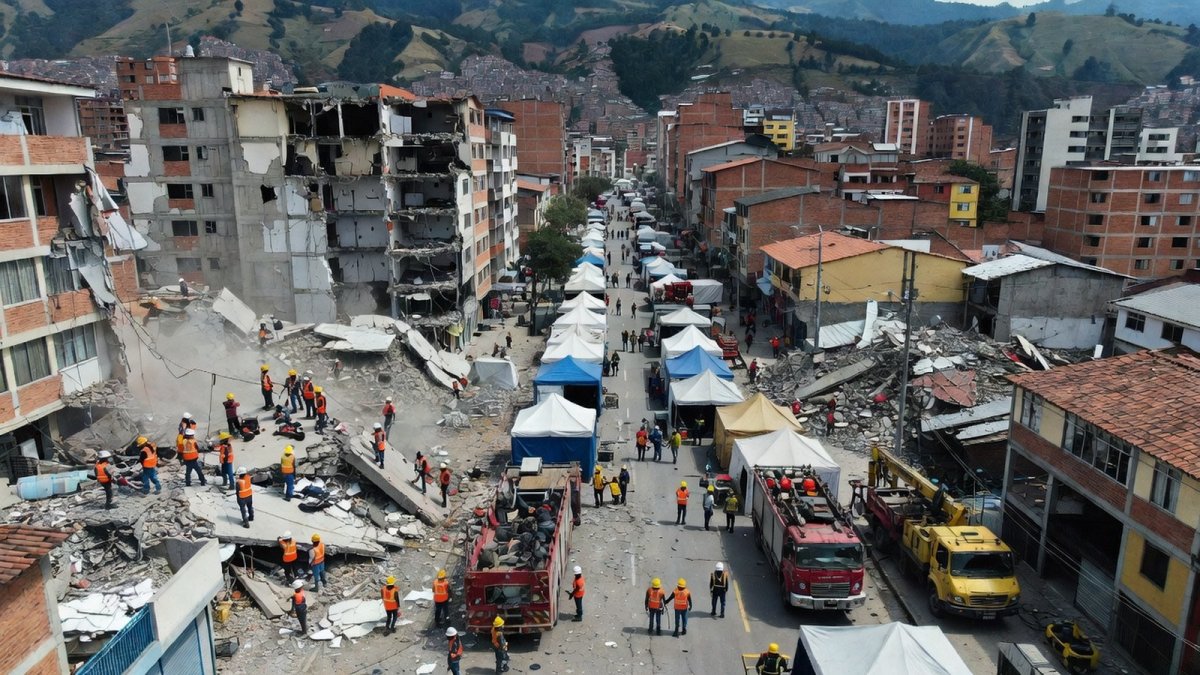
The devastation in Colombia is not an accident of geology alone. Latin America's cities are built in some of the most seismically active zones on Earth, from the Andes to the Caribbean, yet construction practices and enforcement of building codes remain dangerously inconsistent. In Pereira and Cali, as in much of the region, informal construction is widespread — homes and small businesses built without engineering oversight, using materials that crumble under stress. When a 7.4-magnitude quake strikes, the difference between a building that sways and one that collapses is often a matter of whether a structural engineer ever reviewed the plans.
Colombia has some of the region's more robust building codes, introduced after the 1999 Armenia earthquake that killed more than 1,000 people. But enforcement is uneven, particularly in poorer neighbourhoods and smaller towns where permits are bypassed and inspections are rare. The same pattern repeats across Latin America: Mexico City's 2017 earthquake exposed vulnerabilities in buildings constructed before modern codes; Peru and Chile face chronic seismic risk; and Venezuela's economic collapse has compounded the danger, as maintenance of existing structures has deteriorated and new construction proceeds with little oversight.
The Venezuelan quakes of 24 June were a stark warning that went unheeded. More than 6,300 people died in a country where infrastructure had been crumbling for years, where hospitals lacked supplies to treat the injured, and where the government's response was slow and inadequate. The brothers who survived La Guaira and now live in Cali are part of a broader migration pattern — millions of Venezuelans have fled to Colombia, Ecuador, Peru and Chile in recent years, carrying with them not just their belongings but their trauma. When disaster strikes in their new homes, they are often among the most vulnerable, lacking documentation, social networks, and savings to rebuild.
Brazil, too, has reason to pay attention. While the country is not on a major tectonic fault line, it faces its own disaster vulnerabilities — catastrophic flooding and landslides in cities like Petrópolis and Recife have killed hundreds in recent years, exposing similar weaknesses in urban planning and emergency preparedness. The lesson from Colombia is universal: resilience is not a luxury but a necessity, and it requires investment in building codes, early warning systems, and community preparedness long before the ground begins to shake.
The Response and What Comes Next
The immediate response to Monday's quake has been a coordinated effort involving local firefighters, the national police disaster response team, and reinforcements deployed from Bogotá. In Pereira, the rescue of Daniela Largo demonstrated what these teams can achieve under extreme conditions. In Cali, soldiers are patrolling the worst-hit areas under a night-time curfew, while rescue workers continue to dig through collapsed buildings in search of the more than 200 people still trapped. The confirmed death toll of 265 is expected to rise as rescue operations continue and the 496 missing are accounted for.
President de la Espriella has promised a full investigation into building failures and a review of construction practices across the affected region. But the recovery ahead is immense. Entire neighbourhoods in Pereira and Cali have been reduced to rubble; families are sleeping in parks and public squares; hospitals are overwhelmed with the injured. The economic cost will run into billions of dollars, and the psychological toll will last for years.
Regional cooperation will be essential. Colombia has received offers of assistance from neighbouring countries, including Brazil, Mexico and Chile — nations that have their own experience with seismic disasters and can offer technical expertise in search-and-rescue and structural assessment. The Venezuelan brothers' story is a reminder that disasters do not respect borders, and neither should the response. A stronger regional framework for disaster preparedness — shared early warning systems, mutual aid agreements, and common building standards — would save lives across Latin America.
For now, the focus remains on the search for survivors. Every hour that passes reduces the chances of finding more people alive, but the rescue of Daniela Largo after 36 hours has given rescuers and families alike a reason to keep hoping. In Cali, in Pereira, in the small villages of Chocó, the work continues — a testament to the resilience of a region that has learned, too often, that the ground beneath our feet is not as solid as we like to believe.
This article was produced with AI-assisted research and editorial support. Sources: BBC News.
By Elena Vasquez, Staff Writer
What's Your Reaction?
 Like
0
Like
0
 Dislike
0
Dislike
0
 Love
0
Love
0
 Funny
0
Funny
0
 Wow
0
Wow
0
 Sad
0
Sad
0
 Angry
0
Angry
0

Latin America Correspondent at Global1.News. Based in Mexico City, covering politics, economics, energy, and culture across the region. Brings an on-the-ground perspective to stories spanning from the Rio Grande to Patagonia.









Comments (0)