
China's Teenage 'Pharmaceutical High': Prescription Drug Abuse Exposes Deeper Crisis
Xiaomei, a 14-year-old high-performing student from a coastal province, began her descent at a young age. Hoping to impress an older boy who claimed it would help her relax, she overdosed on a prescription-only cough suppressant she had purchased online.
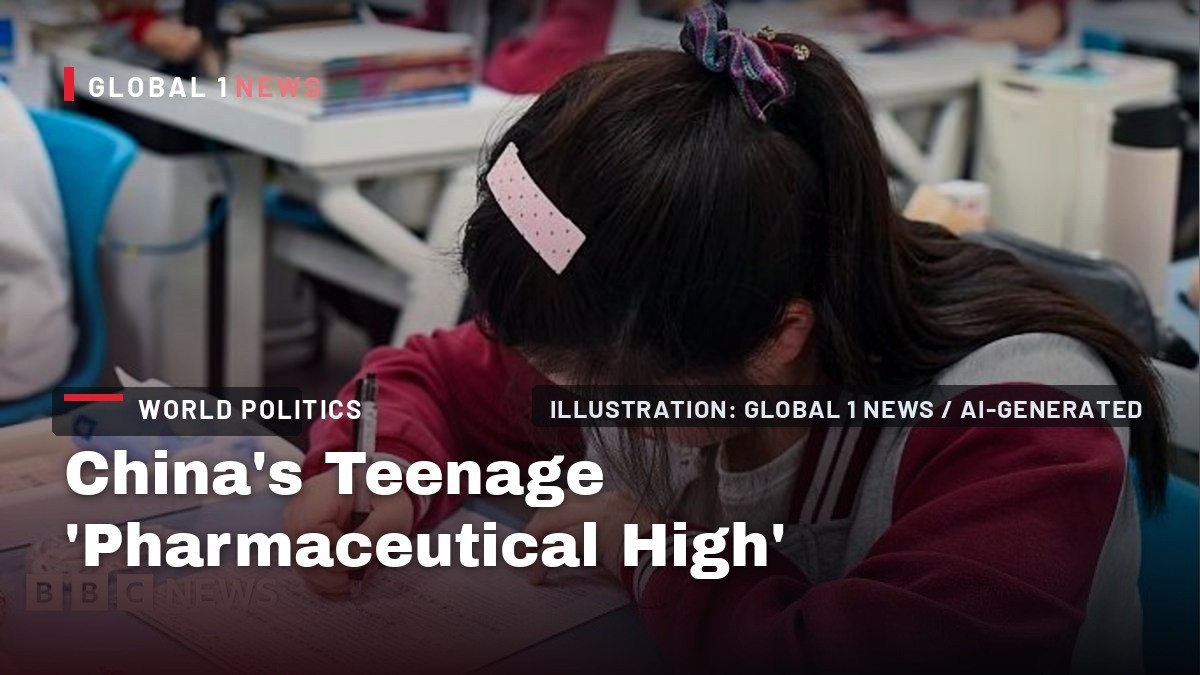
A Teenage Descent into Drug Abuse
Xiaomei, a 14-year-old high-performing student from a coastal province, began her descent at a young age. Hoping to impress an older boy who claimed it would help her relax, she overdosed on a prescription-only cough suppressant she had purchased online. What began as a dizzying experiment quickly became a two-year addiction. "When I felt too much pressure from my studies, or I didn't do well at exams, or even when I quarrelled with my parents, I would take these drugs," she told the BBC. "I was running away from reality."
Her story is not isolated. The BBC has heard similar accounts from dozens of teenagers in chat rooms across various social media platforms. Nearly all of them are escaping the same thing: pressure. They share tips on which drugs to use, how to fake prescriptions, and how to avoid detection. One girl sent a slurred voice note after taking a neuropathic pain drug, saying, "I feel my body doesn't belong to me. I'm so dizzy." Another boy offered to use his father's old prescription to forge a new one. The ease with which these substances are obtained and discussed paints a stark picture of a generation in distress.
The Cat-and-Mouse Game of Regulation
The scale of the problem is difficult to gauge due to a lack of official figures, but it has been serious enough to trigger a government response. Two years ago, authorities launched a nationwide crackdown on the cough suppressant Xiaomei first used, reclassifying it as a psychotropic drug requiring a doctor's prescription. This made it harder to buy online. Then, in April 2026, authorities noticed a shift to another drug and imposed tighter controls on its prescription and dispensing.
Yet, the BBC was still offered the newer drug in an online chat room for as little as 10 Chinese yuan ($1.5) per gram. This "whack-a-mole" approach is proving ineffective. A 2025 paper written for the Crime Prevention Institute at the Ministry of Justice noted that when one drug is controlled, young people quickly find alternatives, often using coded names to avoid detection. The sheer volume of China's pharmaceutical industry, which produces the vast majority of the world's drug ingredients, makes cheap and easy access almost inevitable. Xiaomei noted that a simple ID number entry on shopping platforms was enough to have a box of medication delivered to her door, no questions asked.
The Crushing Weight of the 'Elite Class' System
At the heart of this crisis is the relentless academic pressure placed on Chinese students. Xiaomei, a student in an elite chemistry class, says discussions about overdosing were common among her peers, who sought to avoid feeling like "complete losers." The system is unforgiving. "In our school, the elite classes operate on an elimination system; if your academic scores drop, you get kicked out of the class. When you fail, you feel like failures, believing you have no chance in life," she explained.
This environment is a direct product of the education system's role in national strategy, where academic success is seen as the primary pathway to social mobility and a contribution to the country's human capital. The high-stakes nature of exams like the gaokao (college entrance exam) and the high school entrance exam creates a pressure cooker atmosphere. Students spend nine or ten hours a day in school, leaving little room for social development or a broader perspective on life, a factor that renowned sociologist Xiang Biao, director of the Max Planck Institute for Social Anthropology, identifies as a key differentiator for Chinese teens.
The One-Child Policy Legacy and Parental Expectations
This academic pressure is amplified by the legacy of the one-child policy, which ended in 2016. With many families having only one child, that child shoulders the entirety of their parents' hopes and dreams for the future. "Parents see their child as their only hope for the future," says Xiang Biao. This dynamic creates an isolating environment where a child's failure is perceived not as a setback, but as a catastrophic family tragedy.
The pressure is further compounded by a lack of emotional support at home. "Many children receive lots of attention but the type of attention they want is to be asked how they feel. Do they feel lonely or stressed? Often in China parents brush that away and say you just have to be stronger," Biao observes. This emotional disconnect leaves teenagers feeling isolated and without a safety net, making the temporary numbness offered by drugs an appealing, albeit dangerous, solution.
A Mental Health Crisis Masked by Drug War Statistics
On paper, China appears to be winning its war on illegal drugs. Official data for 2025 shows a dramatic 41% fall in newly identified drug users under 35. However, the National Narcotics Control Commission has been forced to acknowledge that the misuse of prescription drugs is a widespread and growing problem, particularly surging among minors. The official statistics on illegal drugs mask a more complex and troubling reality of a mental health crisis.
The numbers are stark. A 2023 study for China's Mental Health Blue Book found that nearly 95 million people suffer from depression, with more than 30% being under 18 years old. This suggests a systemic issue that cannot be solved by simply tightening controls on pharmaceuticals. Experts argue that the government's focus on suppressing online sales is a reactive measure that fails to address the root cause: the immense psychological strain on the nation's youth.
Government Response: A System Under Strain
The Chinese government has recognised the need for mental health support. Plans are in place to build a nationwide system of psychological support and crisis intervention by 2030, including counselling rooms in every school and psychiatric services in at least one hospital in every county. According to the State Council, progress has been made, with 92% of primary schools and 95% of junior middle schools now having a counsellor. Major cities like Beijing have begun to incorporate mental health into the curriculum.
However, the system is severely under-resourced. A 2020 study published in The Lancet claimed there were only 500 qualified child psychiatrists in the entire country, with most concentrated in major cities like Beijing and Shanghai. This is a monumental challenge for a nation of 1.4 billion people, leaving vast swathes of the population, particularly in rural areas, without access to professional help. The gap between policy ambition and on-the-ground reality remains a critical vulnerability.
Economic Anxiety and a Shifting Social Contract
The crisis is also unfolding against a backdrop of economic uncertainty. The China that Xiaomei's parents grew up in was one where hard work was reliably rewarded. Today, even with a university degree, a bright future is not guaranteed. Following the pandemic, the economy has struggled to bounce back, with one in five young people thought to be struggling to find a job. This has led to a pervasive pessimism that extends from the youth to their parents.
"People have become more pessimistic in general," Biao admits. "I think parents feel confused and anxious because they see a problem in their children, but they don't see an alternative. If my child has a problem, it's the end of the world." This anxiety represents a fundamental shift in the social contract, where the promise of upward mobility through education is no longer a certainty, leaving both generations feeling trapped and uncertain about the future.
A Path Forward: Listening and Open Conversation
For Xiaomei, the turning point came after a serious overdose that required hospitalisation. Her parents, instead of scolding her, chose to listen. "They mostly expressed how heartbreaking it was for them to see me like that. They didn't scold or criticise me. Their approach was gentle," she says. This newfound support helped her perform well in the entrance exam she had dreaded. "Knowing that there was someone standing by my side made me feel really good," she adds.
Her story offers a glimmer of hope, but it is not the reality for everyone. Lu Jingchan, a 22-year-old who overdosed more than four times in four years, now spends his time on social media urging others not to start. "The drugs drove me to the brink of madness. You risk sinking into an abyss of addiction, destroying your health," he warns. The real battle, experts conclude, lies not in suppressing online sales, but in fostering open family conversations and building a robust mental health infrastructure. As Xiang Biao puts it, "There's a very loud alarm being sounded out across Chinese society. Adults have to examine how to be responsible for a teenager." The question remains whether the government and parents will heed this alarm before more of the nation's youth are lost to the abyss.
By Prof. Marcus Chen, Staff Writer
This article was produced with AI-assisted research and editorial support. Sources: BBC News.
What's Your Reaction?
 Like
0
Like
0
 Dislike
0
Dislike
0
 Love
0
Love
0
 Funny
0
Funny
0
 Wow
0
Wow
0
 Sad
0
Sad
0
 Angry
0
Angry
0
World Politics Analyst at Global1.News. Based in Beijing, covering US-China relations, global trade, and geopolitical strategy. Brings deep analytical perspective to the power dynamics shaping international affairs.














Comments (0)