
Butcher of Bosnia: Ratko Mladic Dies in Prison at 84, Leaving Unhealed Wounds
Ratko Mladic, the Bosnian-Serb general convicted of genocide for the Srebrenica massacre and Sarajevo siege, died August 27, 2026, in a UN prison in The Hague at age 84, closing a landmark chapter in international justice while leaving deep Balkan wounds unhealed.
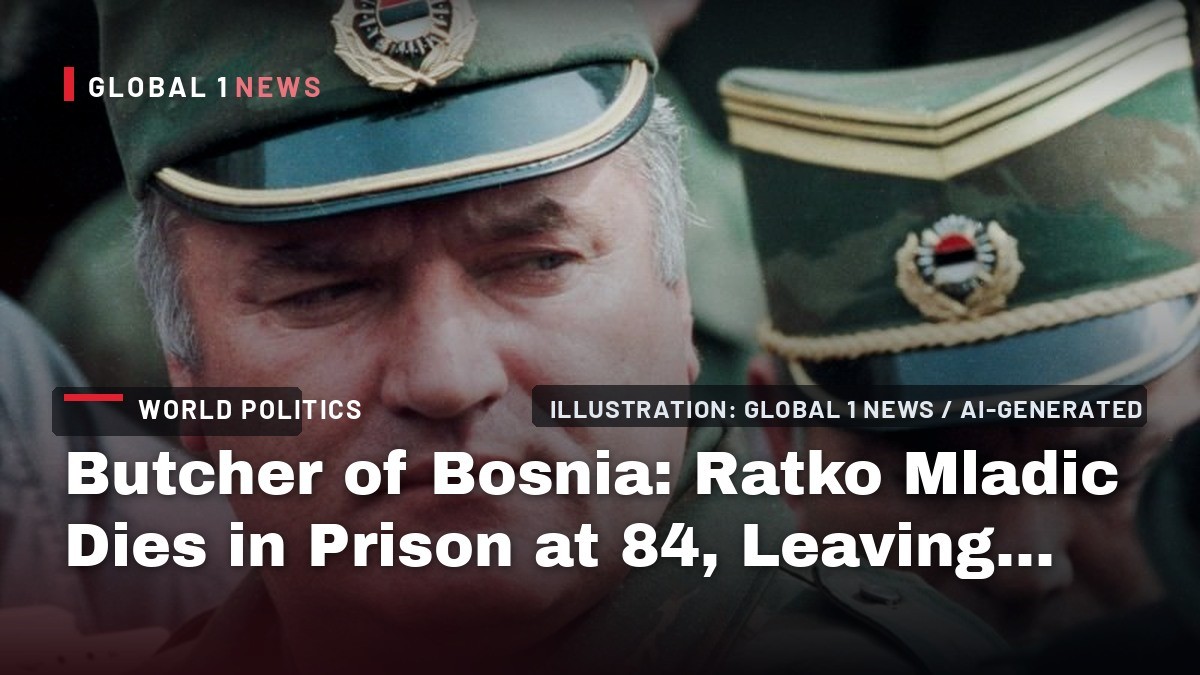
The man who orchestrated Europe's worst atrocity since World War II has answered for his crimes in the final court of last resort. Ratko Mladic, the Bosnian-Serb general known around the world as the "Butcher of Bosnia," died Thursday, August 27, 2026, at the UN detention unit in The Hague, Netherlands. He was 84 years old and serving a life sentence for genocide, crimes against humanity, and war crimes.
Serbian state media, including Radio Television of Serbia, first reported the death. The general, born March 12, 1942, had been held at the UN detention facility's prison hospital, where he had been receiving medical care for a series of chronic health conditions that plagued his final years. His death closes a chapter in international justice, but for the thousands of families who lost loved ones in the Bosnian War, the wounds remain as raw as they were three decades ago.
The Final Verdict: A Life Sentence Served to Its End
Mladic's death comes nearly nine years after his conviction was finalized. In November 2017, the UN International Criminal Tribunal for the former Yugoslavia (ICTY) in The Hague found him guilty on multiple counts, sentencing him to life imprisonment. Presiding judge Alphons Orie delivered a damning assessment at the time, stating that Mladic's crimes ranked "among the most heinous known to humankind."The conviction was not the end of the legal road. Mladic's defense team filed an appeal, but on June 8, 2021, the Appeals Chamber of the UN International Residual Mechanism for Criminal Tribunals (IRMCT) rejected the appeal and upheld the life sentence. The IRMCT, which took over the ICTY's remaining functions, confirmed that the evidence against the general was overwhelming and that his role in the atrocities was beyond reasonable doubt.The original indictment against Mladic was staggering in its scope. He faced 11 counts in total: two counts of genocide, five counts of crimes against humanity, and four counts of violations of the laws or customs of war. The charges spanned the entirety of the Bosnian War from 1992 to 1995, covering everything from the siege of Sarajevo to the systematic ethnic cleansing campaigns that defined the conflict.The Srebrenica Massacre: A Crime That Shook the World
At the heart of Mladic's conviction lies the Srebrenica massacre of July 1995. In what the ICTY and the International Court of Justice have both formally recognized as genocide, Mladic's forces systematically killed more than 8,000 Bosniak men and boys in and around the town of Srebrenica. The victims were separated from their families, marched to execution sites, and murdered in cold blood before being buried in mass graves.The massacre unfolded despite Srebrenica having been declared a UN "safe area" under the protection of Dutch peacekeepers. The international community's failure to protect the enclave remains one of the most painful and controversial episodes in modern diplomatic history. Mladic, who was seen on video accepting sweets from children in Srebrenica days before the killings began, became the face of that betrayal.Today, the Srebrenica-Potocari Memorial Center stands as a solemn reminder of what happened. The remains of victims are still being identified through DNA analysis and reburied each year at the memorial's annual commemoration ceremonies. The work of identification continues even as the perpetrator of the crime has now passed away, a testament to the enduring commitment to justice for the dead.The Siege of Sarajevo: 44 Months of Terror
Srebrenica was not Mladic's only crime. As Commander of the Bosnian Serb Army (VRS) Main Staff from May 12, 1992, he oversaw the siege of Sarajevo, which remains the longest siege of a capital city in modern warfare. Bosnian Serb forces surrounded the city for almost 44 months, from April 1992 to February 1996, shelling it relentlessly from the surrounding hills and deploying snipers to target civilians going about their daily lives.More than 10,000 people were killed in Sarajevo during the siege, including thousands of civilians who were simply trying to fetch water, buy bread, or walk to work. The city's residents lived in a state of constant terror, with no safe haven from the mortars and bullets that rained down from the heights above. The siege became a symbol of the brutality of ethnic cleansing and the international community's paralysis in the face of it.Mladic's forces also carried out widespread ethnic cleansing campaigns across Bosnia, forcibly expelling Bosniak and Croat populations from their homes in a systematic effort to create ethnically pure Serb territories. The scale of the displacement was staggering, with hundreds of thousands of people driven from their homes, many of whom never returned.Sixteen Years on the Run: The Longest Manhunt
After the war ended in 1995, Mladic evaded justice for almost 16 years. He disappeared from public view, reportedly moving between Serbia and the Bosnian Serb entity of Republika Srpska, protected by networks of loyalists who refused to cooperate with international authorities. His evasion became one of the longest manhunts in modern history, a constant source of tension between Serbia and the international community.The breakthrough came on May 26, 2011, when Serbian authorities captured Mladic in Lazarevo, a farming village north of Belgrade. The arrest was a major milestone for Serbia's European Union aspirations and a moment of profound relief for victims' families who had waited nearly two decades for justice. Mladic was found living under an assumed identity, looking aged and diminished from the confident general who had once strutted through the streets of occupied Bosnian towns.His trial at the ICTY opened in 2012, but it was anything but smooth. Mladic refused to enter pleas, forcing the court to enter not-guilty pleas on his behalf. He was frequently removed from the courtroom for outbursts and disruptive behavior, and his health problems caused repeated delays. Despite these disruptions, the prosecution built a comprehensive case that ultimately convinced the judges of his guilt on the most serious charges.A Contested Legacy: Hero or Butcher?
The death of Mladic will be received very differently depending on who you ask. For many Serb nationalists, Mladic was a hero who defended Serb interests during a brutal civil war. His father was killed in World War II, and Mladic rose through the ranks of the Yugoslav People's Army before taking command of Bosnian Serb forces in 1992. To his supporters, he was a patriot who fought to keep Serbs safe in a region where they had historically been persecuted.For victims' families and the international community, however, Mladic was the embodiment of ethnic cleansing. His name became synonymous with the worst excesses of the Bosnian War, and his conviction was seen as a validation of the suffering endured by the Bosniak and Croat communities. The fact that he died in prison, rather than in freedom, is a small measure of justice for those who lost everything.The division in perceptions of Mladic reflects the deeper divisions that still plague the Balkans. The Bosnian War ended more than 30 years ago, but the ethnic tensions that fueled it remain close to the surface. In Republika Srpska, Mladic is still honored by some as a national hero, while in Sarajevo and Srebrenica, his name is spoken with the same hatred reserved for the worst war criminals in history.International Justice: A System That Worked
Mladic's death also prompts reflection on the system of international justice that brought him to account. The ICTY, established by the UN Security Council in 1993, was the first international war crimes tribunal since Nuremberg and Tokyo. It set a precedent for holding individuals accountable for atrocities, regardless of their official position or political connections.The tribunal's work was not without controversy. Critics pointed to its slow pace, its high costs, and its perceived bias against Serbs. But its legacy is undeniable: it established that genocide, crimes against humanity, and war crimes would not go unpunished, and it created a body of jurisprudence that continues to influence international law today. The IRMCT, which succeeded the ICTY, has continued this work, handling residual functions and appeals.Mladic's conviction and his death in custody send a clear message: even the most powerful perpetrators of atrocity crimes will eventually face justice. The fact that he died in a UN detention facility, rather than in comfortable exile, is a testament to the persistence of prosecutors, investigators, and the families who never gave up demanding accountability.What Happens Now: The Unfinished Work of Reconciliation
With Mladic's death, the legal chapter is closed, but the human chapter remains open. The Srebrenica-Potocari Memorial Center continues its work of identifying remains and providing a place for families to mourn. Each year, newly identified victims are buried at the memorial, a painful reminder that the work of the war is not yet complete.The broader project of reconciliation in the Balkans remains fragile. Political leaders in the region continue to exploit ethnic divisions for electoral gain, and the educational systems in Bosnia, Serbia, and Croatia often teach very different versions of the war's history. The death of Mladic will not resolve these tensions, but it does remove one of the most potent symbols of the nationalist narrative.For the families of the victims, Mladic's death brings a complex mix of emotions. Some will feel a sense of closure, knowing that the man responsible for their suffering died in prison. Others will feel that his death cheats them of the chance to see him continue to suffer for his crimes. And still others will simply feel the weight of grief renewed, as the passing of the perpetrator brings the memories of the victims back to the surface.The Verdict of History
Ratko Mladic's place in history is secure, but it is not the place he would have chosen. He will be remembered not as a military commander or a patriot, but as the architect of genocide, the man who oversaw the killing of more than 8,000 men and boys in Srebrenica and the siege that killed more than 10,000 people in Sarajevo. The international courts have spoken, and their verdict is final.His death at 84, in a prison hospital in The Hague, is a fitting end for a man who spent his final years stripped of the power and prestige he once enjoyed. The "Butcher of Bosnia" is gone, but the memory of his victims lives on. The task of ensuring that such atrocities never happen again falls to the living, and it is a task that remains as urgent today as it was in 1995.This article was produced with AI-assisted research and editorial support. Sources: CNN, The Guardian, AP, Reuters, NPR, Politico Europe, Al Jazeera, DW, the UN International Residual Mechanism for Criminal Tribunals (IRMCT), and Balkan Insight.By Jessica Ali, Staff WriterWhat's Your Reaction?
 Like
0
Like
0
 Dislike
0
Dislike
0
 Love
0
Love
0
 Funny
0
Funny
0
 Wow
0
Wow
0
 Sad
0
Sad
0
 Angry
0
Angry
0

Editor-in-Chief at Global1.News. Atlanta-based journalist who cuts through the BS and tells it like it is. Lead anchor, host, and the voice you hear when the spin stops and the truth starts.














Comments (0)