
BRICS Adopts New Delhi Declaration After Iran-UAE Compromise
BRICS leaders unanimously adopted the New Delhi Declaration 2026 on Saturday, 12 September 2026, after a last-minute compromise between Iran and the United Arab Emirates allowed the 11-member bloc to speak with one voice on the war in the Middle East. Indian Prime Minister Narendra Modi announced the outcome at the end of the opening day of the 18th BRICS Summit at Bharat Mandapam in New Delhi, telling the room: "No member has raised any objection.
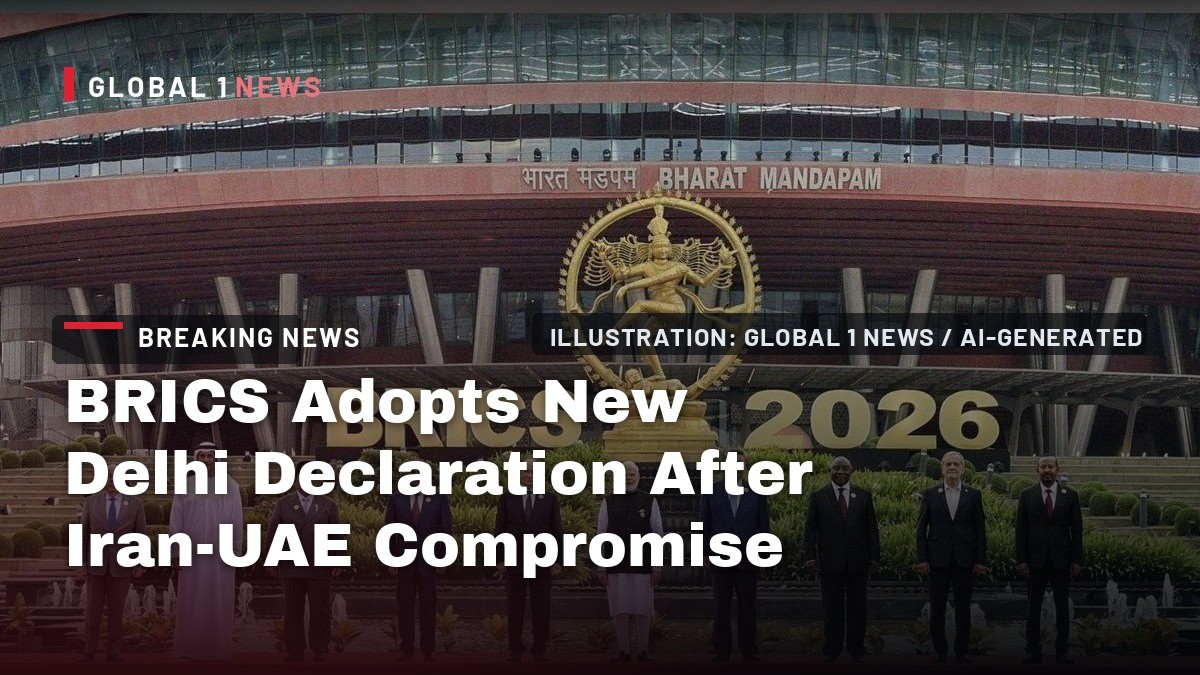
BRICS leaders unanimously adopted the New Delhi Declaration 2026 on Saturday, 12 September 2026, after a last-minute compromise between Iran and the United Arab Emirates allowed the 11-member bloc to speak with one voice on the war in the Middle East. Indian Prime Minister Narendra Modi announced the outcome at the end of the opening day of the 18th BRICS Summit at Bharat Mandapam in New Delhi, telling the room: "No member has raised any objection. The New Delhi Declaration 2026 is adopted unanimously."
The declaration expresses what it calls "deep concern over the continued escalation of tensions in Middle East/West Asia" and calls for "exercising maximum restraint, as well as avoiding actions that could further aggravate the situation." It does not name the United States or Israel, and it does not name Iran's strikes on its Persian Gulf neighbours either — an omission that made the consensus possible, according to officials quoted by The Hindu.
BRICS ADOPTS NEW DELHI DECLARATION AFTER IRAN-UAE COMPROMISE
New Delhi, India — The text was agreed after negotiations that ran until 4 a.m. Saturday, with Iran and the UAE both hardening their positions before Indian negotiators steered a compromise, Republic World reported. BRICS operates on consensus, which means any single member can block a joint declaration outright — a fact that turned a routine diplomatic communiqué into the bloc's hardest test of the year.
The Compromise That Went Down to the Wire
BRICS is a consensus body. There is no majority vote, no weighted formula, no way to outvote a holdout. So when Iran and the UAE arrived in New Delhi on opposite sides of a war — Iran the target of United States and Israeli strikes, the UAE a Persian Gulf state absorbing Iranian retaliation — the joint declaration nearly died before it was written.
The Hindu reported that the paragraphs on the war in Iran required "delicate diplomacy" by Indian negotiators at "various levels," and were forged after overnight talks plus direct conversations between Modi and the leaders of Iran, Russia and the UAE. Reuters, citing a source with direct knowledge of the process, reported that India steered sustained consultations to reconcile competing positions, and that reaching consensus was "especially difficult" given the ongoing conflicts and rising tensions in the Gulf.
The result is a document that conveys the bloc's alarm without assigning blame. Politically, that is the point. A declaration that named Washington would have been vetoed by the UAE, whose crown prince attended as its representative. A declaration that ignored the war altogether would have been vetoed by Iran. What survived was language broad enough to carry both.
What the Declaration Actually Says About the War
Beyond the call for "maximum restraint," the declaration asks members to avoid "actions that could further aggravate the situation" and reaffirms that international disputes should be settled peacefully through dialogue, consultation and diplomacy. It also calls for the protection of civilians and expresses deep concern over attacks on civilian infrastructure and — notably — on nuclear facilities in West Asia.
That nuclear reference is a direct response to the missile strikes on Iranian nuclear sites during the United States and Israeli campaign against Iran, and it marks an escalation in the bloc's language. The declaration warns of the "growing risks" of nuclear danger and conflict, a phrasing earlier BRICS statements had avoided. Al Jazeera reported that the declaration also warned against deliberate attacks on civilian infrastructure and on nuclear facilities "in particular."
The declaration "reaffirmed" the security of navigation and the free flow of global trade, supply chains and energy in accordance with applicable international law — a line written while the region's shipping lanes are under active threat. The declaration also criticised the United States' blockade of Cuba and expressed concern over violence in Sudan, per The Hindu.
Gaza, Palestine and the Two-State Formula
Gaza was a central focus. The declaration calls for the maintenance of the ceasefire and "unhindered" humanitarian aid, backs a two-state solution and supports full United Nations membership for Palestine. It reaffirms that a just and lasting solution to the Israeli-Palestinian conflict depends on the fulfilment of the legitimate rights of the Palestinian people, "including the rights to self-determination and return," as quoted by PTI.
In his own address, Chinese President Xi Jinping urged the bloc to take on a peacemaking role in the Middle East conflict, saying the war "does not serve the common interests of the international community" and that China would work with other members in that role, according to state broadcaster CCTV.
Terrorism: Zero Tolerance and an Unnamed Target
The declaration condemns the 22 April 2025 Pahalgam attack in Jammu and Kashmir and calls for a policy of zero tolerance toward terrorist activity. It rejects "double standards" on terrorism and demands accountability for those involved.
No country is named, but the wording points in one direction. The significance is that China — Pakistan's closest ally and a BRICS member — signed a document referencing an attack India has attributed to Pakistan-based militants. Former Indian foreign secretary Kanwal Sibal told India Today: "It is a big deal; the Pakistanis must be watching."
The declaration also calls for faster adoption of the Comprehensive Convention on International Terrorism, a treaty India tabled at the United Nations in 1996, and states that terrorism should not be tied to any particular religion, nationality, civilisation or ethnic group. It commits members to curbing terrorist financing, safe havens and the cross-border movement of militants, per The Tribune.
The Tariff Fight Washington Did Not Attend
The United States was not in the room at Bharat Mandapam. It dominated the document anyway.
The declaration voices "serious concerns" over the rise of unilateral tariff and non-tariff measures that distort trade and are inconsistent with World Trade Organization rules. It warns that the proliferation of trade restrictions — including what it describes as indiscriminate tariff hikes and protectionism imposed in the name of environmental objectives — could further reduce global trade and create uncertainty for businesses and economies.
It goes further on sanctions. The bloc condemns "unilateral coercive measures, including secondary sanctions and non-UNSC-authorised sanctions," calling them contrary to international law and contrary to the principles and purposes of the UN Charter, and demands their elimination. The Tribune reported that BRICS said such measures disproportionately affect poor and vulnerable populations by undermining rights to development, health and food security.
The backdrop is a running confrontation. President Donald Trump has described BRICS as "anti-American" and threatened punitive tariffs on countries that align with it, and has previously warned of 100-percent tariffs if the grouping "plays games with the dollar," a report carried by UA.NEWS citing the South China Morning Post. Modi's framing in New Delhi was a direct answer: the bloc's approach, he said, "is not against anyone but instead seeks to take everyone along."
Money, Payments and the Currency Question
On finance, the declaration presses for reform at the International Monetary Fund and the World Bank, calling for merit-based, transparent leadership selection and warning that voluntary financial contributions should not buy governance weight. It seeks the entry into force of the 16th General Review quota increases without further delay and a meaningful quota realignment under the 17th Review, and says the World Bank's 2025 Shareholding Review should correct the historic underrepresentation of developing countries.
On trade, it backs restoring a fully functioning two-tier, binding WTO dispute settlement system with Appellate Body members appointed, and it supports the WTO accession bids of Ethiopia and Iran. It also acknowledged China's zero-tariff treatment for 53 African countries, WION reported.
On payments, the declaration points to continuing work by the BRICS Payment Task Force on the interoperability of cross-border payment channels and messaging systems, and on the use of local currencies for trade settlement and investment. It references a New Investment Platform, a Multilateral Guarantees initiative, a proposed Insurance Resilience Centre and a Risk Lab at GIFT City, plus CRA treaty amendments, tax and customs cooperation and the Jaipur Consensus on invoice discounting for small businesses.
Crucially, the bloc declined to endorse a single BRICS currency or a unified alternative to the dollar, noting that no single approach suits all members. The declaration emphasises that there is no universal model for local-currency settlement and that national priorities should be respected.
Modi's Pitch: From Rule-Taker to Rule-Shaper
Modi used India's chairship to argue that the bloc must convert its growing economic weight into institutional power. "The Global South is today in the front row when it comes to facing global crises, but in the back row when it comes to decision-making," he said, adding that artificial intelligence, cyberspace, outer space, biotechnology and critical technologies are "not only creating future opportunities but are also shaping the rules of the future."
"We must make efforts to transform the Global South from a rule-taker into a rule-shaper," he said, per Republic World. The prime minister called on members to jointly prepare ten proposals for global governance reform with the aim of building a BRICS Reform Roadmap by the next summit, and proposed a G20-style "troika" system so incoming and outgoing chairs maintain continuity, along with a seafarer distress network and a Global South mechanism for skills in new technologies. "Today's discussion makes it evident that the changing world cannot be steered by outdated institutions," he said.
The declaration formally backs comprehensive reform of the United Nations Security Council. It welcomes support from China and Russia for Brazil and India to play a "greater role" at the UN, including on the Security Council, and calls for IMF, World Bank and wider institutional reform to give developing countries more voting power and stronger representation in leadership roles. The Tribune reported the declaration also flags the absence of a woman at the head of the United Nations.
Xi's Peacemaker Play and China's Next Year in the Chair
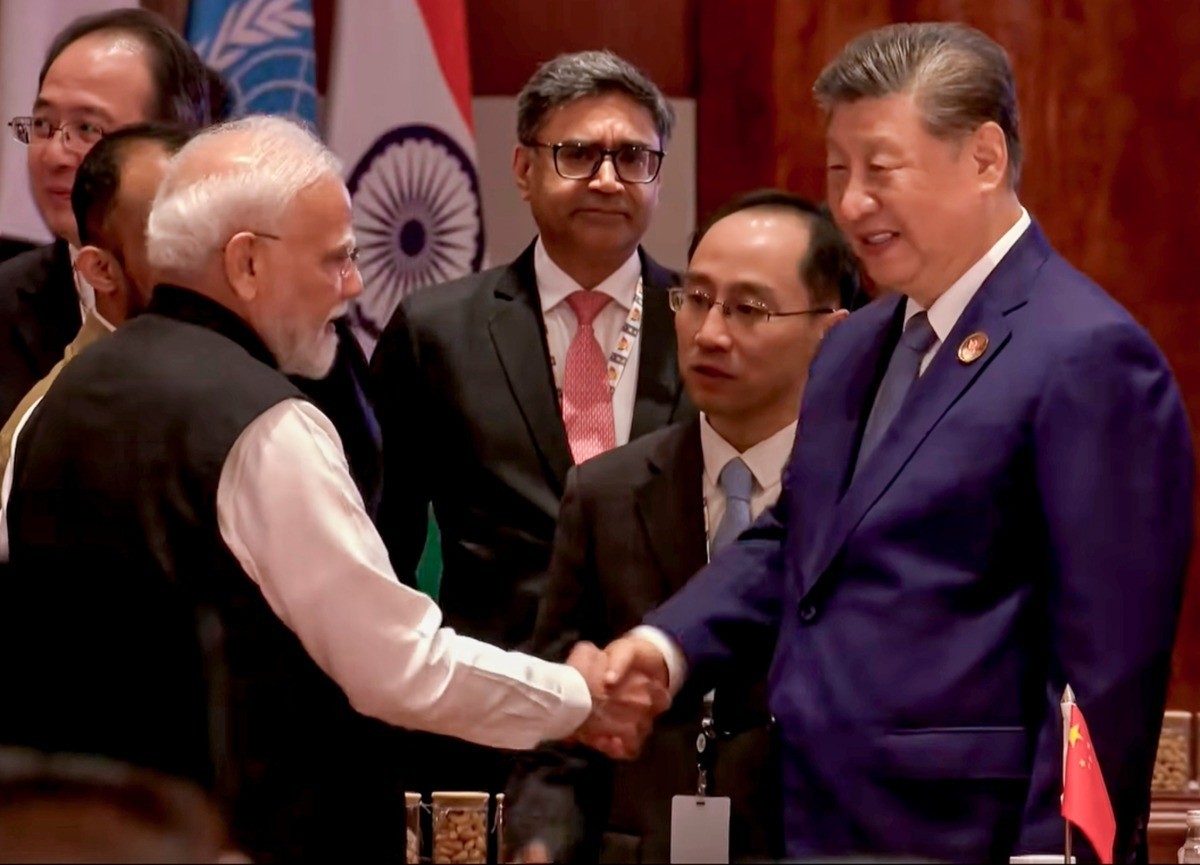
Xi's attendance was his first visit to India in seven years, arriving as the two Asian giants move to stabilise a relationship that had been frozen at the leadership level. He held an hour-long bilateral meeting with Modi after the session and announced that China will take over the BRICS presidency for the coming year, The Hindu reported.
Xi said China and India, the world's two most populous nations and leading voices of the Global South, carry significant weight in a global order marked by turbulence and change, and that the landscape calls for closer cooperation through an expanded BRICS framework to help shape "a fair, orderly multipolar world," per Investing.com.
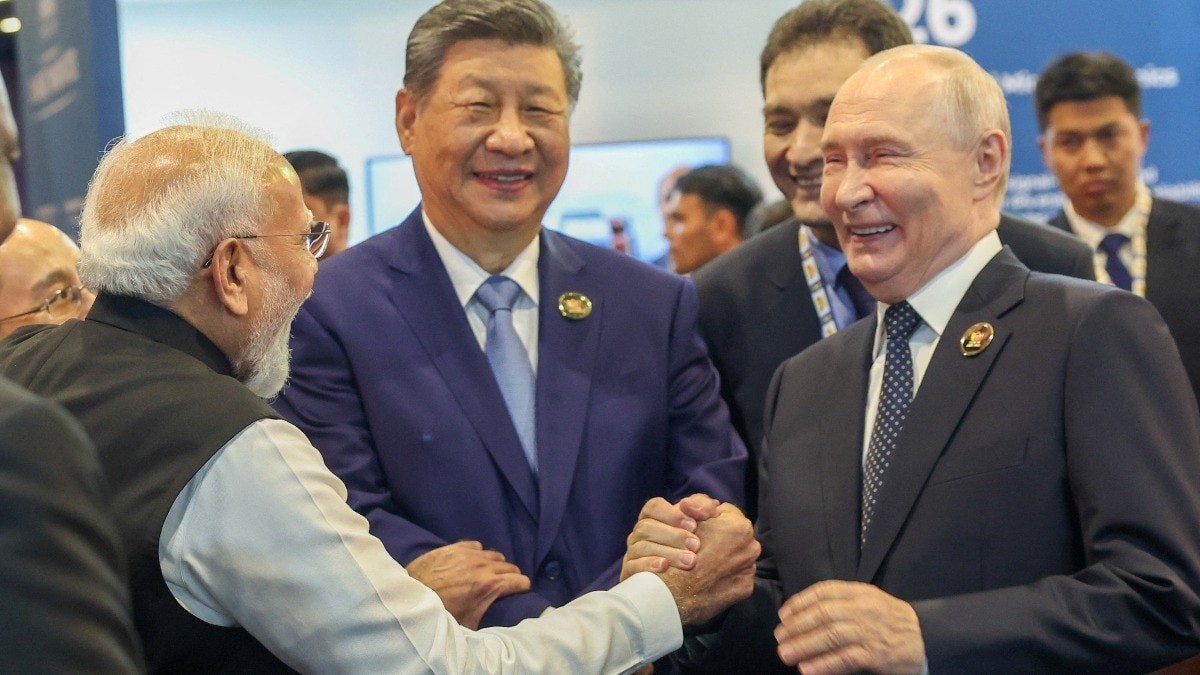
The meeting itself was attended by the leaders of eight member countries, including Putin, Xi, Iranian President Masoud Pezeshkian and the leaders of Indonesia, Ethiopia, Egypt and South Africa, The Hindu reported. Brazil sent Foreign Minister Mauro Vieira, and the UAE sent Abu Dhabi's Crown Prince Sheikh Khaled bin Mohamed bin Zayed Al Nahyan. Al Jazeera reported the UAE's representation, and Ministry of External Affairs handout photographs carried by Reuters identify the crown prince by name. United Nations Secretary-General Antonio Guterres and the heads of the World Health Organization and the World Trade Organization were also in India for the summit.
Why This Matters Now
The summit convened with wars in the Middle East and Ukraine disrupting energy and shipping. Washington and Tehran have resumed tit-for-tat strikes after a pause through much of August. Saudi Arabia shut its East-West oil pipeline as a precaution after attacks on its infrastructure, and the Houthis in Yemen have escalated attacks on Saudi cities while declaring a blockade of Saudi shipping in the Red Sea.
Days before the summit opened, Modi held talks with Putin — agreeing to deepen ties — and with Pezeshkian, raising freedom of navigation and the safety of ship crews, Al Jazeera reported. Xi's arrival came as China Southern prepared to restart its Guangzhou-New Delhi flights after six years, a small but concrete sign of a thaw that Global1 has covered separately.
Against that fragmentation, the declaration's value is partly procedural. WION reported that more than 30 countries are seeking to join the grouping, and the queue is only meaningful if the existing members can still agree on anything at all. On Saturday, on the single most divisive subject in the world, they did.
The Bottom Line
The New Delhi Declaration 2026 is not a peace plan. It has no enforcement mechanism, no timeline and no named party. What it does have is all 11 members on the record — including Iran and the UAE — behind a paragraph calling for restraint in a war those two are on opposite sides of.
The document also carries specifics that will be tested: an IMF quota realignment, a revived WTO appellate system, a payment infrastructure that runs on national currencies, a Security Council reform push that China and Russia have now publicly endorsed, and a terrorism section that China signed with Pakistan's interests in mind. Those are commitments, not sentiments, and every one of them has a fight attached.
Modi's closing line was the honest summary of the day. "The New Delhi Declaration adopted today provides a clear direction for our shared resolve," he said. "It is now our responsibility to translate these resolutions into tangible results." Two-decade-old blocs are judged by the second sentence.
By Jessica Ali, Staff Writer
This article was produced with AI-assisted research and editorial support. Sources: Al Jazeera, Reuters, The Hindu, The Tribune, Telegraph India, India Today, WION, Republic World, PTI, Investing.com, South China Morning Post.
What's Your Reaction?
 Like
0
Like
0
 Dislike
0
Dislike
0
 Love
0
Love
0
 Funny
0
Funny
0
 Wow
0
Wow
0
 Sad
0
Sad
0
 Angry
0
Angry
0

Editor-in-Chief at Global1.News. Atlanta-based journalist who cuts through the BS and tells it like it is. Lead anchor, host, and the voice you hear when the spin stops and the truth starts.











Comments (0)