
Somali Olympic boxer Ali weeps as world title dream realised
Ramla Ali, the 36‑year‑old Somali‑British boxer who fled a war‑torn childhood, has finally lifted the world title she has chased for more than a decade.
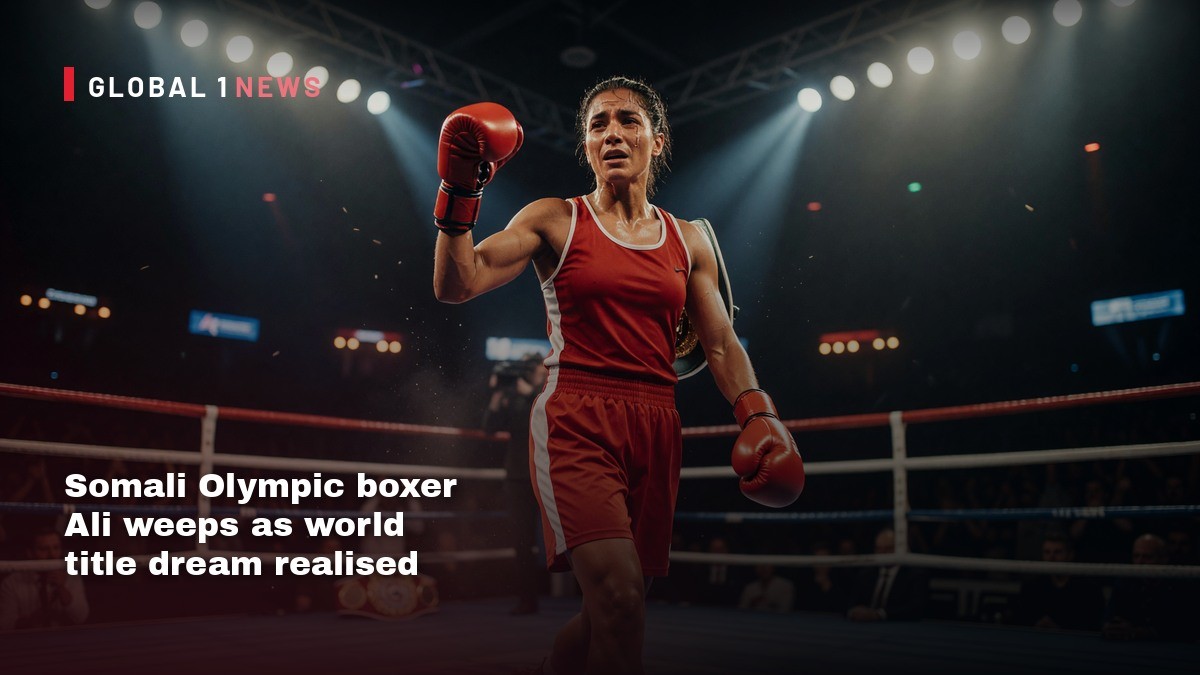
Ramla Ali, the 36‑year‑old Somali‑British boxer who fled a war‑torn childhood, has finally lifted the world title she has chased for more than a decade. In a split‑decision bout in Arlington, Texas, she out‑pointed American challenger Mikiah Kreps to claim both the WBO and IBF super‑bantamweight crowns. The victory, sealed by judges’ scores of 97‑92, 96‑93 and 98‑91, was as much a personal tribute as a sporting triumph, with Ali dedicating the win to her late father and to the hopes of a whole generation of Somali youth.
From refugee camp to the global stage
Ali’s story began in a refugee camp after her family escaped Somalia when she was an infant. Settling in London, she grew up navigating the challenges of displacement while discovering a passion for boxing. That passion carried her to the 2020 Tokyo Olympics, where she became the first Somali boxer to represent Great Britain, and later to the historic milestone of being the first Muslim woman to win an English amateur title.
Her journey has never been linear. After turning professional in late 2020, Ali set her sights on a world championship, only to suffer a knockout loss in 2023 that threatened to derail her ambitions. Yet the setback proved a catalyst, prompting her to double down on training and advocacy through her non‑profit, Sisters Club, which empowers young women across Africa.
The Arlington showdown
The fight against Kreps was a test of endurance as much as skill. The American entered the ring unbeaten, landing 115 punches to Ali’s 78 and out‑powering her with 91 power shots to 70. A decisive moment came in the third round when Ali’s left hook knocked Kreps to the canvas, prompting a 10‑8 round in Ali’s favour. Replays later confirmed the glove‑touch that counted as a knockdown, a detail that sparked a brief dispute from the stunned Kreps.
Despite the early advantage, Kreps rallied, applying relentless pressure in the later rounds. A judge’s wide 98‑91 card reflected that resurgence, but the other two judges kept Ali ahead, rewarding her consistency and the emotional fire that drove her forward.
Emotions in the corner
Ali’s emotional outburst after the decision—falling to her knees in tears—was rooted in a personal promise. “When we were in the changing room, my coach said, because my dad passed away in May, ‘Do this for him’,” she recalled. The memory of her father’s recent loss sharpened every round, turning fatigue into determination. “I remember going to the corner every round and saying ‘I’m so tired, I can’t do this’. All my coach responded was ‘think about your dad, do this for your dad’,” she said.
That personal narrative resonated beyond the ropes. “I can’t put into words what this means to me and what this means to all of Somalia,” Ali said, underscoring how her victory is a beacon for a nation still grappling with conflict and displacement.
Beyond the belt: a platform for change
Ali’s triumph arrives at a moment when African athletes are increasingly using sport as a platform for social advocacy. As a model on magazine covers and a vocal activist, she has faced scrutiny about whether a woman—particularly a Muslim woman—should continue in a physically demanding sport. Critics amplified after her 2023 knockout, questioning her resilience.
Yet Ali’s response has been to double down on her dual role as champion and changemaker. Through Sisters Club, she mentors girls across the continent, encouraging them to “dream big” as she did. Her recent biopic, released alongside the fight, offers a visual record of her journey, reinforcing the narrative that sport can be a conduit for empowerment.
Future fights and the road to unification
With two world titles now in her possession, Ali’s next challenge is a potential unification bout with Australian champion Skye Nicolson, who retained her WBC belt on the same undercard. Nicolson, also signed to Jake Paul’s Most Valuable Promotions, recently defeated Japan’s Miyo Yoshida, positioning her as a worthy adversary.
A unification clash would not only settle the super‑bantamweight hierarchy but also spotlight two women of African and Pacific heritage battling for global recognition—a narrative that aligns with the continent’s growing presence on the world sporting map.
The broader landscape of women’s boxing
The Arlington event also featured other marquee moments that signal a rising tide for women’s boxing. In the main event, Alycia Baumgardner secured a second world title, while Caroline Dubois, unbeaten in 15 fights, publicly challenged Baumgardner for a future showdown. Their exchange, captured ringside, highlighted a competitive spirit that is reshaping the sport’s hierarchy.
These rivalries, alongside Ali’s own story, illustrate a shifting paradigm where female fighters are not merely participants but headline attractions, drawing attention to the depth of talent emerging from diverse backgrounds.
What Ali’s victory means for Somalia and the diaspora
For Somalis at home and in the diaspora, Ali’s ascent is more than a sporting milestone; it is a symbol of resilience. In a country still wrestling with instability, her triumph offers a narrative of hope that transcends the ring. “I’ve hopefully inspired so many young girls and boys out there to dream big and that’s all I’ve ever wanted to do,” she affirmed.
As the world watches her next steps, Ali’s story reminds us that the fight for recognition often begins long before the first bell. Her journey—from a refugee child to a world champion—embodies the tenacity of countless Africans who navigate adversity with quiet strength. In celebrating her victory, we also celebrate the broader African spirit that refuses to be silenced, whether in the streets of Mogadishu or the gyms of London.
This article was produced with AI-assisted research and editorial support. Reporting is based on the source material cited below. Sources: BBC News Africa; bbc.co.uk; Global1.News (12 November 2026).
By Amara Diop, Staff Writer
What's Your Reaction?
 Like
0
 Dislike
0
 Love
0
 Funny
0
 Wow
0
 Sad
0
 Angry
0
West Africa/Sahel Correspondent at Global1.News. Dakar-based journalist covering politics, security, climate, and development across Francophone and Anglophone West Africa. Tells the stories of a region undergoing profound transformation.










Comments (0)