
Braskem's Debt Restructuring Sparks Maceio Victim Fears
Brazilian petrochemical giant Braskem filed for extrajudicial debt recovery in a São Paulo court on Monday, seeking to restructure roughly US$10.9 billion (about R$56 billion) in financial debt.
Brazilian petrochemical giant Braskem filed for extrajudicial debt recovery in a São Paulo court on Monday, seeking to restructure roughly US$10.9 billion (about R$56 billion) in financial debt. The move comes as the company faces mounting legal pressure and billions in compensation claims tied to the ground-sinking disaster in Maceió, the capital of Alagoas state, where salt mining operations have displaced tens of thousands of residents. Victims of the disaster, who have waited years for full reparation, now fear the restructuring will push accountability for the environmental catastrophe into the background. Braskem insists the measure is "strictly financial" and does not affect its commitments in Maceió.
Braskem's Debt Restructuring Sparks Maceió Victim Fears
Maceio, Brazil - The filing, submitted with the support of creditors representing 39.6% of the credits subject to restructuring, covers Braskem and five of its group companies abroad. It deals exclusively with financial debts, leaving operational obligations to suppliers, customers, and service providers untouched. From Monday, Braskem enters a 90-day protection period during which covered creditors cannot judicially collect debts or take certain measures against company assets. The company must present an updated business plan and detailed commercial proposal by Aug. 31, with negotiations on main commercial terms running until Oct. 9.
A Disaster Decades in the Making
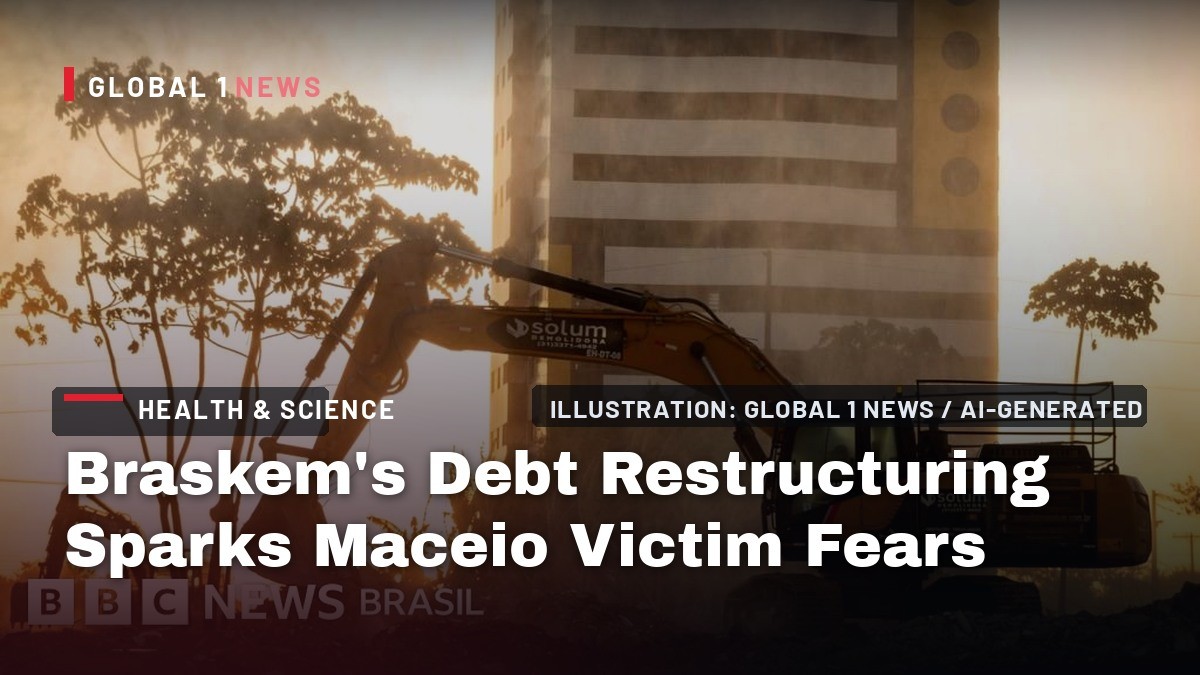
The ground-sinking disaster in Maceió stems from Braskem's rock-salt mining in the city, which began in 1976 and was halted in 2019. In May of that year, a report by the Geological Survey of Brazil (CPRM) identified the salt mining as the cause of the ground sinking. Five neighborhoods have been affected: Pinheiro, Farol, Mutange, Bebedouro, and Bom Parto. Since 2018, about 60,000 people have had to leave their homes. According to Civil Defense (Defesa Civil), more than 14,000 properties are in the affected area, of which 78% have already been demolished.
In December 2023, a Braskem mine in the Mutange neighborhood partially collapsed, forcing another wave of evacuations, including of residents who had stayed in affected areas despite earlier warnings. Recent data shows the speed of the ground sinking has slowed. The monitoring agency is considering reducing the monitored area but says it needs more studies to confirm the slower pace. For the families who lived through the trauma of watching their neighborhoods crack and sink, the physical scars are matched only by the psychological toll of uncertainty that has stretched on for years.
Victims Speak Out: 'Who Went Bankrupt Are the Residents'
Victims fear the extrajudicial recovery will push accountability for the Maceió disaster into the background. Jackson Douglas Ferreira de Souza, 45, a member of the Unified Movement of Braskem Victims (MUVB), put it bluntly: "Who went bankrupt are the residents of the affected neighborhoods, not Braskem." The MUVB said the recovery "cannot become an instrument to protect the company while thousands of families continue waiting for full reparation, fair indemnities and, in some communities, a definitive solution for their lives."
Ricardo Melro, a public defender (Defensoria Publica) who follows several victim cases, said the recovery brings uncertainties. "The concern is with the future, mainly with the company's capacity to withstand new convictions and then pay the victims' credits," he said. Melro, who says he has about 30 years of legal career, called "unusual" what has been seen in certain Braskem case proceedings. He said early closure of cases prevents analysis of new facts and technical studies. "In the Braskem case, new evidence and new studies emerged, including international ones, demonstrating errors of local methodology, proof of capture of technical bodies and new situations that need to be faced," Melro added.
Legal Fronts: Criminal Charges and R$17 Billion in Civil Claims
The legal landscape surrounding Braskem is complex and multi-layered. In June 2026, the Federal Court in Alagoas partially accepted a criminal complaint by the Federal Prosecution Service (Ministerio Publico Federal) against Braskem and 13 people linked to the salt mining. The company is accused of environmental crimes and of presenting false or misleading environmental studies and reports. Part of the accusations was considered time-barred (prescribed), but the case continues on the remaining charges.
On the civil side, there are 14 civil public actions led by the Defensoria Publica with economic claims for victims totaling about R$17 billion. This includes approximately R$5 billion in moral damages, R$4 billion for devaluation of properties around the affected areas, R$1.7 billion related to the Flexais community, and about R$2 billion in an action seeking to review the risk map to include other victims, plus other demands. The sheer scale of these claims underscores the magnitude of the disaster's impact on ordinary families who lost homes, livelihoods, and their sense of security.
What Braskem Has Paid So Far
Braskem says its Financial Compensation and Relocation Support Program had presented 19,205 indemnification proposals by the end of June, equivalent to 100% of requests received. Of those, 19,144 were accepted and 19,132 payments had been made. Eighteen proposals were refused. Counting indemnification payments and social rent, the company says it has paid R$4.25 billion since the program began in 2019. Braskem also reported 14,550 properties were identified as needing relocation. The area classified by Civil Defense as the highest concern level has been completely evacuated.
Existing commitments include a July 2023 agreement with the Maceió city government that established R$1.7 billion in global indemnification. In November 2025, Braskem signed a term with the Alagoas state government worth R$1.2 billion, paid in ten annual installments. These agreements were meant to provide a path forward, but for many victims, the payments have not been enough to rebuild lives shattered by the disaster.
The Flexais Community: Caught in the Margins
The Flexais community sits in the Bebedouro neighborhood but is not in the area directly affected by the sinking. Its residents stayed, but surrounding neighborhoods were emptied, so street movement and local commerce were hit hard. Through agreements with the Maceió city government, Braskem is doing structural works in the Flexais. Valdemir Alves dos Santos, 55, a local merchant, said the interventions did not restore life as it was before. "There wasn't an improvement that brought the joy we felt before all this. Braskem tries with palliatives and makeup to hide what it did with our lives," he said.
Santos says his business is bankrupt and sees the extrajudicial recovery as another way for the company to distance itself from the disaster's consequences. He joins mobilization for indemnities for indirectly affected residents. His story reflects a broader pattern across Latin America, where communities on the periphery of environmental disasters often fall through the cracks of compensation programs designed around technical risk maps rather than lived realities.
What Happens Next and What It Means for the Region
Braskem now enters a critical 90-day period. The company must present an updated business plan and detailed commercial proposal by Aug. 31, with negotiations on main commercial terms running until Oct. 9. The plan may convert part of the credits into company shares, making some creditors shareholders. This could fundamentally alter the company's ownership structure and governance, with implications for how it handles its environmental liabilities going forward.
Braskem told BBC the measure is "strictly financial" and does not include obligations assumed in Maceió. In a statement, it said the recovery "does not affect the payment of indemnities and commitments assumed in Maceió." But victims and their advocates remain skeptical, pointing to the company's track record and the complexity of its legal entanglements.
For Latin America, this case represents a watershed moment in corporate accountability. The Braskem disaster in Maceió is one of the largest urban environmental crises in the region's history, displacing more people than many armed conflicts. How this restructuring unfolds will send a powerful signal to corporations across the continent about whether environmental destruction carries real consequences or can be managed through financial engineering. The National Mining Agency (ANM) did not respond to BBC questions; Federal Justice and the Federal Prosecution Service in Alagoas said they would not comment at this time.
The coming weeks will be decisive. If Braskem's plan converts debt into equity, creditors become shareholders with a stake in the company's future, potentially creating new dynamics in how the Maceió obligations are prioritized. If the plan fails, the company could face a more traditional bankruptcy proceeding, which would likely delay compensation further. Either way, the 60,000 displaced residents of Maceió are watching closely, knowing that the fine print of a corporate restructuring in São Paulo will determine whether they ever see full justice for the ground that gave way beneath their feet.
This article was produced with AI-assisted research and editorial support. Sources: BBC News Brasil.
By Elena Vasquez, Staff Writer
What's Your Reaction?
 Like
0
Like
0
 Dislike
0
Dislike
0
 Love
0
Love
0
 Funny
0
Funny
0
 Wow
0
Wow
0
 Sad
0
Sad
0
 Angry
0
Angry
0

Latin America Correspondent at Global1.News. Based in Mexico City, covering politics, economics, energy, and culture across the region. Brings an on-the-ground perspective to stories spanning from the Rio Grande to Patagonia.













Comments (0)