
AI's Next Shortage Isn't Chips or Power — It's the Metal That Makes Light
Indium phosphide, the compound semiconductor that makes light move data in AI data centers, is now scarcer than DRAM and NAND. Lumentum's CEO warns the gap is critical, and the FCC's proposed Chinese transceiver ban could cut 60 percent of module supply.
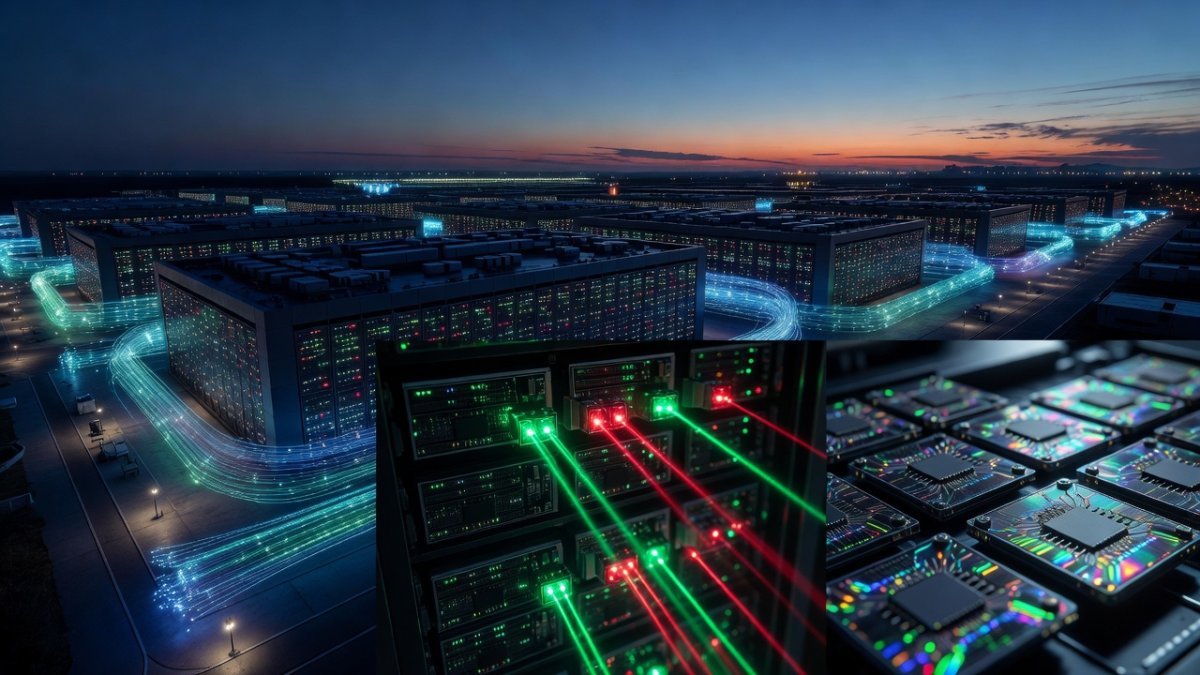
AI's Next Shortage Isn't Chips or Power — It's the Metal That Makes Light
Let me tell you something that's been sitting wrong with me since the news crossed my desk this week. Everyone's watching GPU lead times. Everyone's watching power grids, water cooling, gas plants. But the AI buildout just hit a bottleneck that's invisible to most people — because it's made of light.
I'm talking about indium phosphide. InP. A compound semiconductor most people have never heard of, sitting at the heart of every optical transceiver in every AI data center on Earth. And right now it's the tightest link in the whole chain. Tighter than DRAM. Tighter than NAND. Tighter than anything except maybe your patience with the next earnings call.
The Warning Nobody's Heard — a Gap Worse Than DRAM and NAND
Here's the headline number, and I want you to sit with it: Lumentum's CEO Michael Hurlston went on record this week saying the supply-demand gap for indium phosphide has now surpassed DRAM and NAND. Not "comparable to." Surpassed. The two most talked-about memory shortages of the last two years are both less constrained than this obscure compound right now.
And the scale shift behind it is unreal. Lumentum's orders used to number in the hundreds — telecom customers buying a few hundred lasers here and there. Now they're taking orders in the hundreds of millions of devices, driven by Nvidia and hyperscaler data center operators. Not thousands. Not tens of thousands. Hundreds of millions.
Downstream customers are placing orders further in advance and paying substantial deposits just to hold capacity. Inventory across the supply chain is tightening. Prices are going up. And nobody outside the optics world is talking about it, because the whole thing is buried under the GPU narrative.
Why the Light Layer Can't Be Replaced — the Science of InP
Here's the thing that makes this shortage different from every chip shortage you've read about: you can't engineer your way around it. Silicon — the material we built the entire digital world on — cannot generate light. It can guide it, modulate it, split it, detect it. But it cannot emit it.
InP can. It's the foundation of high-speed optical communications because it efficiently generates light at wavelengths that travel through fiber with minimal loss, and it has the electron mobility to switch at the speeds modern interconnects need. Both conventional pluggable transceivers and the emerging co-packaged optics architectures — where the optical engine gets embedded directly into the switch ASIC — depend on InP lasers as their light source. For long-haul coherent communications, InP remains the only commercially proven substrate for the high-performance EML chips that make it work.
So when the industry moves from 400G to 800G to 1.6T interconnects, you're not just needing more modules. You're needing more InP per module. The demand density is compounding. Every speed bump consumes more of the material per link, and the number of links per cluster explodes with every GPU scale-out.
The Secondary Bottleneck Nobody's Talking About — Indium Itself
Now here's where it gets properly uncomfortable. The raw material — indium — is mostly a by-product of zinc refining. That means you can't just open a new indium mine when demand spikes. You get whatever the zinc smelters give you, and that's that. Expanding output is a multi-year project, not a quarterly fix.
And who controls the stuff? China. Roughly 70 percent of global refined indium production sits inside China, and Beijing has been tightening export controls on InP and indium since 2025. You don't need me to tell you what happens to a supply chain when the dominant producer decides the material is strategic.
The manufacturing side isn't any faster. Producing large-diameter InP substrates requires sophisticated crystal-growth technology where yield improvements take years to achieve. Coherent says moving from 3-inch to 6-inch wafers quadruples the number of devices per wafer and can cut chip costs by more than 60 percent — but that transition is exactly the kind of thing that takes years and billions, and global production capacity is concentrated among a handful of suppliers. There's no TSMC equivalent for InP. No army of fabs ready to surge.
The Policy Bomb — Washington Just Put a Target on Chinese Transceivers
Now add the policy layer, because that's what broke this week. On Wednesday, Reuters reported the FCC is drafting a ban on U.S. imports of new Chinese optical transceiver models, with officials hoping to publish the measure before year-end.
Here's the scale problem. Chinese companies hold seven of the top ten global optical module positions. Zhongji Innolight and Eoptolink alone control more than 60 percent of 800G-and-up modules. Counterpoint Research says Chinese makers supply roughly two-thirds of global transceiver supply — and no Western alternative can absorb that volume within the next one to two years.
Counterpoint's Neil Shah put it bluntly: Coherent and Lumentum "currently lack the cleanroom capacity, automated packaging infrastructure, and yield scale required to absorb Innolight and Eoptolink's volume within a 12-to-24-month horizon." Read that again. The two companies Wall Street immediately bid up as the winners of a ban — Coherent jumped 11 percent, Applied Optoelectronics 18 percent, Lumentum 7 percent — don't have the capacity to actually replace what the ban would remove. The stock market priced in a win. The supply chain hasn't.
Meanwhile in Asia, Eoptolink tumbled 10 percent, Zhongji Innolight fell 8 percent, and the CSI300 telecom index dropped as much as 9 percent. The optics trade is now a geopolitical ping-pong ball.
The Irony the Politicians Missed — the Ban Depends on the Thing It Bans
And here's the part that should make every policymaker in Washington uncomfortable. The Chinese module makers the FCC wants to ban are themselves dependent on American components. They buy digital signal processors from Broadcom and Marvell. They buy laser components from Lumentum, Coherent, and Mitsubishi Electric. This isn't a clean separation where you can just cut one side loose — it's a genuinely integrated supply chain that spans the Pacific in both directions.
Coherent operates large manufacturing facilities in China and is planning expansion there. Chinese module makers are already shifting production to Thailand to hedge against exactly this kind of ban. The mutual dependence is so deep that cutting the knot isn't a policy move — it's surgery on the patient's own heart.
For hyperscalers — AWS, Microsoft, Meta, Google — the consequence of a rushed ban is exactly what Counterpoint warned: cost escalation and delayed AI cluster deployments, with expensive AI accelerators sitting underutilized because the optics to connect them aren't there. Hundreds of billions of dollars of capex, held hostage by a material most of the world has never heard of.
What This Actually Means for Independent Hosting Providers
Okay. You're not a hyperscaler. You're running a hosting business with real racks and real customers. Here's what the light layer means for you.
First, watch optics lead times, not just GPU lead times. The GPU shortage was the last shortage. The InP squeeze is the next one. If your network gear vendors start stretching delivery dates on 800G and 1.6T optics, that's your canary — plan around it now, not when the quote arrives.
Second, lock your switching and optics orders early. The 12-to-24-month window where the FCC ban collides with the InP shortage is the danger zone. If you're buying high-speed transceivers, get purchase orders in now. Prices are rising, and deposits are becoming the norm even for mid-size buyers.
Third, 400G is the safe harbor. The coherent long-haul side — Marvell, Acacia, Ciena, Nokia — is far less exposed than the 800G/1.6T pluggable market. If you're capacity planning for the next 18 months and don't absolutely need bleeding-edge speeds, the slightly older generation is where the supply certainty is.
Fourth, diversify your optics supply chain. Don't build your entire network strategy on a single module vendor, Chinese or Western. The geopolitical whiplash is going to keep hitting this market for years, and the operators who split their optics across vendors and architectures will be the ones who keep their SLAs.
Fifth, price your services for component inflation. Transceiver costs are going up. If your colo and connectivity pricing doesn't account for that, you're going to eat the margin. The hyperscalers are already paying deposits and escalating prices — you should be too, and your customers should see it in the invoice.
The Structural Reality — This Shortage Has Years Left to Run
Don't expect this to fix itself quickly. Nvidia has already committed $2 billion each to two key InP suppliers under long-term agreements — one has doubled its 6-inch wafer capacity and plans another expansion by the end of 2027, the other is upgrading its 6-inch line for mass production in 2028. A leading Japanese supplier has announced a multi-year expansion program. And even with all of that, the industry expects the supply imbalance to persist beyond 2027.
China, meanwhile, is building its own complete InP ecosystem — high-purity indium upstream, Yunnan Germanium as the country's only mass producer of 6-inch InP substrates, San'an Optoelectronics as a vertically integrated IDM, and ZJ Innolight qualifying domestic substrates for its modules. The country that controls the raw material is methodically building the entire stack to go with it.
So you have the material bottleneck, the manufacturing bottleneck, the policy bottleneck, and the geopolitical bottleneck — all converging on a market that's about to double its appetite for light every couple of years. That's not a shortage. That's a structural condition.
The Bottom Line
I've been running hosting infrastructure long enough to know that the bottlenecks that kill you are never the ones on the front page. The GPU shortage was obvious. The power crunch was obvious. The indium phosphide squeeze is not obvious — it's hiding inside every fiber run and every switch port you own, and it's about to get worse before it gets better.
The light layer is the new floor under the AI buildout. The companies that understand it — that lock orders, diversify vendors, and plan around the optics reality — are going to be the ones still standing when the next shortage cycle rolls around. And it will roll around. It always does.
Watch the optics. That's where the next signal is. Buh trust me on that one.
— Allan Ali, Founder
This article was produced with AI-assisted research and editorial support. Reporting is based on sources cited in the article.
What's Your Reaction?
 Like
1
Like
1
 Dislike
0
Dislike
0
 Love
0
Love
0
 Funny
0
Funny
0
 Wow
0
Wow
0
 Sad
0
Sad
0
 Angry
0
Angry
0

Publisher of Global1.News. Automation architect, systems builder, and the guy making sure the truth gets published.















Comments (0)