
Zhu Rongji, who helped turn China into a trading giant, dies at 97
Zhu Rongji, the former Chinese premier who engineered the country's entry into the World Trade Organization and reshaped its state-owned industrial sector, has died at the age of 97. His passing closes a chapter on a generation of leaders who bet China's future on global integration, a strategy that produced unprecedented growth but also sowed the seeds of the very frictions Beijing now navigates with Washington. Serving as premier from 1998 to 2003, Zhu was the arc
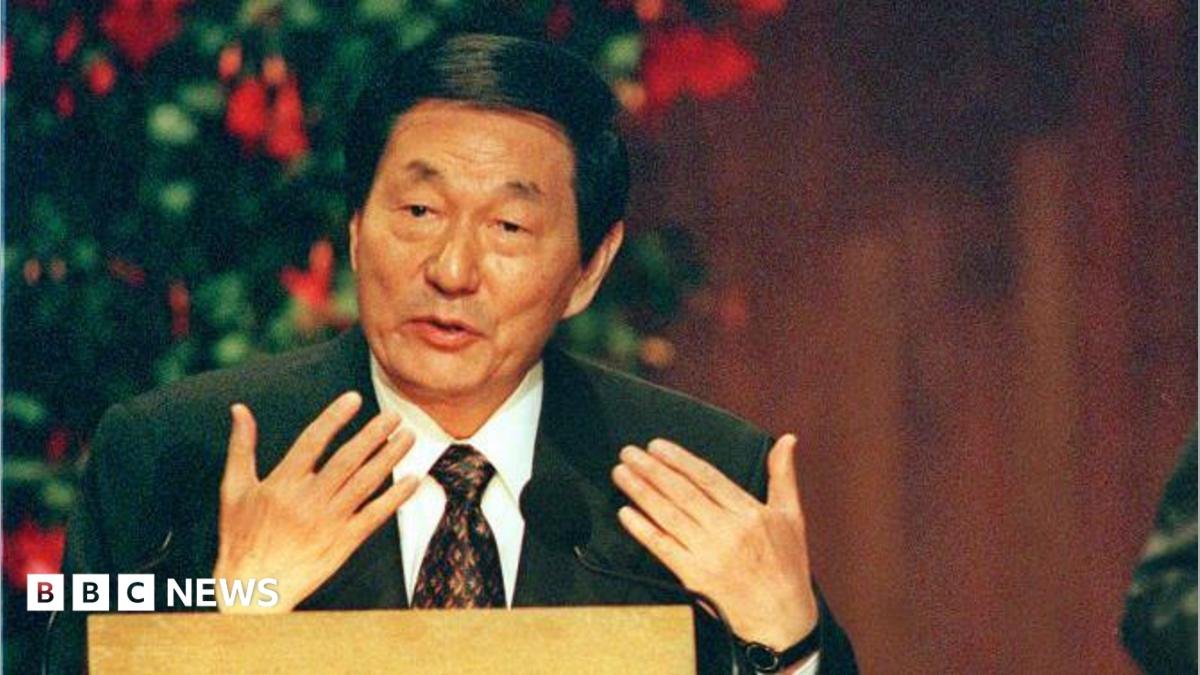
Zhu Rongji, the former Chinese premier who engineered the country's entry into the World Trade Organization and reshaped its state-owned industrial sector, has died at the age of 97. His passing closes a chapter on a generation of leaders who bet China's future on global integration, a strategy that produced unprecedented growth but also sowed the seeds of the very frictions Beijing now navigates with Washington.
Serving as premier from 1998 to 2003, Zhu was the architect of reforms that moved tax authority to the central government, shuttered or privatized failing state firms, and promoted private home ownership. State media have described his life as one of "revolution, struggle and brilliance," while his obituary in official outlets cast him as an "outstanding member of the Communist Party of China and loyal Communist fighter." The tributes, however, only partially capture the complexity of a man who was both a fierce anti-corruption crusader and a pragmatist willing to accept mass layoffs for long-term efficiency.
A Technocrat's Rise Through Turbulent Decades
Born in 1928 in the central province of Hunan, Zhu Rongji's early career was marked by resilience. He earned a degree in electrical engineering before joining the civil service, and he became a party member in 1949. His path was far from linear: he was purged twice, first for criticizing Mao Zedong's economic policies as "irrational" and being labeled a "rightist," and again during the Cultural Revolution. These experiences of political exile likely informed his later insistence on technical competence over ideological purity.
His rehabilitation came after Mao's death, and by 1991 he had risen to vice-premier in charge of China's economy. This trajectory—from purge victim to economic czar—illustrates the pragmatic turn of the post-Mao leadership, which prioritized stability and growth over revolutionary dogma. Zhu's engineering background gave him a problem-solving orientation that would define his tenure: he treated the economy as a machine to be calibrated, not a battlefield for class struggle.
The WTO Gamble: Opening China to the World
Zhu's most consequential achievement was leading China into the World Trade Organization in December 2001, after years of grueling negotiations. The accession was a strategic bet that exposure to international competition would force domestic industries to modernize. It was a high-risk play: Chinese factories would have to compete with global manufacturers, and state-owned enterprises would face unprecedented pressure.
The gamble paid off spectacularly in aggregate terms. WTO membership unlocked access to global markets, drew massive foreign direct investment, and accelerated China's transformation into a manufacturing powerhouse. By the mid-2000s, China had become the world's factory floor, with double-digit growth rates that lifted hundreds of millions out of poverty. The accession also served Beijing's broader strategic objective of embedding itself in the multilateral trading system, a move that enhanced its geopolitical standing without requiring military confrontation.
Domestic Restructuring: The Pain Behind the Growth
The reforms were not without severe social costs. Zhu's drive to close or privatize failing state firms led to an estimated 30 million lay-offs over five years. This was a deliberate, if painful, strategy to eliminate "zombie" enterprises that drained state resources. In his 1998 address, Zhu acknowledged the discontent, warning of "many potential crises that could erupt at any time" and citing corruption, the wealth gap, and local officials who "act like tyrants."
His blunt language was legendary. He labeled rogue bankers as "half-wits" and described the Yangtze River's flood dykes as "flimsy and porous as tofu dregs." This candor endeared him to ordinary citizens who saw him as a straight-talker in a system often characterized by opaque messaging. Yet the lay-offs created a reservoir of resentment that persists in rust-belt provinces, a factor contemporary leaders must still manage.
Fiscal Centralization and the Power Shift
A cornerstone of Zhu's legacy was the 1994 tax-sharing reform, which rebalanced fiscal power between the center and localities. Before this, local governments retained a disproportionate share of revenue, weakening Beijing's ability to direct national economic policy. Zhu's reforms redirected a larger share of tax revenues to the central government, enabling it to fund major infrastructure projects and social programs.
This centralization was not merely administrative; it was a strategic assertion of state capacity. It allowed Beijing to pursue national priorities—from highway construction to high-speed rail—without being hostage to provincial interests. The reform also laid the groundwork for the "national team" approach to strategic industries that characterizes today's industrial policy, from semiconductors to green energy.
Legacy in the Shadow of US-China Friction
Zhu's WTO strategy assumed that economic interdependence would foster mutual benefit and reduce geopolitical tensions. That assumption has been severely tested in recent years. The United States, under successive administrations, has moved to decouple critical supply chains, impose tariffs, and restrict technology transfers. The trade war that began in 2018 under President Donald Trump and has continued under President Joe Biden represents a direct challenge to the Zhu paradigm.
The irony is that Zhu's success in making China a trading giant created the very economic heft that Washington now views as a strategic threat. China's share of global manufacturing and its technological ascent have triggered a defensive response from the West. For Beijing, this has accelerated the shift toward "dual circulation"—a strategy that emphasizes domestic consumption and technological self-sufficiency while maintaining external engagement where possible.
Xi Jinping's Inheritance and Divergence
The current leadership under Xi Jinping inherits Zhu's economic foundation but has diverged in significant ways. Xi has placed greater emphasis on "common prosperity," a campaign to reduce inequality that echoes Zhu's own concerns about the wealth gap. However, Xi's approach has been more interventionist, with a heavier hand in regulating tech platforms, private education, and property developers—sectors that flourished in the post-WTO era.
Xi has also prioritized national security over pure economic efficiency, a calculus that Zhu, with his focus on market mechanisms, might have found uncomfortable. The shift from "reform and opening up" to "high-quality development" signals a move away from breakneck growth toward sustainability and self-reliance. While Zhu's reforms were about integrating China into the global system, Xi's policies increasingly seek to insulate China from external shocks, a response to the weaponization of trade and finance by the West.
A Contested Memory in a Changing China
Zhu Rongji's memory is likely to be contested as China navigates its current challenges. For reform-minded economists, he remains a model of technocratic pragmatism who used market forces to modernize the economy. For critics, his legacy is tainted by the social dislocation of mass lay-offs and the inequality that accompanied rapid growth.
The official narrative, as reflected in state media, emphasizes his loyalty and brilliance, framing him as a loyal fighter for the party. Yet his own words—his warnings about corruption and tyrant-like officials—remain relevant in a political environment where such candor is increasingly rare. His death invites reflection on whether today's leadership can recapture his willingness to speak uncomfortable truths while maintaining the discipline required for long-term governance.
Geopolitical Echoes for the Global South
Zhu's legacy extends beyond China's borders. His WTO accession served as a template for other developing nations seeking to integrate into global markets. Countries in Southeast Asia, Africa, and Latin America have studied China's playbook: use foreign investment to build export capacity, centralize fiscal authority, and gradually liberalize domestic markets.
However, the current global environment is less hospitable to such strategies. The rise of protectionism, supply-chain reshoring, and the securitization of trade have narrowed the space for latecomers. The Global South now faces a choice between aligning with China's model of state-led capitalism or with Western demands for labor and environmental standards. Zhu's example suggests that rapid growth is possible, but it comes with political and social costs that must be managed carefully.
Conclusion: The End of an Era
Zhu Rongji's death marks the end of an era defined by the belief that global integration was the surest path to national strength. His reforms transformed China from a peripheral communist state into a central pillar of the world economy. Yet the very success of that project has generated new challenges—geopolitical rivalry, domestic inequality, and questions about the sustainability of export-led growth.
As China mourns one of its most consequential economic leaders, the debates he embodied remain unresolved. Can China maintain its growth trajectory while reducing external dependencies? Can it balance efficiency with equity? Can it speak truth to power without destabilizing the system? These are the questions Zhu Rongji grappled with, and they will outlive him.
This article was produced with AI-assisted research and editorial support. Sources: BBC News.
By Prof. Marcus Chen, Staff Writer
What's Your Reaction?
 Like
0
Like
0
 Dislike
0
Dislike
0
 Love
0
Love
0
 Funny
0
Funny
0
 Wow
0
Wow
0
 Sad
0
Sad
0
 Angry
0
Angry
0
World Politics Analyst at Global1.News. Based in Beijing, covering US-China relations, global trade, and geopolitical strategy. Brings deep analytical perspective to the power dynamics shaping international affairs.














Comments (0)