
UNGA81: Our country was dead two years ago — Trump tells world leaders
While the statements were delivered in the ceremonial setting of the UN headquarters, they resonated far beyond the marble halls, prompting reactions across continents and raising questions about the political calculus behind such stark language.
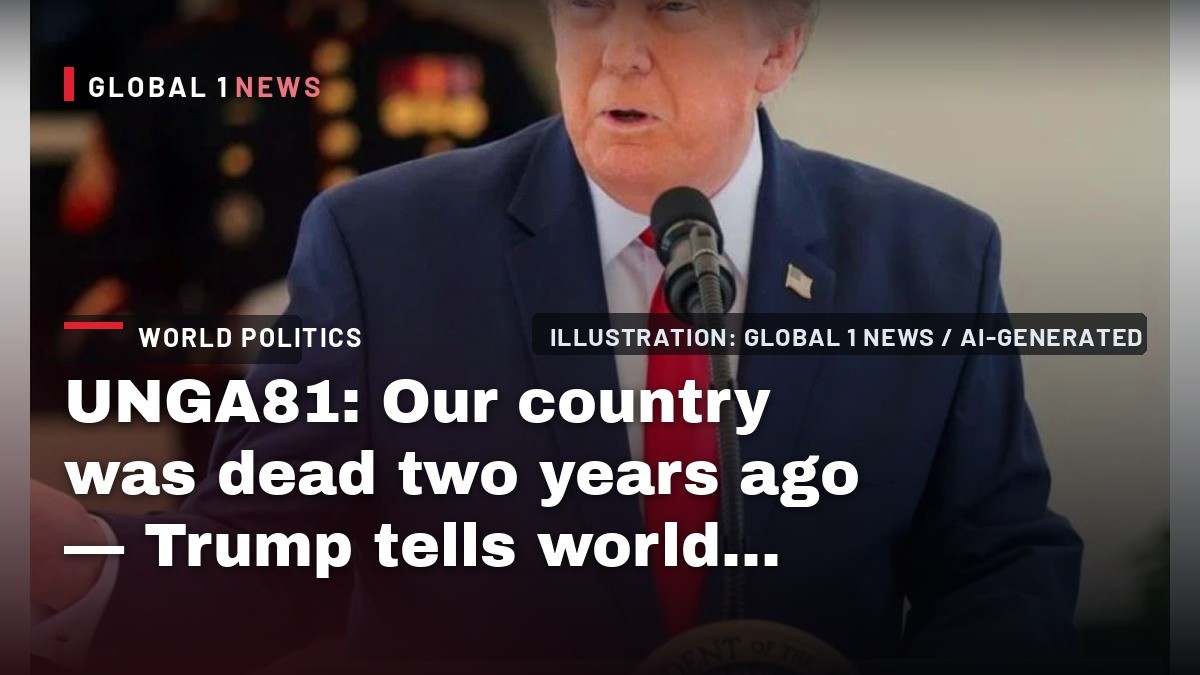
At the opening of the 81st session of the United Nations General Assembly in New York, President Donald Trump delivered a stark assessment of his nation’s condition two years prior, describing it as “dead” after what he termed an invasion by “illegal aliens.” The remarks, delivered to an audience of world leaders, framed a narrative of dramatic reversal, asserting that the United States now enjoys the most secure border in its history. While the statements were delivered in the ceremonial setting of the UN headquarters, they resonated far beyond the marble halls, prompting reactions across continents and raising questions about the political calculus behind such stark language.
Trump’s Diagnosis of a Nation in Crisis
President Trump opened his address by painting a bleak picture of the United States two years earlier, saying the country was “dead” following an “invasion” by illegal aliens. The choice of words—“dead” and “invasion”—evoked a sense of existential threat, suggesting a nation on the brink of collapse. By framing the issue in terms of life and death, the president positioned immigration as not merely a policy concern but a matter of national survival.
The description of the border as “the worst and most dangerous in the world” before his administration took office reinforced this narrative of crisis. It implied that prior to his leadership, the United States had been unable to protect its sovereignty, a claim that aligns with his broader political messaging about border security. The stark contrast between the alleged past chaos and the present “most secure border” serves to dramatize the perceived transformation under his tenure.
Claiming a Turnaround: From “Dead” to “Hottest”
Trump’s rhetoric shifted from the dire to the triumphant when he declared that the United States now has “the hottest country anywhere in the world.” While the source material does not define “hottest,” the phrase suggests a resurgence of vitality, vigor, or perhaps economic dynamism. By juxtaposing the earlier notion of death with a present state of heat, the president painted a picture of a nation reborn, invigorated, and perhaps more attractive on the global stage.
The claim that “zero illegal aliens have been admitted” in the last sixteen months was presented as concrete evidence of the border’s newfound security. By quantifying the reduction to a literal zero, the president offered a measurable indicator of success, even though the source material does not provide comparative figures from earlier periods. The emphasis on “zero” underscores a narrative of total control and absolute enforcement of immigration policy.
Contextualising the Remarks at the UN
Delivering these statements at the United Nations General Assembly adds a layer of diplomatic significance. The UN platform is traditionally a venue for multilateral cooperation, human rights advocacy, and global problem‑solving. By choosing this stage to announce a hard‑line stance on immigration, President Trump positioned his domestic policy as a model for international emulation, implying that border security is a universal imperative.
The audience, comprised of world leaders from diverse political systems, would have heard the president’s claim that “nobody comes into the country unless they’re invited and have permission.” This assertion underscores a sovereign right to control entry, resonating with nations that grapple with migration pressures of their own. It also subtly challenges the prevailing international discourse that often emphasizes humanitarian obligations toward migrants and refugees.
Implications for International Perception
Trump’s portrayal of the United States as a nation that has turned the tide against illegal immigration may influence how other countries view American policy. Nations with similar border challenges might see the United States as a benchmark, while others could interpret the rhetoric as an invitation to adopt more restrictive measures. The phrase “most secure border in its history” suggests an unprecedented level of control, potentially setting a new standard in the eyes of policymakers abroad.
Moreover, the stark language—referring to an “invasion” and a nation that was “dead”—could be read as a warning to those who view open borders as a hallmark of liberal democracy. It frames the debate in existential terms, implying that failure to secure borders could lead to national decline. This framing may embolden governments that favor stringent immigration policies and provide rhetorical ammunition for political actors campaigning on security platforms.
Domestic Resonance and Political Messaging
Within the United States, the president’s statements reinforce a core element of his political brand: the promise of law and order, and the restoration of national greatness. By quantifying the success—zero illegal entrants over sixteen months—he offers a tangible metric that supporters can rally around. The narrative of a nation revived from death to heat aligns with a broader storyline of redemption and triumph that has characterized his public communication.
The emphasis on “invited and have permission” also signals a shift toward a more selective, perhaps merit‑based, approach to immigration. While the source material does not elaborate on the mechanisms for such invitations, the language suggests a controlled, discretionary process. This could be interpreted as an appeal to voters who favour tighter immigration controls while also hinting at a possible framework for legal migration that is contingent upon explicit permission.
Analyzing the Rhetorical Strategy
President Trump’s address employed a stark binary: a dead nation versus a hot, thriving one; a porous border versus an impregnable one. This dichotomy simplifies a complex policy area into a clear, emotionally resonant story. By using absolute terms—“zero illegal aliens”—the president eliminates nuance, presenting an unequivocal victory. Such rhetoric is effective in rallying a base that values decisive action and clear outcomes.
However, the lack of detailed data or comparative statistics in the speech means that the claims rest largely on perception rather than empirical verification. The audience is asked to accept the transformation on the basis of the president’s authority and the emotive power of the language. This approach underscores the importance of narrative in political communication, especially on contentious issues like immigration.
Looking Ahead: Potential Consequences and Questions
While the president’s statements project confidence, they also raise questions about the sustainability of the claimed border security. Maintaining a “most secure border” may require ongoing resources, policy adjustments, and diplomatic coordination, especially given the United States’ extensive land and maritime frontiers. The source material does not detail the mechanisms that have achieved the reported zero illegal entries, leaving observers to wonder about the practical measures behind the rhetoric.
Furthermore, the broader implications for international migration governance remain uncertain. If other nations adopt similar hard‑line stances, global migration patterns could shift, potentially leading to increased pressure on alternative routes or destinations. The president’s framing of immigration as an “invasion” may also influence public sentiment, potentially hardening attitudes toward migrants and affecting humanitarian responses.
In sum, President Trump’s UN address painted a dramatic picture of national revival through stringent border control, positioning the United States as a model of security and sovereignty. The statements, delivered on a global stage, carry weight both domestically and internationally, shaping narratives about immigration, national identity, and the balance between openness and protection. As the world watches how these claims translate into policy and practice, the discourse around borders and migration is likely to remain a focal point of political debate for years to come.
This article was produced with AI-assisted research and editorial support. Reporting is based on the source material cited below. Sources: Daily Post Nigeria; dailypost.ng; Global1.News (23 September 2026).
By Sarah Okafor, Staff Writer
What's Your Reaction?
 Like
0
Like
0
 Dislike
0
Dislike
0
 Love
0
Love
0
 Funny
0
Funny
0
 Wow
0
Wow
0
 Sad
0
Sad
0
 Angry
0
Angry
0

Africa Correspondent at Global1.News. Based in Lagos, covering politics, business, technology, and culture across the continent. Focused on telling African stories beyond the headlines — the innovation, entrepreneurs, and communities shaping the region's future.












Comments (0)