
A SpaceX Rocket Is About to Slam Into the Moon at 5,400 mph
Folks, buckle up, because a 45-foot chunk of a Falcon 9 rocket that has been tumbling through space for 18 months is barreling straight toward the Moon at more than seven times the speed of sound.
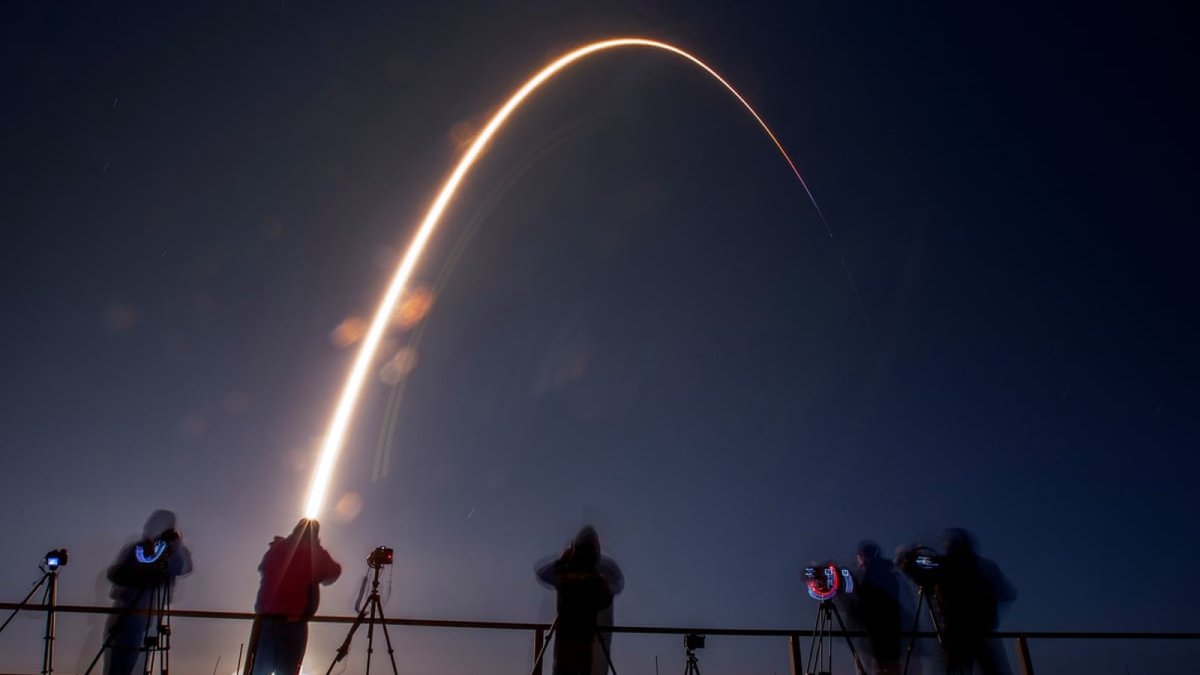
Folks, buckle up, because a 45-foot chunk of a Falcon 9 rocket that has been tumbling through space for 18 months is barreling straight toward the Moon at more than seven times the speed of sound. This abandoned upper stage is about to slam into the lunar surface in an unplanned crash that scientists have tracked with unprecedented precision — and they want the whole world watching when it happens.
A SpaceX Rocket Is About to Slam Into the Moon at 5,400 mph
Atlanta, Georgia — August 1, 2026 — On Wednesday morning, a spent piece of SpaceX hardware becomes a high-speed missile aimed at the Moon. Here is everything you need to know about the crash, the wild ride that got it there, and why astronomers are actually excited about it.
The Crash Course
This Wednesday, August 5, the impact is set for roughly 2:34 AM ET — 06:35 UTC — near Einstein Crater on the Moon's sunlit western limb, on the near side that permanently faces Earth. The rocket piece will hit at 5,400 mph, or about 8,700 kilometers per hour, more than seven times the speed of sound.
The energy released at the moment of impact equals about three tons of TNT. That force should carve out a crater roughly 90 feet across and 16 feet deep — big enough for orbiting spacecraft to photograph clearly, but far too small to see from Earth. The impact flash itself will last less than a second and stay too dim for naked-eye viewing, yet the ejecta plume kicked up by the blast could stretch several miles into space and linger, visible to telescopes, for tens of minutes. Because the Moon has no atmosphere to speak of, none of that debris burns up — it just hangs there, giving scientists a front-row seat to a very rare event.
The Rocket's Wild Ride
The spent upper stage, catalogued as 2025-010D and standing about 45 feet tall — roughly the height of a five-story building — launched on January 15, 2025 from Kennedy Space Center in Florida. Its job was to send two private lunar landers on their way, and it did that job perfectly. The problem came after.
That rideshare mission tells a tale of two very different lunar dreams. Firefly Aerospace's Blue Ghost Mission 1 pulled off the first fully successful commercial soft landing on the Moon on March 2, 2025, proving private companies can stick the landing when everything lines up right. ispace's Hakuto-R Mission 2 was not so lucky: it lost contact roughly 90 seconds before its attempted touchdown on June 5, 2025, after a laser rangefinder glitch turned the descent into a hard landing. Together, those outcomes show the new lunar economy is moving fast, with real wins and painful setbacks happening on the same flight.
After releasing the landers, the stage was supposed to reenter Earth's atmosphere and burn up — the standard fate for Falcon 9 second stages. Instead, the high-energy trans-lunar injection that sent the landers moonward left the stage stuck in a highly elliptical orbit swinging between roughly 220,000 and 510,000 kilometers from Earth, completing one loop every 26 days. Over 18 months, the Moon's gravity slowly reshaped that path until impact became unavoidable.
The Astronomer Who Saw It Coming
Bill Gray is the independent astronomer who developed Project Pluto, the widely used orbital tracking software, and he flagged this collision back in September 2025 — nearly a year before impact. His analysis drew on more than 1,000 observations gathered by asteroid surveys and amateur observers at facilities in Mississippi, Utah, Beijing, and England. By February 26, 2026, the count had reached 1,053 data points, producing what experts call the most precisely predicted unplanned lunar impact on record.
Predicting the exact crash spot is tougher than it sounds. Gravity alone would make the math almost trivially precise — lunar gravity, Earth's gravity, the pull of the Sun and planets are all known to extraordinary accuracy. But this tumbling, hollow metal cylinder is also pushed by sunlight. Solar radiation pressure is a real but extraordinarily gentle force: the cumulative push of individual photons over months introduces deviation that grows in ways that are only partly predictable. That is why the prediction is so tight, yet the precise landing point still carries uncertainty.
And here is the uncomfortable part: the whole mess could have been avoided. If the stage had been nudged into orbit around the Sun instead of left to drift, it never would have become a Moon-bound missile. Nobody took that step. The result is an unplanned impact that highlights how even small forces — and small decisions — can decide the fate of big pieces of hardware.

What Scientists Hope to Learn
Benjamin Fernando of Los Alamos National Laboratory is rallying both professionals and amateurs to watch the event. His team's interest is not just spectacle — it is survival. As Fernando put it, part of the reason for the interest in this event is to figure out how much of a hazard debris impacts pose to future astronauts. Every unplanned crash adds real hazard data we cannot afford to ignore as humanity prepares to put boots back on the lunar surface.
"Gravity on the moon is low and there is no wind to blow the dust away," Fernando noted — which is exactly why the ejecta plume should linger. He anticipates an impact crater nearly 90 feet across and 16 feet deep, too small to see from Earth but clearly visible to spacecraft orbiting overhead.
The observation campaign is already in motion. A 23-researcher team posted arXiv preprint 2607.14625 calling for coordinated observations across three continents, arguing that the plume rising above the lunar limb may offer the clearest view anyone has ever had of a human-made object striking another world. NASA's Lunar Reconnaissance Orbiter and South Korea's Danuri lunar orbiter are both lined up to capture before-and-after shots of the crash scene near Einstein Crater. The real prize is that ejecta plume — the lingering dust cloud matters far more than the dim flash, because it reveals how debris behaves in low gravity with no wind to clear it away.
A Warning for the Crowded Skies
This marks only the second known accidental rocket crash into the Moon. A Chinese rocket segment dug out a pair of craters on the lunar far side back in 2022. But with tens of thousands of objects now crowding Earth orbit — spent stages, dead satellites, fragments of collisions — the odds of more unplanned impacts keep climbing. As Gray puts it plainly: things are getting crowded up there.
The irony is hard to miss. SpaceX is developing its much larger Starship rocket for stable, planned Moon landings — the very future of controlled lunar exploration — while one of its earlier Falcon 9 stages smashes into the surface without warning. And as NASA's Artemis program and commercial landers push harder to return humans to the Moon, the growing orbital debris problem becomes impossible to ignore. Every piece of hardware we leave behind is a potential hazard for the astronauts who follow.
This crash is a reminder that space is not a clean, empty frontier. It is a working environment we are filling with our own trash, and the bill for that carelessness keeps coming due. The good news: events like this one give scientists real data on how debris impacts behave, data that will help design safer missions and better disposal plans for the rockets of tomorrow.
How to Watch
If you want to catch the aftermath, timing and location matter. With the impact happening in the wee hours of the morning for the United States, the eastern portions of the US and Canada — along with much of South America — should have the best views of the region around Einstein Crater. Bill Gray, the astronomer who predicted the crash, plans to watch the aftermath himself from New Brunswick, Canada.
You will not see the impact flash with the naked eye — it is too dim and lasts less than a second. But experienced observers with telescopes, especially those participating in the coordinated global campaign, may catch the ejecta plume as it rises above the lunar limb and lingers for tens of minutes. Amateur astronomers have already played a starring role in tracking this very object, contributing observations from Mississippi, Utah, Beijing, and England. If you have a telescope and clear skies, this is a rare chance to be part of a genuinely historic observation.
The Bottom Line
On Wednesday morning, a piece of human hardware will do something no one intended: it will become a crater on the Moon. Scientists will learn from it. Astronomers will watch it. And all of us should take it as a reminder that our future in space depends on how responsibly we manage the space around us.
If you're as fired up as I am about keeping our future in space safe and smart, stay curious, keep your eyes on the sky, and never stop asking the tough questions about what we leave behind. Watch the sky Wednesday morning — and keep demanding that the people launching rockets clean up after themselves.
By Jessica Ali, Staff Writer
This article was produced with AI-assisted research and editorial support. Reporting is based on sources cited in the article.
What's Your Reaction?
 Like
0
Like
0
 Dislike
0
Dislike
0
 Love
0
Love
0
 Funny
0
Funny
0
 Wow
0
Wow
0
 Sad
0
Sad
0
 Angry
0
Angry
0

Editor-in-Chief at Global1.News. Atlanta-based journalist who cuts through the BS and tells it like it is. Lead anchor, host, and the voice you hear when the spin stops and the truth starts.















Comments (0)