
Pope Leo XIV Renews Gaza Reconstruction Appeal as Humanitarian Crisis Deepens
Pope Leo XIV renewed his appeal for Gaza reconstruction as he departed Castel Gandolfo, urging all authorities to help a people still cut off from humanitarian aid. More than 72,600 Palestinians have been killed and rebuilding needs are estimated at $71.4 billion.
In a recent Middle East Eye report published August 21, 2026, Pope Leo XIV issued a renewed and urgent appeal for the reconstruction of Gaza, speaking as he departed Castel Gandolfo to return to the Vatican. The Pope's words, captured on video, came amid mounting evidence that the humanitarian catastrophe in the Gaza Strip is not only persisting but deepening, with the people of Gaza still cut off from the most basic necessities of life. His appeal, framed within a broader call for the respect of human rights worldwide, arrives at a moment when the gap between diplomatic rhetoric and on-the-ground reality has never been wider.
Pope Leo XIV Renews Gaza Reconstruction Appeal as Humanitarian Crisis Deepens
Castel Gandolfo, Italy – August 2026 — Speaking to journalists outside the papal residence on Tuesday evening, Pope Leo XIV did not mince words about the situation in Gaza. "Unfortunately, the people of Gaza are still not receiving humanitarian aid," he said, his tone carrying the weight of a man who has watched months of promises yield little tangible change. The Pope's remarks, first reported by Vatican News on May 26, 2026, and now amplified in the Middle East Eye video report, come as the United Nations and humanitarian organizations describe a territory in which the basic infrastructure of life has been systematically dismantled.
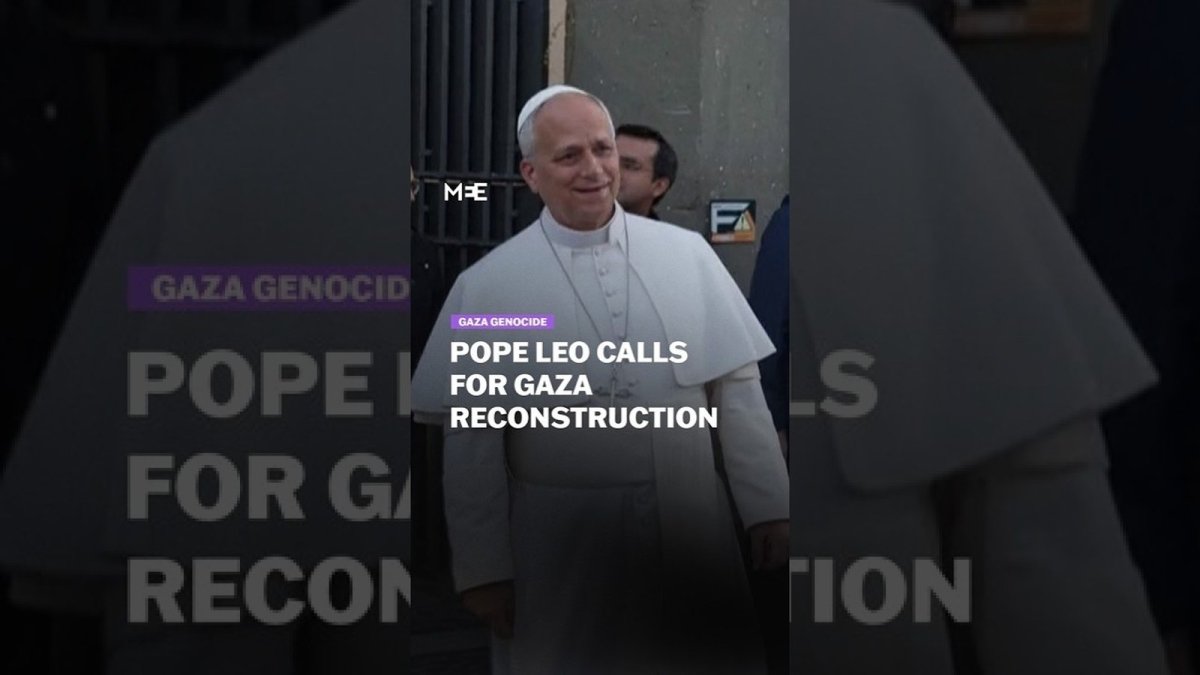
An Appeal for Gaza's People
The Pope's message was both simple and devastating in its clarity. "The people are truly suffering... continue to suffer greatly," he told reporters, responding to questions about activists aboard the Gaza-bound Global Sumud Flotilla, which had been intercepted by Israeli forces in international waters weeks earlier. Reports that some activists had been handcuffed and blindfolded prompted the Pope to broaden his appeal beyond the immediate humanitarian crisis to the fundamental question of human dignity.
"We must renew our appeal for the respect of the human rights of every person," the Pope said, before pivoting to the core of his message. "I would also like to renew this not only as an invitation, but truly as an appeal," he urged, calling on "all authorities to assist and accompany the people of Gaza, and to help begin reconstruction." The word "reconstruction" hung in the air — a term that implies not just the rebuilding of buildings, but the restoration of a society, a future, and a semblance of normal life for more than two million people who have known nothing but war and blockade for years.
Human Rights for Every Person
The flotilla incident that prompted the Pope's remarks has become a flashpoint in the ongoing debate over how the international community engages with Gaza. The Global Sumud Flotilla, carrying activists from multiple countries, was intercepted by Israeli naval forces in international waters in May 2026. Hundreds of activists were abducted and deported, with images circulating widely showing them handcuffed, blindfolded, and forced to kneel — images that Israeli National Security Minister Itamar Ben-Gvir posted on social media with the caption "Welcome to Israel."
The brazenness of the post drew international condemnation, including from Italian Prime Minister Giorgia Meloni, who criticized the treatment of the activists. United Nations experts demanded the immediate release of those unlawfully arrested, noting that the interception occurred in international waters, far beyond any legitimate security perimeter. The Pope's response was measured but firm: "We are provoking more and more hatred... violence does not help. From any side." He stressed the need "to return to negotiations" and "to seek, through dialogue, to resolve problems, always respecting the human rights of everyone."

A Territory in Ruins
The scale of destruction in Gaza defies easy comprehension. A joint assessment by the United Nations, the World Bank, and the European Union estimates $57.9 billion in direct damage and economic losses, with long-term reconstruction needs projected at $71.4 billion. More than 72,600 Palestinians have been killed since October 7, 2023, according to figures cited in the UNSCO Rapid Damage and Needs Assessment published in April 2026. Over 1.9 million people remain displaced, and more than 1.2 million — almost 60 percent of Gaza's population — have lost their homes entirely.
The situation has not improved since the ceasefire agreement went into effect on October 10, 2025. According to figures from the Gaza Ministry of Health, compiled by the Israeli human rights organization Gisha, 1,259 people have been killed and 4,146 injured in Gaza in Israeli attacks between the ceasefire and August 11, 2026. The UN Office for the Coordination of Humanitarian Affairs (OCHA), in its August 14, 2026 Humanitarian Situation Report, described the situation as "critical," noting that intense military activity continues to cause civilian casualties and is hitting health and education infrastructure. Structural damage continues to rise, OCHA reported, even as the world's attention has drifted to other crises.
UNRWA, the UN agency for Palestinian refugees, reports that the Israeli military remains deployed in over 50 percent of the Gaza Strip, beyond the so-called "Yellow Line" that was supposed to demarcate a buffer zone. This continued military presence, combined with the ongoing blockade, has made it nearly impossible for humanitarian convoys to operate with any consistency. The Pope's observation that "the people of Gaza are still not receiving humanitarian aid" is not a rhetorical flourish — it is a factual description of a system that has been allowed to fail.
War by Algorithm: The Pope's Warning on AI
In a striking departure from traditional papal addresses on conflict, Pope Leo XIV turned his attention to the role of artificial intelligence in modern warfare. "War is being waged with AI, without thinking about human lives, which are truly victims of all this," he said, citing conflicts including Lebanon as examples of this troubling trend. The Pope renewed his appeal for a "disarmed artificial intelligence" — a phrase that has become a hallmark of his papacy's engagement with the ethics of emerging technology.
The Vatican's dialogue on this issue is not merely theoretical. The Dicastery for Promoting Integral Human Development has been in ongoing discussions with Anthropic, the AI company, exploring the ethical frameworks that should govern the development and deployment of autonomous weapons systems. The Pope's warning reflects a growing concern among human rights organizations that the use of AI in targeting decisions is removing human accountability from the act of killing, making it easier to wage war without confronting its human cost.
A Consistent Vatican Voice
Pope Leo XIV's appeal for Gaza is not an isolated statement but part of a consistent pattern of advocacy that has defined his papacy. On August 16, 2026, during his Angelus address at Castel Gandolfo, the Pope renewed his appeal "for an end to the ongoing violence against the Palestinian civilian population in the West Bank," and urgently called on the international community "to work toward advancing the two-state solution, for a just and lasting peace." That appeal came amid a wave of settler attacks, including in Taybeh, one of the last remaining Christian villages in the West Bank, where a UN inquiry released in June 2026 accused Israeli forces of enabling settler violence.
Earlier, in his January 9, 2026 address to the Vatican diplomatic corps, the Pope had made clear the Holy See's position: "The Holy See is especially attentive to any diplomatic initiative that seeks to guarantee to the Palestinians in the Gaza Strip a future of lasting peace and justice in their own land." Cardinal Pierbattista Pizzaballa, the Latin Patriarch of Jerusalem, visited Taybeh on August 15, 2026, celebrating Mass on the Feast of the Assumption and pledging that the Church will "do everything within our power to preserve the ecclesial presence here." The message from the Vatican is consistent: the Palestinian people, including the dwindling Christian community, are not to be abandoned.
Analysis and Implications
The Pope's renewed appeal arrives at a moment of profound diplomatic paralysis. The ceasefire that took effect in October 2025 has held in name but has not translated into the kind of sustained humanitarian access that reconstruction would require. The Vatican, which has no military or economic leverage, wields a different kind of power — moral authority. But the question that hangs over every papal statement on Gaza is whether that authority can translate into concrete change.
For the people of Gaza, the Pope's words are a reminder that they have not been forgotten, even as the world's attention has shifted. But words, however sincere, do not rebuild homes or restore hospitals. The $71.4 billion reconstruction estimate is not an abstract figure — it represents the cost of rebuilding schools where children can learn without fear, hospitals where the wounded can be treated, and homes where families can live with dignity. The Global Sumud Flotilla, for all the controversy it generated, was a symptom of the desperation that has driven civil society to take matters into its own hands when governments have failed to act.
The Pope's warning about AI in warfare adds another layer of urgency. If war is being waged by algorithm, with human lives reduced to data points in a targeting system, then the traditional mechanisms of accountability and international law become even more difficult to enforce. The Vatican's engagement with Anthropic is a recognition that the ethical questions raised by AI are not abstract philosophical debates but urgent practical concerns that will shape the future of conflict and, by extension, the future of civilian populations caught in the crossfire.
As Pope Leo XIV returned to the Vatican, his appeal for Gaza's reconstruction echoed in a geopolitical landscape marked by indifference and competing priorities. The two-state solution, long the cornerstone of international diplomacy on the Israeli-Palestinian conflict, appears more distant than ever. Yet the Pope's insistence on dialogue, on the respect for human rights, and on the necessity of reconstruction offers a path forward — if only the world has the will to take it.
The people of Gaza, as the Pope said, "are truly suffering." They have suffered through war, through displacement, through the slow erosion of hope that comes from watching the world acknowledge their pain without acting to end it. The Pope's appeal is a call to conscience, but conscience without action is merely observation. The question now is whether the international community will heed the call — not with words, but with the resources, political will, and sustained engagement that reconstruction demands. The people of Gaza have waited long enough.
By Fatima Al-Rashid, Staff Writer
This article was produced with AI-assisted research and editorial support. Reporting is based on sources cited in the article.
What's Your Reaction?
 Like
0
Like
0
 Dislike
0
Dislike
0
 Love
0
Love
0
 Funny
0
Funny
0
 Wow
0
Wow
0
 Sad
0
Sad
0
 Angry
0
Angry
0

Gulf/MENA Correspondent at Global1.News. Based in Doha, covering Gulf politics, energy markets, diplomacy, and development across the Middle East and North Africa. Tracks the economic transformation of the Gulf states.










Comments (0)