
Genetically Modified Pig Kidney Keeps Man Alive for Record Nine Months in World-First Bridge Transplant
A genetically modified pig kidney kept a New Hampshire man alive without dialysis for a record 271 days, then was removed and replaced with a human kidney in a world-first bridge transplant at Mass General Brigham, published in The Lancet.
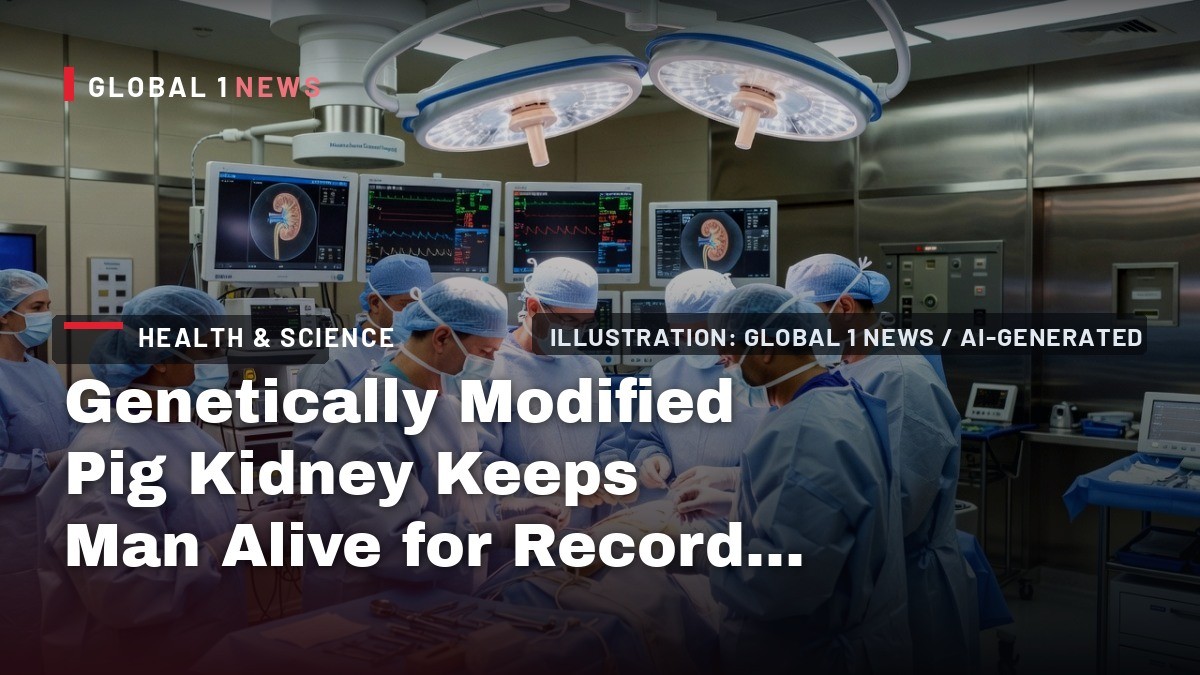
(Boston, Massachusetts) — For 271 days, Tim Andrews lived with a pig's kidney inside him. No dialysis. No machine keeping him alive three nights a week. Just a genetically engineered organ from a Yucatan miniature pig named Wilma, doing the job his own kidneys could not.
It was a world record. And when that pig kidney finally failed, surgeons at Massachusetts General Hospital did something never done before: they removed it and gave Andrews a human kidney instead. The transition worked. The pig organ had served its purpose — a bridge, not a destination — and it bought a 66-year-old New Hampshire man with end-stage kidney disease something precious: time.
The case, published Wednesday in The Lancet, marks the first time a genetically modified pig kidney has been used as a temporary bridge to a human transplant. It is a proof of concept that could reshape how medicine handles the brutal math of organ scarcity — a crisis where thousands of Americans die each year waiting for kidneys that never come.
A Record Nine Months Without Dialysis
Andrews, from New Hampshire, had been on hemodialysis for two years before the experimental transplant. His kidneys had failed because of type 2 diabetes. He was on a waiting list for a human organ, but the numbers were stacked against him: he had only a 9 percent chance of receiving a human kidney within five years, while facing a more than 40 percent risk of dying or being removed from the list altogether.
No living donor was available. The expected wait for a deceased donor's kidney: more than five years.
For a man whose quality of life had collapsed under the weight of dialysis, that was not a wait — it was a sentence.
Surgeons at Mass General Brigham transplanted Wilma's kidney into Andrews on January 25, 2025. The organ worked immediately. For 271 days — more than nine months — Andrews lived without dialysis, the longest period ever recorded for a pig kidney in a living human. Previous studies had documented no xenograft survival beyond two months. The first pig kidney transplant into a living person, in 2024, ended after 52 days when the patient died from unrelated heart problems.
Andrews didn't just survive. He lived. He cooked. He vacuumed. He took long walks with his dog, Cupcake. He described the transplant as a "miracle," adding: "I was alive, and I hadn't been in a long time."
But around the six-month mark, damage began developing in the pig kidney's blood vessels. The injury progressed, and the organ eventually failed. Nine months after transplantation, surgeons removed it. Andrews went back on dialysis for several months — and then received a kidney from a deceased human donor.
That human kidney worked well during six months of follow-up. Critically, doctors detected no new antibodies against human tissue — a sign that the pig kidney had not sensitized Andrews's immune system or made the subsequent human transplant harder to succeed. No pig viruses or other pig pathogens were detected at any point.
The Science: 69 Edits to Make a Pig Kidney Human-Compatible
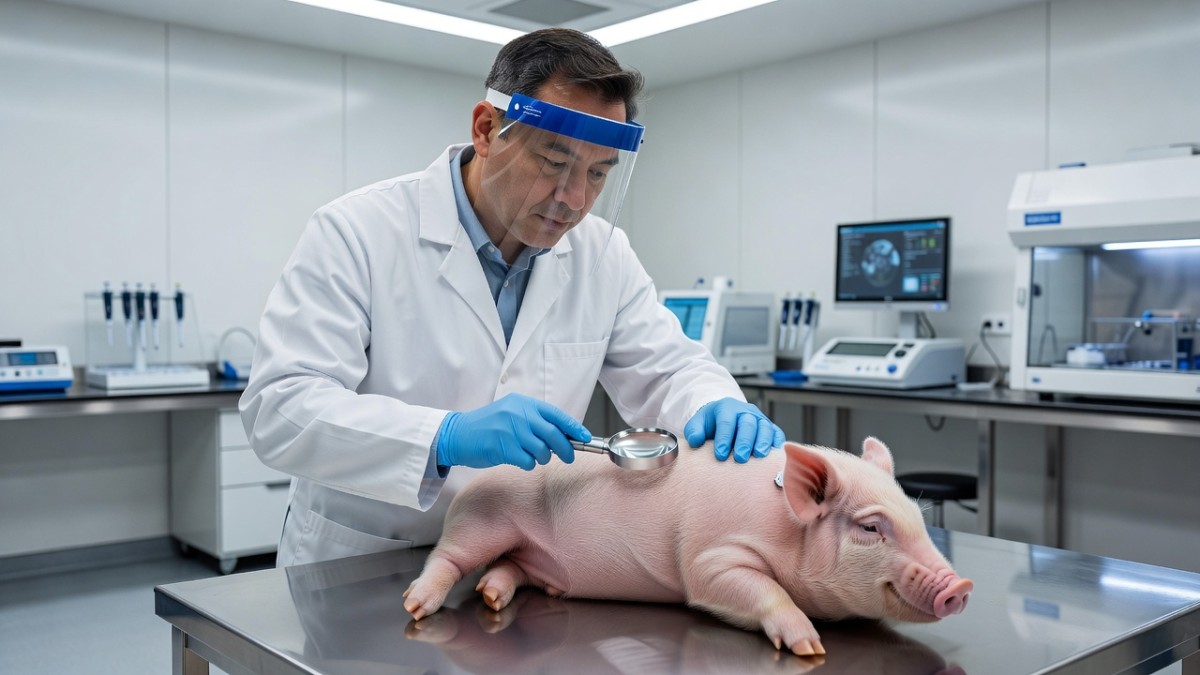
Wilma was not an ordinary pig. She was a Yucatan miniature pig, bred for research, and her genome carried 69 edits designed to make her organs safe and compatible for human use.
The edits fell into two broad categories. Some were designed to dodge viruses that might pose a risk to humans — a critical safety measure given concerns about porcine endogenous retroviruses and other pathogens jumping species. Others were engineered to make the organ more compatible with the human immune system, reducing the odds of rejection.
This is not simple genetic tinkering. It is precision surgery at the molecular level, altering dozens of genes to trick the human body into accepting an organ from another species. The science of xenotransplantation — cross-species transplantation — has advanced dramatically in recent years, but it remains experimental, fraught with unknowns about long-term durability and immune response.
In Andrews's case, the edits held up well enough to keep the kidney functioning for nine months. The eventual failure was due to damage in the kidney's blood vessels — a complication that will need to be addressed in future iterations of the technology.

From Pig Kidney to Human Transplant
The significance of this case goes beyond the record duration. It is the first time a pig kidney has been used as a temporary bridge to a human transplant — and the world's first transition from pig kidney xenotransplantation to human kidney transplantation.
That sequencing matters. For patients like Andrews, who face years-long waits for human organs, a pig kidney could keep them alive and healthy while they wait — not just surviving on dialysis, but living full lives. When a human organ becomes available, the pig kidney can be removed and replaced.
The approach has a name in transplant medicine: bridging. It is commonly used with mechanical heart pumps and other devices that keep patients alive until a donor organ arrives. But using a genetically modified animal organ as the bridge is unprecedented.
Dr. Leonardo Riella, of the Center for Transplantation Sciences and the Division of Nephrology at Mass General Brigham, led the research team. He framed the case in stark terms.
"The organ shortage is the greatest crisis we have right now in transplantation," Riella said. "We know that the best treatment option for patients with end-stage kidney disease who have developed renal failure is transplantation, but we simply don't have enough human organs to transplant in a timely manner. Our vision is that xenotransplantation could help address this gap — initially as a bridge to get patients off dialysis while they wait for a human donor kidney, and potentially, as we establish long-term safety and durability, as a destination therapy in its own right."
That last phrase — "destination therapy" — is the holy grail of xenotransplantation. If pig kidneys can be engineered to last for years, not months, they could become a permanent solution for patients who will never receive a human organ. The bridge is step one. The destination is the long game.
What This Means for the Organ Shortage
The numbers behind this story are grim. Kidney transplantation provides the best survival and quality of life for patients with end-stage kidney disease — but global demand for human organs far exceeds supply. In the United States alone, thousands of patients die each year while waiting for a kidney. Many more are removed from waiting lists because they become too sick to transplant.
Dialysis keeps patients alive, but it is a poor substitute for a functioning organ. It consumes hours of patients' lives each week, carries its own risks of infection and cardiovascular complications, and is associated with a significantly lower quality of life than transplantation.
Andrews's case demonstrates that a pig kidney can fill that gap — at least temporarily. For patients with no living donor and a multi-year wait ahead of them, a bridge transplant could mean the difference between surviving to receive a human organ and dying on the list.
The broader context is moving quickly. In October 2025, the world's first pig-to-human liver transplant kept a patient alive for 171 days. In March 2026, the Vatican issued new guidelines saying Catholics may receive animal organ transplants — removing a potential ethical barrier for millions of believers.
Mass General Brigham, a non-profit, integrated academic healthcare system in Massachusetts, is positioning itself at the forefront of this field. The institution has the surgical expertise, the research infrastructure, and the regulatory relationships to push xenotransplantation forward — but it is also proceeding with caution.
The Road Ahead
The team at Mass General Brigham is careful to note the limits of this case. It is a single patient with no comparison group. The outcome reflected careful patient selection and intensive specialist care that may not be available at other institutions. Further clinical trials are needed before this approach can be broadly applied.
Riella acknowledged the debt the field owes to patients willing to take a chance on experimental medicine.
"The patients are the true pioneers here," he said. "By stepping forward and being willing to participate in these early stage studies, they are advancing the science. Without their trust and courage, we would not be able to do what we do."
Andrews, for his part, got what he needed: a functioning kidney, a life without dialysis, and eventually a human organ that is working well. His nine months with Wilma's kidney were not just a personal victory — they were a proof of concept for a technology that could one day save tens of thousands of lives.
The questions that remain are substantial. Can the blood vessel damage that ended Wilma's kidney's run be prevented or repaired? Can the organs be engineered to last longer — years, not months? Can the approach be replicated at scale, with consistent results across diverse patient populations? And can the cost and complexity of 69 genetic edits be brought down to something approaching practicality?
None of those questions have answers yet. But for the first time, there is evidence that the bridge can be crossed. A pig kidney kept a man alive for nine months. It failed, yes — but it failed slowly enough, and safely enough, that he could walk away and receive a human organ.
That is not a cure. It is not even a complete solution. But it is a start — and in the world of transplantation, where patients die waiting every single day, a start is more than they had yesterday.
By Jessica Ali, Staff Writer
This article was produced with AI-assisted research and editorial support. Sources: The Guardian, Euronews, Harvard Medical School, The Lancet.
What's Your Reaction?
 Like
0
Like
0
 Dislike
0
Dislike
0
 Love
0
Love
0
 Funny
0
Funny
0
 Wow
0
Wow
0
 Sad
0
Sad
0
 Angry
0
Angry
0

Editor-in-Chief at Global1.News. Atlanta-based journalist who cuts through the BS and tells it like it is. Lead anchor, host, and the voice you hear when the spin stops and the truth starts.















Comments (0)