
Once-in-200-Year Rain Batters Geoje and Tongyeong: Landslides Devastate Southern Coast
The torrential downpour that inundated South Korea’s southern coast in mid-August 2026 was not merely a seasonal storm; it was a geological-scale event that tested the limits of the nation’s disaster management infrastructure.
Once-in-200-Year Rain Batters Geoje and Tongyeong: Landslides and Flooding Devastate the Southern Coast
Seoul, South Korea – August 2026 — The weekend of August 15-17, 2026, which coincided with the Liberation Day holiday period and a peak domestic travel window, turned catastrophic for residents of South Gyeongsang Province. A stationary weather front, supercharged by anomalously warm sea surface temperatures, unleashed a deluge that meteorologists have since described as a "once-in-200-year" probability event. The resulting landslide in Geoje, which claimed a life, has now triggered a swift, albeit carefully calibrated, central government response under President Lee Jae-myung.
The Deluge: Record Rainfall on the Southern Coast
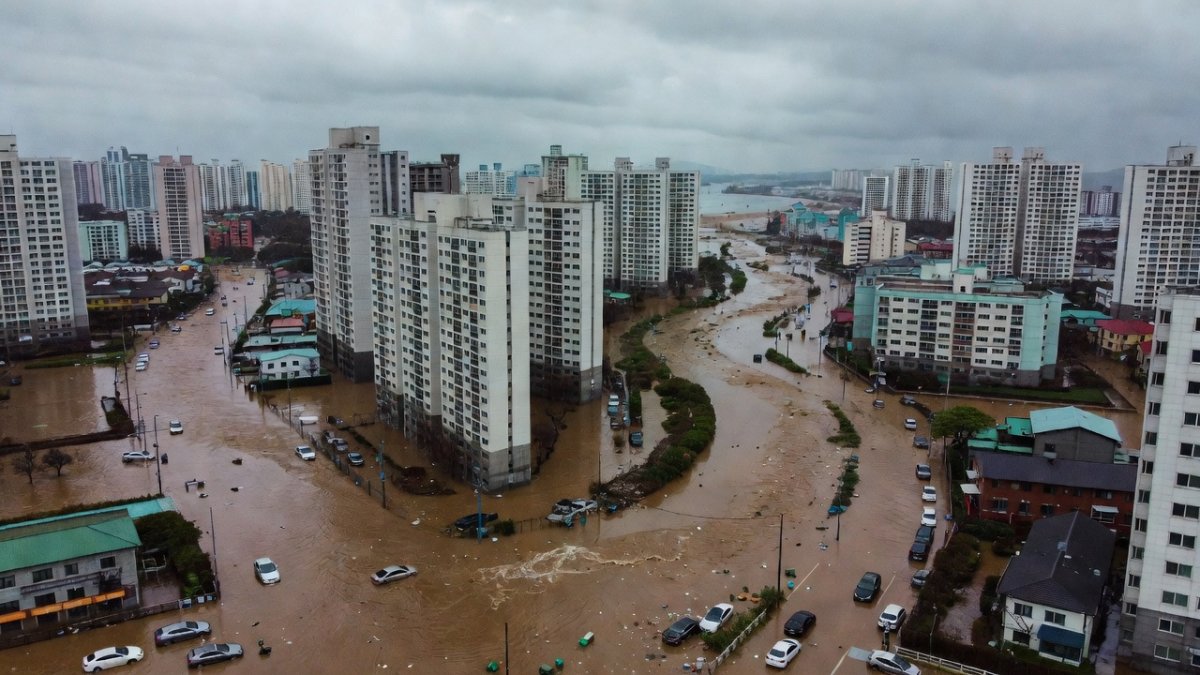
The numbers emerging from the Korea Meteorological Administration (KMA) are staggering. From Saturday through 8 a.m. Monday, August 17, the city of Geoje—located over 300 kilometers southeast of Seoul—recorded 805.7 millimeters of rain. Neighboring Tongyeong received 671.9 millimeters in the same window, while other parts of the province saw between 240 and 340 millimeters. The Seoul Economic Daily later reported that the cumulative totals from August 15-18 reached 956.1 millimeters for Geoje and 766.9 millimeters for Tongyeong. By 6 p.m. Monday, The Guardian reported the Geoje total had climbed to 912 millimeters—roughly two-thirds of the region's average annual precipitation—in under 72 hours.
This was not a gentle, sustained drizzle. As of Monday morning, both Geoje and Tongyeong were experiencing rainfall rates of up to 100 millimeters per hour, with the KMA forecasting an additional 150 millimeters could fall that day. The intensity of this event aligns with a troubling trend identified by the KMA in recent years. In September 2025, the agency described a 152.2-millimeter-per-hour downpour in Gunsan-Seocheon as a "once-in-200-years" probability event. The recurrence of this statistical benchmark within a single year suggests that the peninsula’s summer monsoon, or *jangma*, is undergoing a structural shift toward more volatile and concentrated precipitation events.
A Deadly Landslide in Geoje
The human cost of this meteorological anomaly materialized in the pre-dawn hours of Monday. At 4:42 a.m., a landslide tore through a residential neighborhood in Geoje, striking an apartment building directly. Police and firefighters, who had already received more than 20 calls for help from residents overnight, rushed to the scene. They successfully rescued three residents from the debris, but a fourth individual was found in cardiac arrest and was pronounced dead upon arrival at a local hospital. The Guardian confirmed one fatality and four injuries overall. A separate landslide struck a house in the vicinity, though no casualties were reported in that instance.
The physical damage extended far beyond the landslide sites. Several streams overflowed their banks, flooding roads and isolating communities. The Chosun Ilbo English edition reported that elementary and middle school facilities suffered significant flooding damage, raising concerns about the start of the fall semester. By Monday morning, over 600 damage reports had been filed with authorities, and 154 people required rescue operations. Residents in high-risk zones were evacuated preemptively due to the ongoing threat of additional slope failures.
The Central Disaster Response
The scale of the event necessitated an immediate escalation of the government’s response machinery. The Ministry of the Interior and Safety activated the first stage of the Central Disaster and Safety Countermeasures Headquarters on Monday, August 17. This activation is not a symbolic gesture; it formally coordinates the efforts of multiple ministries, the military, and provincial governments under a unified command structure. The heavy rain warnings that were in effect across five areas of the province, including Geoje and Tongyeong, triggered a cascade of localized responses, with lower-level advisories blanketing much of the broader region.
President Lee Jae-myung’s administration moved quickly to frame this as a national priority. The activation of the headquarters allowed for the deployment of additional rescue personnel and equipment to the affected areas. However, the immediate response phase was complicated by the timing of the disaster. The Liberation Day holiday weekend meant that many government offices were operating on reduced staffing, and the peak travel period exacerbated the logistical challenges of moving resources into the affected coastal zones. Despite these hurdles, the initial rescue and evacuation operations were completed without further loss of life, a testament to the improvements in local emergency response protocols since the 2022 flooding in Seoul.
Special Disaster Zone Designation
The most consequential political decision came on Friday, August 21, when President Lee Jae-myung formally designated the entire city of Geoje and the Sanyang and Bongpyeong districts of Tongyeong as special disaster zones. This designation, made with presidential approval and a recommendation from the Central Disaster and Safety Countermeasures Headquarters, unlocks a suite of additional state funding mechanisms for reconstruction, including tax cuts, discounts on electricity and telecommunications utility fees, deferred tax payments, and direct relief payments for affected residents.
The decision was grounded in a preliminary damage survey conducted by the Ministry of the Interior and Safety on August 18-19. For a city to qualify for this designation, the estimated damage must exceed 2.5 times the state-support threshold, which was set at 10.25 billion won (approximately $7.4 million) for Geoje. The survey confirmed that all of Geoje met this criterion. Tongyeong, however, presented a more complex picture. The two-day survey could not confirm that citywide damage exceeded the 10.25 billion won threshold, so the city as a whole was excluded from the initial designation. Instead, the Sanyang and Bongpyeong districts were designated individually, as their estimated damage certainly exceeded the district-level threshold of 1.025 billion won.
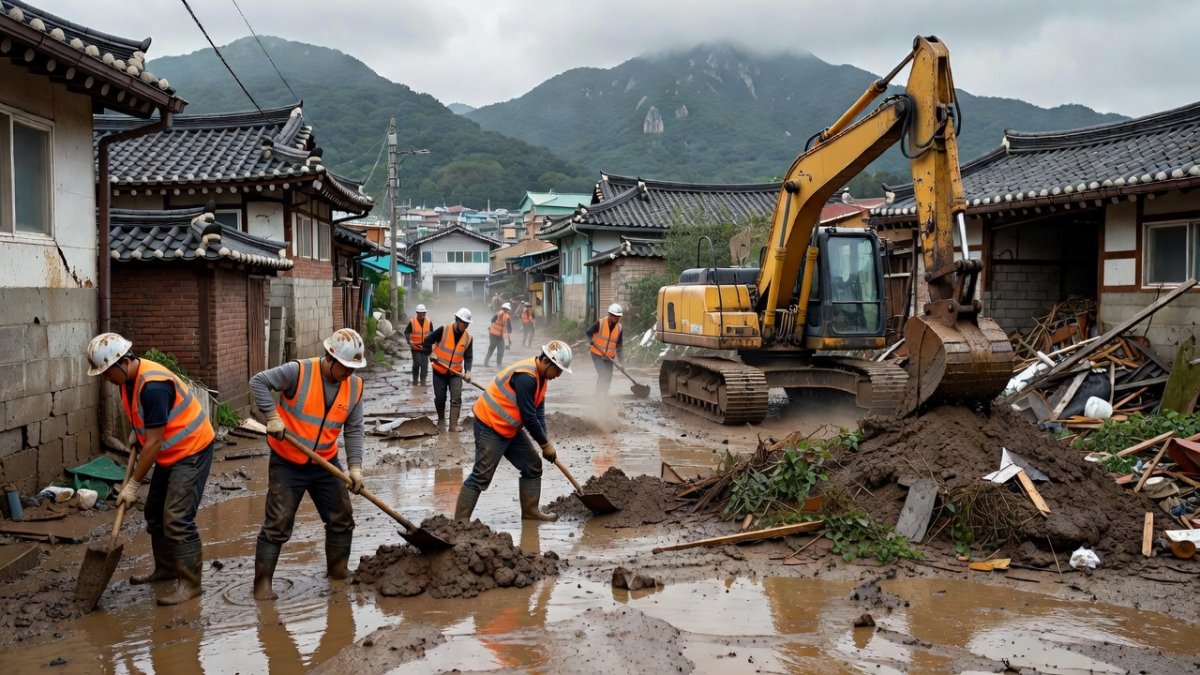
Presidential spokesperson Kang Yu-jung stated that the government plans to consider designating additional areas after a more detailed review, and that a full-scale restoration effort involving all available resources is under way. The government has also committed to disbursing relief payments to affected residents before the Chuseok holiday, a politically significant deadline that signals the administration’s awareness of the public’s expectation for tangible, timely support.
Disaster Governance in the Lee Jae-myung Era
This designation is not an isolated act of crisis management; it is part of a broader pattern of disaster governance under President Lee. The special disaster zone mechanism has been deployed repeatedly during his tenure. Six areas were designated following the July 2025 rains, and that number was expanded to 36 areas in August 2025. This frequent use of the mechanism reflects a deliberate policy shift toward proactive, centralized fiscal intervention in the wake of climate-related disasters. It also carries a distinct political dimension, as the speed and generosity of the federal response can significantly influence regional political sentiment.
The political resonance of this particular disaster is amplified by its geography. Geoje is the home region of former President Moon Jae-in, who contributed 10 million won to relief efforts directed at the area. This gesture, while ostensibly apolitical, underscores the deep personal and political connections that bind the region to the broader progressive political establishment. For President Lee, a fellow member of the Democratic Party, the response to this disaster is not merely an administrative task but a test of his ability to manage a crisis in a region that holds symbolic significance for his political base.
Climate Risk and Northeast Asia
The Geoje-Tongyeong disaster must be understood within the broader context of accelerating climate risk in Northeast Asia. The Korean Peninsula has experienced a marked intensification of extreme rainfall events over the past decade, a trend that climate models have consistently attributed to anthropogenic warming. The warming of the seas surrounding the peninsula increases the moisture content of the atmosphere, providing the fuel for these explosive precipitation events. The KMA’s repeated invocation of the "once-in-200-years" probability benchmark is a statistical acknowledgment that the climate baseline is shifting beneath our feet.
This event also carries regional implications. South Korea’s disaster management systems are among the most advanced in Asia, and its response protocols are closely studied by neighboring countries, including Japan and China, which face similar monsoon-driven risks. The effectiveness of the Lee administration’s response will therefore be scrutinized not only domestically but also by regional partners seeking models for climate adaptation. Furthermore, the disaster highlights the vulnerability of coastal infrastructure and the urgent need for investment in slope stabilization, drainage systems, and urban planning that accounts for a more volatile climate.
Looking Ahead
As the immediate rescue phase transitions into long-term reconstruction, the focus will shift to the adequacy of the recovery effort. The preliminary damage survey has provided a baseline, but a detailed assessment is required to determine the full scope of the destruction and whether additional areas of Tongyeong will be added to the special disaster zone designation. The government’s commitment to disbursing relief payments before Chuseok will be a key metric of its administrative efficiency.
Beyond the immediate recovery, this disaster raises profound questions about the sustainability of current development patterns along South Korea’s southern coast. The frequency of "once-in-200-year" events is increasing, and the nation’s infrastructure and insurance systems must adapt accordingly. For President Lee, the Geoje landslide is a stark reminder that climate change is not a distant threat but a present-day governance challenge that will define his administration’s legacy. The coming months will reveal whether the special disaster zone mechanism, and the broader disaster governance framework, can evolve quickly enough to meet the accelerating pace of climate risk on the Korean Peninsula.
By Prof. David Park, Staff Writer
This article was produced with AI-assisted research and editorial support. Reporting is based on sources cited in the article.
What's Your Reaction?
 Like
0
Like
0
 Dislike
0
Dislike
0
 Love
0
Love
0
 Funny
0
Funny
0
 Wow
0
Wow
0
 Sad
0
Sad
0
 Angry
0
Angry
0

East Asia/Technology Correspondent at Global1.News. Seoul-based voice covering Korean politics, technology, business, and culture. Analyzes how technology and geopolitics intersect across East Asia.














Comments (0)