
Nicaragua Ortega Term Extension Proposal Targets Opposition in New Reforms
Nicaraguan President Daniel Ortega proposed extending his term by one year and barring opposition "traitors" from elections, with approval expected in September. The move follows his July 19 vow against future votes and builds on 2024-2025 changes naming Rosario Murillo co-president.
Nicaragua Ortega Term Extension Proposal Targets Opposition in New Reforms
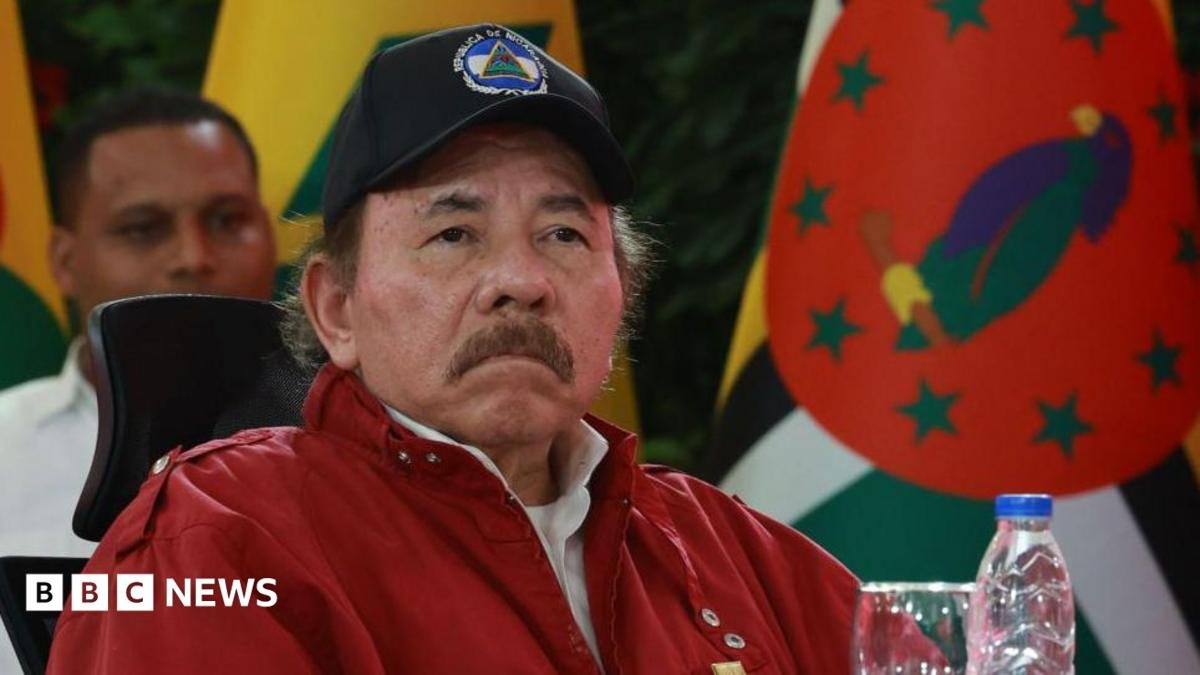
Nicaraguan President Daniel Ortega has sent a draft constitutional reform to the National Assembly that would extend the presidential term by one year while barring opposition figures labeled as traitors or coup plotters from elections. The government-controlled legislature is expected to vote on the measures in September. The proposal follows Ortega's July 19 declaration that Nicaragua would hold no further elections to prevent the opposition from gaining power. It also builds on earlier changes that named his wife Rosario Murillo as co-president.
Managua, Nicaragua — Nicaraguan President Daniel Ortega, 80, who has held power since 2007, proposed extending the presidential term from six to seven renewable years as part of a broader constitutional overhaul. The draft reform, sent to the National Assembly this week, also seeks to constitutionally exclude opposition members deemed traitors or coup plotters from running for office and to revoke the legal status of parties that nominate them. National Assembly President Gustavo Porras briefed ambassadors and multilateral organizations on the changes on July 27. The measures come after Ortega stated on July 19 during the 47th anniversary of the Sandinista Revolution that there would never again be elections allowing the opposition to seize power.
Details of the Proposed Reforms
The draft reform extends the presidential term by one additional year beyond the six-year length set in 2024. It includes provisions to bar candidates labeled as coup plotters from participating in politics and to cancel the registration of any political party that nominates such individuals. These elements build on changes first published in February 2025 that rewrote 93 percent of the articles in Nicaragua's Constitution. National Assembly approval is expected in September, after which the reforms would take effect if passed.
This latest maneuver fits a pattern of incremental power consolidation that has defined Ortega's rule since 2007, where each constitutional tweak serves to entrench the Sandinista Front's dominance rather than expand democratic space. The February 2025 rewrite already embedded mechanisms to strip nationality rights and sideline dissenters, and the current draft simply layers additional barriers that make any future challenge structurally impossible.
By extending the term to seven renewable years while simultaneously targeting parties that might field "traitors," the reforms aim to lock in continuity for the Ortega-Murillo family dynasty. Observers note that these provisions build directly on the 2024 extension and the 2014 removal of term limits, creating a cumulative architecture of indefinite rule. The expected September vote in the controlled National Assembly will likely rubber-stamp the package, foreclosing any pathway for opposition voices to contest power through ballots.
Background of Term Length Adjustments
Nicaragua has altered presidential terms multiple times under Ortega. In 2014 the National Assembly eliminated term limits entirely. The body then lengthened the term from five to six years in 2024. The current proposal would add another year, making seven years the new standard. These adjustments have occurred while the legislature remains under full control of Ortega's Sandinista Front.
Effects on Opposition Participation
Presidential elections last occurred in November 2021, when Ortega won after security forces detained or forced into exile most viable challengers. The new rules would formalize exclusions already applied in practice. Dozens of opposition figures remain in exile, with many stripped of Nicaraguan citizenship and their properties seized and sold. Ortega's July 19 speech explicitly called for building a barrier against coup plotters and traitors regardless of foreign funding they might receive.
The 2021 contest already demonstrated the regime's willingness to hollow out electoral competition, leaving only token candidates who posed no real threat. Now the constitutional language seeks to make those exclusions permanent, ensuring that anyone labeled a traitor faces not only disqualification but the dissolution of their political vehicle. This approach transforms exile from a temporary refuge into a lifelong sentence of political erasure, as citizenship revocation severs ties to the homeland while properties are liquidated to fund the very apparatus of control.
For Nicaraguans watching from abroad, the reforms confirm that Ortega's July 19 vow to erect an impenetrable wall against opposition ambitions is no idle threat but a blueprint for sustained exclusion. By revoking party registrations and barring candidates outright, the draft reform closes the narrow openings that might have allowed even limited participation in future cycles. The result is a political arena stripped of contestation, where the Sandinista Front faces no meaningful check from within or without.
Human Rights and International Concerns
UN human rights chief Volker Türk has stated that repression in Nicaragua has intensified since 2021, with the rule of law eroded and persecution of dissidents increasing. More than 300 people died when security forces suppressed anti-government protests in 2018, after which few citizens have spoken publicly against the government. The United States secured the release of 135 political prisoners from Nicaragua in 2026. Regional bodies including the Organization of American States have condemned the ongoing crackdown.
The shadow of 2018 still looms large over Nicaraguan society, where the memory of hundreds killed by security forces continues to deter open dissent and force many into quiet endurance or flight. Türk's warnings underscore how the post-2021 period has seen this repression deepen into systematic erosion of legal protections, turning courts and institutions into instruments of persecution rather than justice. From the perspective of those who have watched similar dynamics unfold elsewhere in Latin America, these patterns represent a deliberate dismantling of the social contract that once bound citizens to their state.
International condemnations from the OAS and Washington carry particular weight because they reflect accumulated evidence of arbitrary detentions, citizenship stripping, and property seizures that target not only activists but entire families. The release of 135 political prisoners secured by the United States offers a rare humanitarian bright spot, yet it also highlights how many more remain trapped in a system designed to break opposition through isolation and fear.
Regional Patterns and Exile Flows
Nicaragua's developments reflect broader democratic backsliding across Latin America. Tens of thousands of Nicaraguans have fled to Costa Rica, the United States, and Spain in recent years. The February 2025 constitutional rewrite also affected nationality rights, drawing further international criticism. Washington and the OAS have repeatedly denounced the measures that limit political competition and concentrate authority in the executive.
The exodus of tens of thousands to neighboring Costa Rica, the United States, and Spain illustrates the human cost of this backsliding, as families uproot lives to escape a system that punishes political thought with exile and asset loss. These flows connect Nicaragua's story to wider regional struggles where authoritarian consolidation drives similar displacements, turning borders into lifelines for those seeking to preserve dignity and voice. The 2025 nationality provisions only accelerate this hemorrhage by formalizing the severance of ties to the homeland.
OAS and U.S. condemnations highlight how Ortega's project aligns with other efforts across the hemisphere to centralize power while dismantling checks that once protected pluralism. For Latin American observers, the Nicaraguan case stands as a cautionary tale of how constitutional engineering can mask the suffocation of democratic aspirations under the rhetoric of anti-imperialist defense. Exile communities now carry the burden of preserving memory and advocacy from afar, their numbers swelling with each new layer of exclusion imposed from Managua.
Regime Communications and Responses
After Ortega's July 19 remarks, regime officials and pro-government voices claimed the comments were misrepresented and referred only to avoiding past elections influenced by the United States. On July 27 Porras told diplomats that anyone who failed to understand the reforms was choosing not to understand. State media and aligned outlets including Sputnik and Venezuelan outlet Extra News promoted the changes while dismissing independent reporting as fake news. Some accounts circulated linguistic arguments about Spanish word confusion to deflect criticism.
The coordinated propaganda effort, spanning state media, social media troll farms, and even Russian and Belarusian outlets, reveals a regime deeply invested in narrative control to obscure the true scope of its power grab. By reframing Ortega's blunt July 19 declaration as a mere linguistic misunderstanding between "haber" and "a ver," the campaign seeks to gaslight both domestic audiences and international observers into doubting their own reading of events. This tactic fits a familiar authoritarian playbook seen across Latin America, where information warfare becomes the first line of defense against accountability.
Porras's July 27 assertion that critics are simply choosing not to understand further entrenches the regime's posture of defiant opacity, dismissing legitimate concerns from ambassadors and multilateral bodies as willful ignorance. In the end, these communications strategies expose the fragility of a project that must expend such energy to suppress the plain meaning of its own leader's words.
By Elena Vasquez, Staff Writer
This article was produced with AI-assisted research and editorial support. Reporting is based on sources cited in the article.
What's Your Reaction?
 Like
0
Like
0
 Dislike
0
Dislike
0
 Love
0
Love
0
 Funny
0
Funny
0
 Wow
0
Wow
0
 Sad
0
Sad
0
 Angry
0
Angry
0
Latin America Correspondent at Global1.News. Based in Mexico City, covering politics, economics, energy, and culture across the region. Brings an on-the-ground perspective to stories spanning from the Rio Grande to Patagonia.










Comments (0)