
Kyiv Under Fire: Russia's 27-Missile Barrage Exposes a Patriot Crisis
Russia's overnight ballistic missile and drone barrage on Kyiv killed at least nine people, wounded more than 30, and hit five districts as Ukraine's Patriot interceptor stocks run dry and the White House stalls on production licenses.
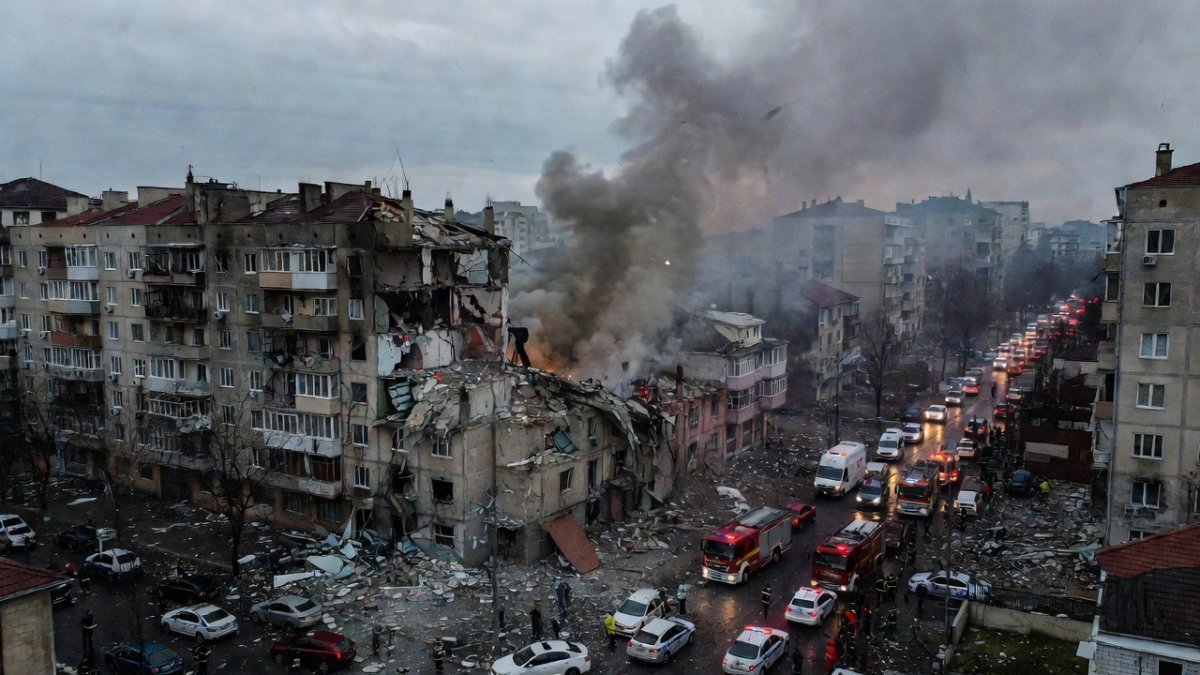
A City Held Hostage by a Ballistic Dawn
The sirens wailed over Kyiv before midnight, and the sky did not stop burning until the early hours of Saturday, August 1, 2026. Russia launched a mass combined ballistic missile and drone attack on the Ukrainian capital, an assault so dense that air defenses were still hunting targets as rescue crews pulled bodies from apartment blocks. Mayor Vitali Klitschko reported the ballistic missile threat in real time, confirming explosions across the city and active air defense operations throughout the night.
This was not a glancing blow. It was a deliberate, coordinated saturation strike aimed at the heart of a city that has endured Russian bombardment since the full-scale invasion began in February 2022. Residential buildings were hit. Fires roared in five districts. And when the smoke finally cleared, Ukraine's State Emergency Service counted nine dead and more than 30 wounded, including four children — with some reports, including Reuters via CNBC and The Guardian, putting the toll at at least ten.
The attack landed exactly 48 hours after another mass assault on Kyiv that killed more than a dozen people and wounded more than 130. Two catastrophic nights in a row. One unmistakable message from Moscow: the capital is a target, and Ukraine's shield is running dangerously thin.
The Human Toll: Nine Dead, Five Districts, Four Children Wounded
The numbers tell a brutal story. According to Ukraine's State Emergency Service, seven people were killed in the Darnytskyi district, a densely populated area on the eastern bank of the Dnipro River, and two more were killed in the Solomianskyi district, home to the city's main railway station. More than 30 people were treated for injuries, and among them were four children. The dead were civilians — people asleep in their homes when ballistic missiles arrived without a meaningful window to shelter.
The Emergency Service documented fires and destruction across five districts of the capital, a footprint that suggests multiple simultaneous impacts rather than a single lucky strike. Kyiv's residential neighborhoods absorbed the punishment, with apartment towers hit and emergency crews scrambling from one blaze to the next while the threat of follow-up drone waves lingered overhead.
Kyiv Post, Ukrainska Pravda, the Kyiv Independent, and NPR all confirmed the casualty figures. The discrepancy between nine and ten dead is a grim statistical argument — what matters is that families in Darnytskyi and Solomianskyi are burying loved ones this weekend, and the world is arguing over a number.
48 Hours, Two Massacres: The Pattern No One Can Ignore
Context matters. The overnight assault of July 30-31 killed more than a dozen people and wounded more than 130, according to Ukrainian authorities cited by the Kyiv Independent. That attack was already catastrophic. Then Russia did it again, just one night later, with an even heavier ballistic component.
This is not random violence. It is a deliberate escalation pattern. Al Jazeera reports that Russia has stepped up its ballistic missile attacks on Ukraine in recent months, shifting toward munitions that are faster, harder to intercept, and more devastating when they hit. Ballistic missiles travel at several times the speed of sound. They give civilians minutes of warning at best — often less.
The July 19 attack on Kyiv was large enough that the UN Security Council met at Ukraine's request. Now, less than two weeks later, the capital has been struck twice more. The rhythm of Russian escalation is accelerating, and the window for allies to respond is shrinking with every launch.
Zelenskyy's Blunt Warning: We Are Out of Patriots
President Volodymyr Zelenskyy delivered the hard truth in his overnight statement. Russia launched 35 missiles, including 27 ballistic missiles, along with 185 attack drones of various types, with Kyiv as the primary target. Additional strikes hammered the Dnipro, Sumy, Kharkiv, and Poltava regions. This was a national-scale assault, not a single-city tragedy.
And here is the brutal arithmetic: Ukraine has run out of Patriot interceptor missiles. Zelenskyy said it plainly — the munitions that are critical to defending against ballistic missiles are exhausted. Kyiv has appealed to allies for more interceptors, and that appeal is now an emergency, not a diplomatic nicety.
When Kyiv's air defense system was fully stocked, it performed near-miracles, knocking down Russian drones and cruise missiles night after night. But the Patriot system is the only shield that can reliably engage ballistic missiles. Without interceptors, the most dangerous weapons in Russia's arsenal face no credible opposition over the capital. That is not a prediction. That is what we watched unfold on the night of July 31.
The Trump Reversal: A License Denied at the Worst Possible Moment
Friday, July 31, 2026 was supposed to be a day of progress. Instead, it became a day of whiplash. President Donald Trump backed away from his earlier promise to let Ukraine produce Patriot missile systems domestically, according to The New York Times, NPR, and Radio Free Europe/Radio Liberty. Trump did not commit to Zelenskyy's request for production licenses.
The stakes could not be higher. Zelenskyy has been pressing Washington to grant licenses for Ukraine to build its own Patriot air defense missiles on Ukrainian soil. That would end the dependence on foreign stockpiles. That would mean Russian ballistic missiles would meet a homegrown wall of interceptors. Instead, the White House pulled back, and twenty-four hours later, Kyiv bled.
This is not a coincidence to be waved away. Ukraine's interceptor stockpile is empty because foreign supplies have not kept pace with Russian consumption of ballistic missiles. A production license would have been a structural answer to a structural problem. Without it, Ukraine is left waiting on deliveries that arrive too slowly and in numbers that are too small.
Starlink, Drones, and the Battlefield Ukraine Is Building
While the Patriot fight plays out in Washington, Ukraine is waging another war on its own terms. Zelenskyy has pushed to use Starlink for attacks inside Russia, but Elon Musk restricts Starlink use within Russia's internationally recognized borders, according to The Guardian. The service works inside Ukraine, including in Russian-occupied areas, but the restriction remains a point of friction between Kyiv and its most important communications provider.
The drone war, however, is not waiting for permission. Ukraine is intensifying its own drone attacks on Russian territory, mainly targeting oil depots. The Independent and Al Jazeera report that Russia has faced fuel shortages and disrupted supply lines directly caused by Ukraine's deep-strike drone campaign. A military that cannot fuel its vehicles cannot sustain an offensive.
This is the asymmetry of modern war. Russia attacks cities with ballistic missiles it can produce faster than allies can resupply interceptor stocks. Ukraine attacks fuel depots with drones it can build by the thousands. One side's strategy depends on allies. The other side's depends on endurance. Right now, endurance is winning — but at an unbearable human cost.
The Law Is Clear. The Response Is Not.
International law has already rendered its verdict. United Nations officials have said earlier Russian strikes on Kyiv violated international humanitarian law protections for civilians and civilian infrastructure. The UN Security Council met at Ukraine's request following the large July 19 attack, according to UN News and Jurist. The legal analysis has not changed. It has been reaffirmed by every additional strike.
But legal findings do not stop ballistic missiles. They did not protect Darnytskyi district on Saturday morning, and they did not shield the dozen people killed in the July 30-31 attack. The gap between what international law condemns and what the international community actually does about it is measured in Ukrainian civilian deaths.
Russia's full-scale invasion began in February 2022. Since then, Kyiv has defended itself through years of strikes, absorbing attacks that would break most cities. The capital has held. But holding requires ammunition, and ammunition requires political decisions made thousands of miles away.
The Bottom Line: Words Will Not Stop Ballistic Missiles
Here is where we stand. Ukraine needs Patriot interceptors delivered now — not next quarter, not after another round of negotiations. It needs production licenses granted so this crisis never repeats. And it needs Western leaders to stop reacting to massacres and start preventing them. Zelenskyy has been explicit about what he needs. The question is whether Washington and its allies are listening.
Every day of delay has a price, and that price is now being paid in the wreckage of Kyiv apartment buildings. The previous 48-hour attack cycle killed more than a dozen and wounded over 130. This one killed at least nine and wounded more than 30. Add those numbers together and you have the true cost of an empty interceptor stockpile.
The facts are not complicated. Russia launched 35 missiles, including 27 ballistic missiles, and 185 drones. Ukraine ran out of Patriots. Nine people are dead. Four children are injured. And the only acceptable response from the free world is to resupply Ukraine with the munitions it needs to defend its capital — and to license its factories to build more. Kyiv has done the impossible before, defending itself since February 2022 against overwhelming odds. It should not have to do it with empty hands.
By Jessica Ali, Staff Writer
This article was produced with AI-assisted research and editorial support. Reporting is based on sources cited in the article.
What's Your Reaction?
 Like
0
Like
0
 Dislike
0
Dislike
0
 Love
0
Love
0
 Funny
0
Funny
0
 Wow
0
Wow
0
 Sad
0
Sad
0
 Angry
0
Angry
0

Editor-in-Chief at Global1.News. Atlanta-based journalist who cuts through the BS and tells it like it is. Lead anchor, host, and the voice you hear when the spin stops and the truth starts.















Comments (0)