
Jailed Election Expert Kynev Denied Crutches After Leg Broken During Arrest, Journalist Says
Alexander Kynev, a prominent Russian political scientist and election analyst, is now confined to a cast‑bound leg and denied basic mobility aids after his arrest in late September.
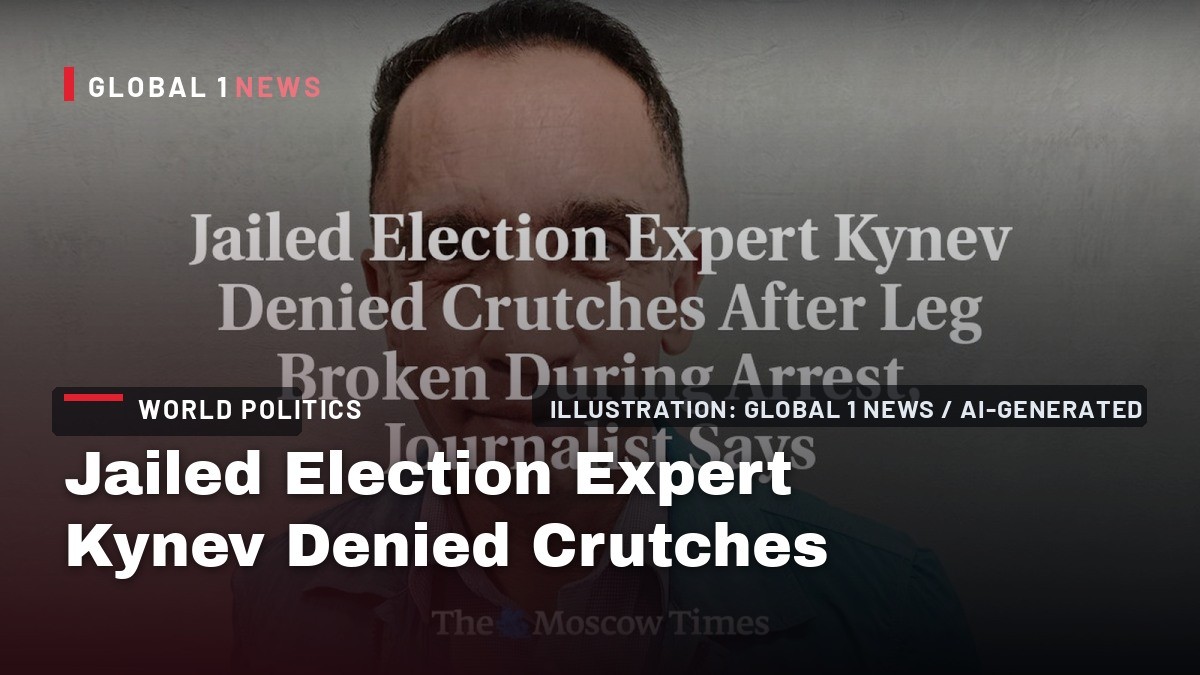
Alexander Kynev, a prominent Russian political scientist and election analyst, is now confined to a cast‑bound leg and denied basic mobility aids after his arrest in late September. According to a letter relayed by journalist Gleb Yarovoy, Kynev is being held at Moscow’s Pre‑Trial Detention Center No. 4, known colloquially as “Medved” (“Bear”), where he reports being placed in quarantine and cut off from any information about the outside world. The circumstances of his injury and the broader pattern of repression against independent experts illuminate the Kremlin’s tightening grip on dissenting voices ahead of the 2026 State Duma elections.
Arrest, Injury and Detention Conditions
The Perovsky District Court ordered Kynev’s pre‑trial detention on 25 September on charges of attempting to sell a large quantity of drugs. He denies any wrongdoing and faces a potential sentence of ten to twenty years if convicted. The Moscow Times reports that Kynev’s leg was broken during the arrest, a claim corroborated by the legal‑news Telegram channel Slovo Zashchite, which noted two fractures to his shinbone after he was beaten. He was subsequently taken to the hospital at Moscow’s Matrosskaya Tishina detention centre before being transferred to Medved.
Yarovoy’s letter states that Kynev remains in a cast with “about three more weeks to ‘walk’ around in it,” yet he cannot walk at all. Moreover, Kynev says he is being held in quarantine and receives no information about external events, a condition that isolates him from the public discourse he once shaped. His lawyer, Mikhail Biryukov, has refrained from confirming or denying the injury account, reflecting the cautious legal strategies often adopted by defence counsel in politically sensitive cases.
Medved Detention Centre: A Hub for Political Prisoners
Medved, located in Moscow’s Yuzhnoye Medvedkovo district, has a documented history of housing high‑profile political detainees. Opposition politician Ilya Yashin was previously confined there while under investigation for allegedly spreading “false information” about the Russian military, as noted by the investigative outlet Agentstvo. Other former inmates include police‑rights activist Vladimir Vorontsov, former monk Nikolai Romanov, and Andrei Bykov, former head of the Federal Penitentiary Service’s research institute. This roster underscores Medved’s role as a de facto holding facility for individuals deemed threatening to the state narrative.
Former presidential human‑rights council member Yelena Masyuk has documented systematic abuse at Medved, ranging from extortion and beatings by fellow inmates to incidents that drove prisoners to suicide. Such allegations, combined with the recent denial of crutches to Kynev, suggest a pattern of neglect and punitive conditions designed to break the morale of detainees who possess analytical or oppositional influence.
Kynev’s Political Profile and Pre‑Arrest Activity
Before his detention, Kynev was a regular commentator on the September 18‑20 State Duma elections. He estimated voter turnout at around forty percent and warned that United Russia would likely secure no more than thirty‑five percent of the vote without electoral fraud. He further cautioned that the party’s record haul of three hundred forty‑nine seats could backfire, implying potential instability in the legislative body.
Kynev’s expertise stems from his academic tenure at the Higher School of Economics and his leadership of the analytical department at Golos, an independent election‑monitoring organisation. His public assessments, grounded in empirical research, have long positioned him as a credible counter‑weight to official election narratives, making him a target for state repression.
Designation as a “Foreign Agent” and “Undesirable” Entity
In February 2026, the Justice Ministry designated Kynev a “foreign agent,” accusing him of spreading false information about government policies and the electoral system, and of cooperating with an organisation labelled “undesirable.” This label carries severe legal and social ramifications, including heightened surveillance, financial restrictions, and the stigma of being a foreign‑linked subversive. The designation aligns with a broader campaign to marginalise independent analysts and NGOs that challenge state‑sanctioned narratives.
The Moscow Times itself has been labelled “undesirable” by the Prosecutor General’s Office, criminalising its operations and exposing its staff to prosecution. The outlet’s own statement highlights the Kremlin’s systematic effort to silence dissenting journalism, a climate that directly impacts the safety and freedom of analysts like Kynev.
Implications for the 2026 Electoral Landscape
Kynev’s arrest and the broader crackdown on election experts signal a tightening of the Kremlin’s control over electoral discourse. By removing a leading independent voice that projected a modest turnout and warned of United Russia’s overreach, the state reduces the availability of credible alternative analyses that could fuel public scepticism.
The denial of medical assistance, such as crutches, further illustrates an intent to inflict hardship on those who could shape public opinion. Such tactics may deter other scholars from offering independent assessments, thereby consolidating the official narrative that the election results reflect genuine popular support.
Legal Outlook and Potential International Repercussions
Kynev faces a possible ten‑to‑twenty‑year prison term if convicted on the drug‑trafficking charges, a sentence that would be severe even by Russian standards for non‑violent offences. The lack of transparent evidence linking him to drug activity, combined with the timing of his arrest amid heightened electoral scrutiny, raises questions about the political motivation behind the case.
International human‑rights organisations have repeatedly condemned the use of “foreign agent” and “undesirable” designations to stifle dissent. While the article does not detail any external diplomatic response, the pattern of targeting independent analysts suggests that Kynev’s case could become a focal point for advocacy groups urging the Kremlin to respect academic freedom and due process.
Broader Context: The Kremlin’s Strategy of Suppression
The treatment of Kynev fits within a broader Kremlin strategy of neutralising independent expertise that challenges official narratives. By branding analysts as “foreign agents,” imprisoning them on dubious charges, and subjecting them to harsh detention conditions, the state creates a climate of fear that discourages critical assessment of its policies.
Such tactics have been evident across multiple sectors: opposition politicians, human‑rights activists, and even former members of the presidential human‑rights council have faced similar repression. The systematic denial of basic medical aids, as illustrated by Kynev’s lack of crutches, underscores an approach that extends beyond legal prosecution to physical intimidation.
This article was produced with AI-assisted research and editorial support. Reporting is based on the source material cited below. Sources: The Moscow Times; themoscowtimes.com; Global1.News (17 October 2026).
By Irina Volkov, Staff Writer
What's Your Reaction?
 Like
0
Like
0
 Dislike
0
Dislike
0
 Love
0
Love
0
 Funny
0
Funny
0
 Wow
0
Wow
0
 Sad
0
Sad
0
 Angry
0
Angry
0
Russia/Eastern Europe Correspondent at Global1.News. Covering Russian politics, energy, security, and the shifting dynamics of the post-Soviet space. Provides clear-eyed analysis on one of the world's most opaque regions.














Comments (0)