
DepEd Launches AI Platform to End Blanket Class Suspensions, Keep More Kids in School During Calamities
DepEd launched Project LIGTAS+, an AI-powered platform using satellite imagery and geospatial analytics to enable school-specific class suspensions during calamities, potentially ending blanket shutdowns that cost millions of learners 30+ school days annually. Recommendations still under review.
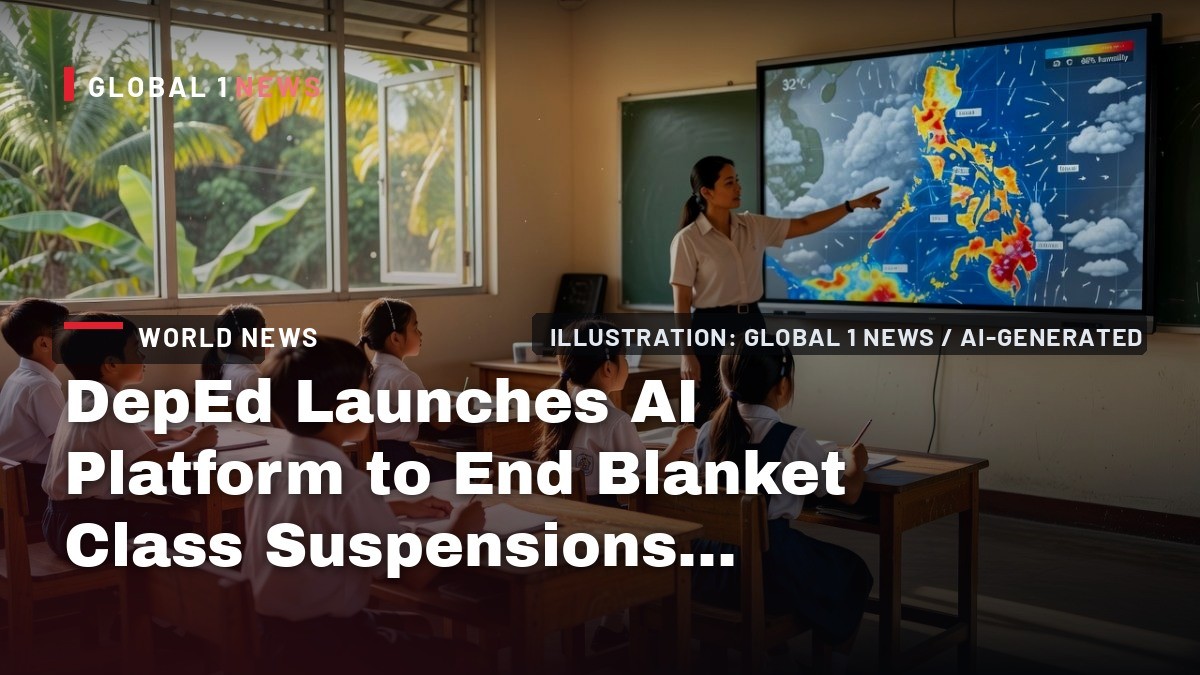
MANILA — For generations of Filipino students, the arrival of a typhoon signal or a scorching heat index has meant one thing: a day off from school. But for millions of learners, those days off have quietly added up to more than a month of lost classroom time every single year. On Wednesday, August 26, 2026, the Department of Education (DepEd) took a bold step to change that, launching an artificial intelligence-powered platform designed to make class suspensions school-specific rather than blanket orders that shut down entire cities or provinces.
The new system, called Project LIGTAS+ (Learning Institution Geohazard Tracking and Assessment for Safety), was unveiled at the Techzone Building in Makati City, led by DepEd Secretary Sonny Angara. The platform integrates AI, satellite imagery, and geospatial analytics with school-level risk data to convert fragmented hazard updates into real-time, actionable intelligence for education leaders. The goal is simple but ambitious: allow a school in a flooded barangay to suspend classes while a campus just a few kilometers away, safe from the rising waters, continues its lessons uninterrupted.
From Blanket Suspensions to Precision Decisions
For decades, the default response to calamities in the Philippines has been a blunt instrument. When the Philippine Atmospheric, Geophysical and Astronomical Services Administration (PAGASA) raises a storm signal or the heat index hits dangerous levels, local government units (LGUs) often declare a citywide or province-wide suspension of classes. The decision is made for the sake of safety, but it comes at a steep cost.
According to the Second Congressional Commission on Education (EDCOM 2), millions of learners lose more than 30 school days a year due to class suspensions. That is roughly six weeks of instruction lost annually — time that could have been spent on reading, mathematics, and science. For a country already grappling with learning poverty and the lingering effects of pandemic school closures, those lost days are a national emergency in their own right.
Secretary Angara made the case for a fundamental shift in how the education system approaches disasters. "We cannot solely rely on our resilience, especially when it comes to education," Angara said during the launch. "We have to make sure that our schools are prepared, ready to respond and ready to move forward with learning, whatever challenges may come."
The message is a departure from the passive acceptance of calamity disruptions that has long characterized the sector. Instead of simply bracing for the worst, DepEd is now aiming to anticipate, assess, and act with precision.
How LIGTAS+ Works: Satellites, AI, and School-Level Risk Profiles
At its core, Project LIGTAS+ is a multi-hazard analytics and risk management platform developed by DepEd's Disaster Risk Reduction and Management Service (DRRMS) in partnership with the Education Center for AI Research (ECAIR). The system consolidates hazard information from various government agencies and combines it with detailed risk profiles for each of the more than 48,000 public schools nationwide.
The platform uses geospatial analytics and satellite imagery to generate school-specific risk assessments. It monitors a wide range of hazards, including floods, earthquakes, typhoons, landslides, volcanic activity, storm surges, and extreme heat. The system provides interactive multi-hazard maps, flood intelligence based on satellite radar data, earthquake impact assessments, volcanic monitoring, and AI-powered weather forecasts of up to 10 days.
DepEd Undersecretary for Governance and Operations Malcolm Garma explained the philosophy behind the platform. "One of the objectives ng Project LIGTAS+ [is] to be able to provide more granular data, more science-based, more data-based decision-making," Garma said.
In practical terms, this means that when a typhoon approaches, education officials will no longer have to rely solely on a single storm signal number to decide the fate of every school in a region. Instead, they will be able to see which specific campuses are in flood-prone areas, which are near rivers that might swell, and which are on higher ground and can safely remain open.
What It Means for Parents, Students, and Teachers
For parents like Aling Nena, a sari-sari store owner in a low-lying barangay in Marikina City, the current system has always been a gamble. When heavy rain begins, she has to decide whether to send her two children to school or keep them home. If she sends them and classes are suspended, they walk back in the rain. If she keeps them home and classes push through, they miss a lesson.
The new platform aims to remove that guesswork. By providing school-specific data, parents will have a clearer picture of whether their child's campus is actually at risk. Teachers, too, stand to benefit. Instead of preparing for a sudden suspension, they can plan lessons with greater certainty, knowing that their school's status is based on real-time conditions rather than a citywide announcement.
The system is designed to be accessed by schools directly, with regional and division offices providing support when campuses encounter difficulties. This decentralized approach empowers school heads and barangay officials to make informed decisions based on ground conditions, rather than waiting for a top-down directive from a distant regional office.
The Challenge of Ground Conditions and Infrastructure
While the promise of LIGTAS+ is significant, DepEd officials are careful not to oversell the platform's capabilities. Garma acknowledged that the usefulness of the system depends heavily on ground conditions and infrastructure availability, especially during hazards such as flooding and earthquakes. A school may have a perfect risk profile on paper, but if the roads leading to it are impassable, students cannot safely travel.
There is also the question of connectivity. Many public schools in remote areas, particularly in the Bangsamoro region and the Visayas, still struggle with unreliable internet access. The platform's real-time data is only as good as the connection that delivers it. DepEd has not yet announced specific plans to address these connectivity gaps, but the agency's regional and division offices are expected to play a critical role in bridging the digital divide.
Another practical concern is the human element. The platform provides data, but the final decision to suspend or resume classes will still rest with education officials and school heads. The system is a decision-support tool, not a replacement for human judgment. In a country where weather patterns can shift dramatically within hours, the ability to interpret data quickly and act decisively will remain a crucial skill.
From Passive Resilience to Proactive Management
Secretary Angara framed the launch as a philosophical shift for the Department of Education. The old approach, he suggested, was one of passive resilience — waiting for a hazard to strike and then reacting. The new approach is proactive disaster management, ensuring that local officials have actionable intelligence to protect learners and maintain learning continuity before hazards escalate into crises.
This shift is particularly urgent given the realities of climate change. The Philippines is consistently ranked among the most disaster-prone countries in the world, and extreme weather events are becoming more frequent and more severe. The heat index, once a minor concern, has become a major factor in class suspensions, with temperatures regularly exceeding dangerous thresholds in many parts of the country.
The platform's ability to incorporate heat index data into suspension decisions is a significant development. In recent years, schools in Metro Manila and other urban centers have been forced to suspend classes during extreme heat events, often with little notice. With LIGTAS+, education officials will be able to assess which schools have adequate ventilation, shaded areas, and cooling measures, and make more nuanced decisions about whether to suspend or adjust class schedules.
Recommendations Still Under Review
Despite the fanfare of the launch, DepEd is careful to note that the full implementation of school-level suspensions and resumptions is not yet a done deal. Garma revealed that the department has already drafted recommendations that would allow both class suspensions and resumptions to be made at a more granular level. However, these recommendations are still being reviewed, and no date has been announced for when the approach would take effect.
The department is also still deciding on the legal instrument that would formalize the new policy. Garma said the recommendations for inspections of schools have been drafted, but the department has not yet determined whether the policy will be issued as an executive order or a memorandum circular. This cautious approach reflects the complexity of the issue — changing how class suspensions are declared involves coordination with LGUs, the Department of the Interior and Local Government (DILG), and other agencies.
For now, the platform is being positioned as a tool to support decision-making, not to override existing protocols. The transition from blanket suspensions to school-specific ones will likely be gradual, with pilot testing in select divisions before a nationwide rollout.
A Future of Fewer Lost School Days
For the millions of Filipino learners who lose more than 30 school days a year, the promise of LIGTAS+ is a glimmer of hope. The platform represents a recognition that education cannot simply stop every time it rains or the temperature rises. In a country where the bayanihan spirit is strong, the new system embodies a collective effort to keep learning alive even in the face of adversity.
The challenge ahead is significant. The platform must prove its reliability in real-world conditions, from the flooded streets of Marikina to the earthquake-prone valleys of Benguet. It must win the trust of parents who have grown accustomed to checking the news for suspension announcements. And it must be accessible to every school, from the sprawling campuses of Manila to the one-room schoolhouses in remote island barangays.
But the direction is clear. With Project LIGTAS+, the Department of Education is signaling that the days of blanket class suspensions may be numbered. The future, Angara and his team hope, is one where a child in a safe school can continue learning even as a storm rages elsewhere — and where no Filipino student loses a month of education to a calamity that could have been managed with better data.
As the typhoon season approaches, all eyes will be on how this ambitious platform performs in the real world. For now, the promise is there: a smarter, safer, and more resilient education system for the Philippines.
This article was produced with AI-assisted research and editorial support. Sources: PhilStar, GMA News, Daily Tribune.
By Bella Reyes, Staff Writer
This article was produced with AI-assisted research and editorial support. Sources: PhilStar, GMA News, Daily Tribune.
By Bella Reyes, Staff Writer
What's Your Reaction?
 Like
0
Like
0
 Dislike
0
Dislike
0
 Love
0
Love
0
 Funny
0
Funny
0
 Wow
0
Wow
0
 Sad
0
Sad
0
 Angry
0
Angry
0

Philippines/Southeast Asia Correspondent at Global1.News. Manila-based journalist covering Philippine politics, environment, maritime security, and social issues. Passionate about marine conservation and the communities protecting the Philippines' natural heritage.













Comments (0)