
Damascus Court Sentences Assad to Death in Landmark War Crimes Verdict
In a recent i24NEWS English report, Syria's transitional justice system delivered a historic and unprecedented verdict: the Fourth Criminal Court in Damascus sentenced ousted President Bashar al-Assad, his brother Maher al-Assad, and former security chief Atef Najib to death for war crimes and crimes against humanity. The ruling marks the first time a Syrian court has convicted the former dictator for the atrocities committed during the country's brutal 14-year civil war, a...
In a recent i24NEWS English report, Syria's transitional justice system delivered a historic and unprecedented verdict: the Fourth Criminal Court in Damascus sentenced ousted President Bashar al-Assad, his brother Maher al-Assad, and former security chief Atef Najib to death for war crimes and crimes against humanity. The ruling marks the first time a Syrian court has convicted the former dictator for the atrocities committed during the country's brutal 14-year civil war, a conflict that killed roughly half a million people and displaced millions more.
Damascus Court Sentences Assad to Death in Landmark War Crimes Verdict
Jerusalem, Israel — In a ruling that reverberates far beyond the halls of the Fourth Criminal Court in Damascus, Syria's transitional authorities on Tuesday sentenced the ousted president and two of his most notorious security lieutenants to death. The court convicted Bashar al-Assad, his brother Maher al-Assad, and Atef Najib, a former brigadier general who led the Political Security Branch in Daraa, on charges including premeditated murder of civilians—including children—torture, incitement to murder, arbitrary detention, crimes against humanity, and war crimes. While the Assad brothers were tried in absentia, Najib appeared in person, standing in a cage as the sentence was read, a stark visual symbol of the fall of the regime that once ruled Syria with an iron fist.
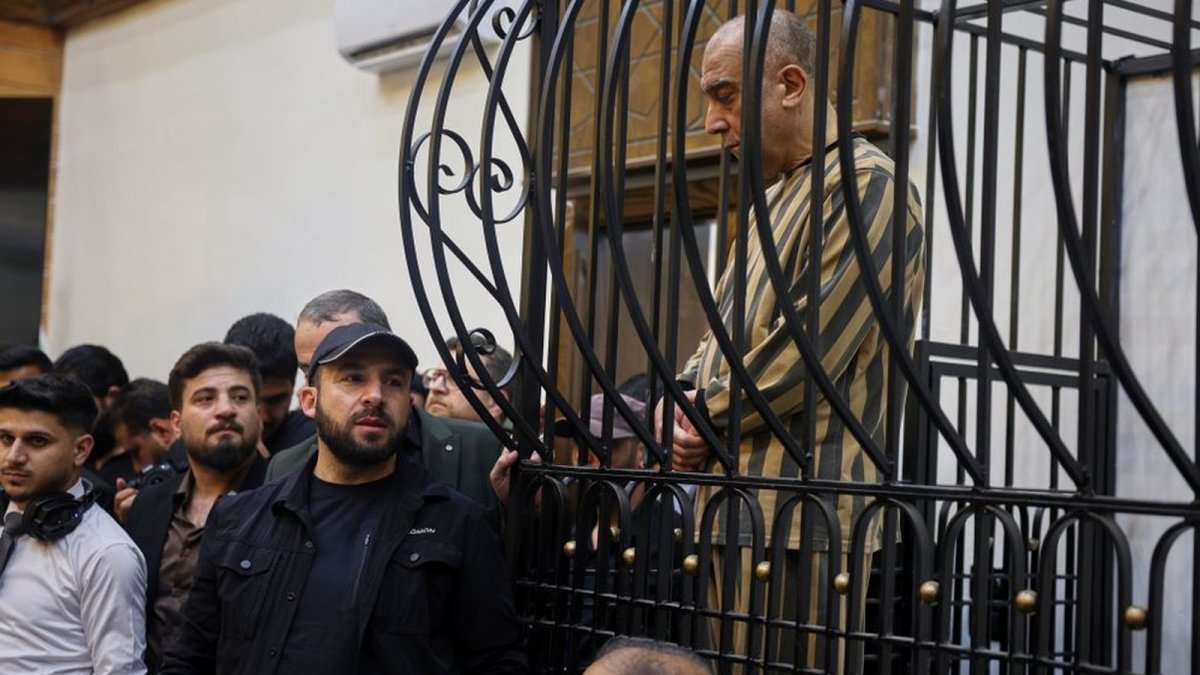
The Verdict in Damascus
The Fourth Criminal Court's decision on Tuesday was the culmination of months of legal proceedings under Syria's new transitional authorities, who have begun prosecuting former government figures both in person and in absentia. The court ordered that the Assad brothers be pursued internationally, a largely symbolic gesture given that Bashar al-Assad fled to Moscow in December 2024 as opposition forces closed in on Damascus. Najib, however, faced his judgment directly. As a former brigadier general who led the Political Security Branch in Daraa in 2011, Najib was the man on the ground when the anti-government uprising erupted in that southern city—the spark that ignited the nationwide revolt and, subsequently, the civil war.
The charges against the three men were sweeping and specific. The court detailed acts of premeditated murder, including the killing of children, alongside systematic torture and arbitrary detention that characterized the Assad regime's response to dissent. The inclusion of incitement to murder and crimes against humanity reflects the international legal framework that the transitional authorities have sought to invoke, signaling an attempt to align Syria's domestic justice process with global standards. For the new Damascus government, led by interim president Ahmed al-Sharaa and the Islamist Hayat Tahrir al-Sham (HTS) faction, this verdict is a cornerstone of their claim to legitimacy—a clear break from the brutal past and a promise of accountability.
From Daraa to Moscow: The Assad Era
The roots of this verdict lie in the dusty streets of Daraa, where in March 2011, teenagers were arrested and tortured for scrawling anti-government graffiti. The crackdown ordered by Najib's Political Security Branch sparked protests that spread like wildfire across Syria, and the regime's violent response—shelling cities, using barrel bombs, and employing chemical weapons—plunged the country into a war that would last nearly 14 years. The conflict drew in regional and global powers, from Iran and Hezbollah propping up Assad to Turkey, the United States, and Russia backing various opposition factions. By the time the war wound down, an estimated 500,000 Syrians were dead, and millions had fled to neighboring countries and Europe, creating a refugee crisis that reshaped Middle Eastern and European politics.
Bashar al-Assad inherited the presidency from his father, Hafez al-Assad, who ruled Syria from 1971 until his death in 2000. The younger Assad, an ophthalmologist trained in London, was initially seen by some as a potential reformer, but he quickly proved to be as ruthless as his father. His fall in December 2024, when opposition forces swept into Damascus and he fled to Moscow with his family, ended more than five decades of Assad family rule. The verdict this week is the first judicial reckoning for that era, a formal declaration by the Syrian state itself that the Assad regime was criminal. For the victims and their families, it is a validation of their suffering; for the transitional authorities, it is a foundational act of the new order.

Regional Context: Israel and the Post-Assad Order
For Israel, the verdict in Damascus is being watched closely from the Golan Heights, where the Jewish state shares a northern border with Syria. Since Assad's fall, Israel has conducted a series of strikes on former Syrian military assets, including air defenses, missile depots, and chemical weapons facilities, to prevent them from falling into hostile hands. The IDF has also established positions in the buffer zone along the border, a move that has drawn criticism from Damascus but which Israel defends as a necessary security measure given the uncertainty of the transition. The verdict lands amid Israeli concerns about instability in southern Syria, particularly the fate of the Druze community there, which has historical ties to Israel and has faced pressure from various armed factions.
The broader question for Jerusalem is what kind of state emerges from the ashes of the Assad regime. The transitional authorities under Ahmed al-Sharaa, a former al-Qaeda affiliate who has sought to moderate his image, are an unknown quantity. Israel has maintained a cautious, pragmatic line, engaging in indirect communications while reserving the right to act militarily against any threat. The verdict against Assad, while symbolically significant, does little to address Israel's core security concerns: the potential for renewed Iranian or Hezbollah influence in Syria, the durability of the post-Assad order, and the risk that the country could fragment into sectarian fiefdoms. For Israel, the death sentence for Assad is a footnote; the stability of the Golan border is the headline.
Diplomatic and International Reactions
The international community has responded to the verdict with a mix of cautious approval and legal skepticism. Farhan Haq, deputy spokesperson for the United Nations, called for a transitional justice mechanism centered on victims that fully respects human rights, a statement that implicitly acknowledges the legitimacy of the Syrian process while urging adherence to international standards. Western governments, including the United States and European Union members, have largely welcomed the accountability step, though they have stopped short of endorsing the death penalty, which many of them oppose on principle. Russia, which granted Assad refuge in Moscow, has remained silent on the verdict, and the practical impossibility of extraditing the former president from Russian soil makes the sentence largely symbolic for Assad himself.
The legal debate surrounding the trial is significant. The use of in absentia trials, while common in some legal systems, raises questions about the right to a defense and the fairness of the proceedings. Head-of-state immunity, a principle that has historically protected sitting leaders from prosecution, is another contentious issue, though many legal scholars argue that immunity does not extend to crimes against humanity. The death penalty itself is a point of contention, with human rights organizations urging the transitional authorities to commute the sentences. For the new Damascus government, however, the verdict is a political statement as much as a legal one—a declaration that the old regime is not merely defeated but condemned.
Analysis and What This Means
The verdict is a landmark step for Syria's accountability process, but its practical impact is limited. Bashar al-Assad sits in Moscow, protected by the Kremlin, and there is no realistic scenario in which he is handed over to face execution. Maher al-Assad, the feared commander of the Republican Guard, is also believed to be in Russia, and Atef Najib, the only defendant tried in person, is now facing the ultimate penalty. The symbolic weight of the ruling, however, cannot be overstated. For the first time, a Syrian court has formally declared that the Assad regime was a criminal enterprise, and that its leaders are guilty of war crimes. This sets a precedent for future prosecutions of lower-level regime figures, and it provides a foundation for the transitional justice process that the UN and other international bodies have called for.
For Israel and the region, the verdict is a reminder that the post-Assad order is still being defined. The transitional authorities in Damascus are seeking to establish their legitimacy through legal means, a departure from the brutal methods of their predecessors. But the challenges remain immense: a shattered economy, sectarian tensions, the presence of foreign forces, and the ever-present risk of renewed conflict. Israel will continue to monitor the situation along the Golan Heights, wary of any signs that the new government is unable or unwilling to control its territory. The death sentence for Assad is a powerful symbol, but symbols do not secure borders or guarantee stability.
As the dust settles on this historic verdict, the question that lingers is not whether Assad will ever face the gallows—he almost certainly will not—but whether Syria can build a justice system that serves its people and a state that can coexist with its neighbors. The transitional authorities have taken a bold step, but the road ahead is long and uncertain. For the victims of the Assad regime, the verdict offers a measure of closure, a recognition that their suffering was not in vain. For the region, it is a signal that the old order is truly gone, and that the new one, for all its flaws, is at least attempting to reckon with the past. Whether that reckoning leads to reconciliation or further division remains to be seen, but for now, Damascus has spoken, and the world is watching.
By Hannah Berg, Staff Writer
This article was produced with AI-assisted research and editorial support. Reporting is based on sources cited in the article.
What's Your Reaction?
 Like
0
Like
0
 Dislike
0
Dislike
0
 Love
0
Love
0
 Funny
0
Funny
0
 Wow
0
Wow
0
 Sad
0
Sad
0
 Angry
0
Angry
0

Israel Correspondent at Global1.News. Based in Tel Aviv, covering Israeli politics, security, technology, and society. Provides balanced, deeply-sourced reporting on one of the most closely-watched regions in the world.














Comments (0)