
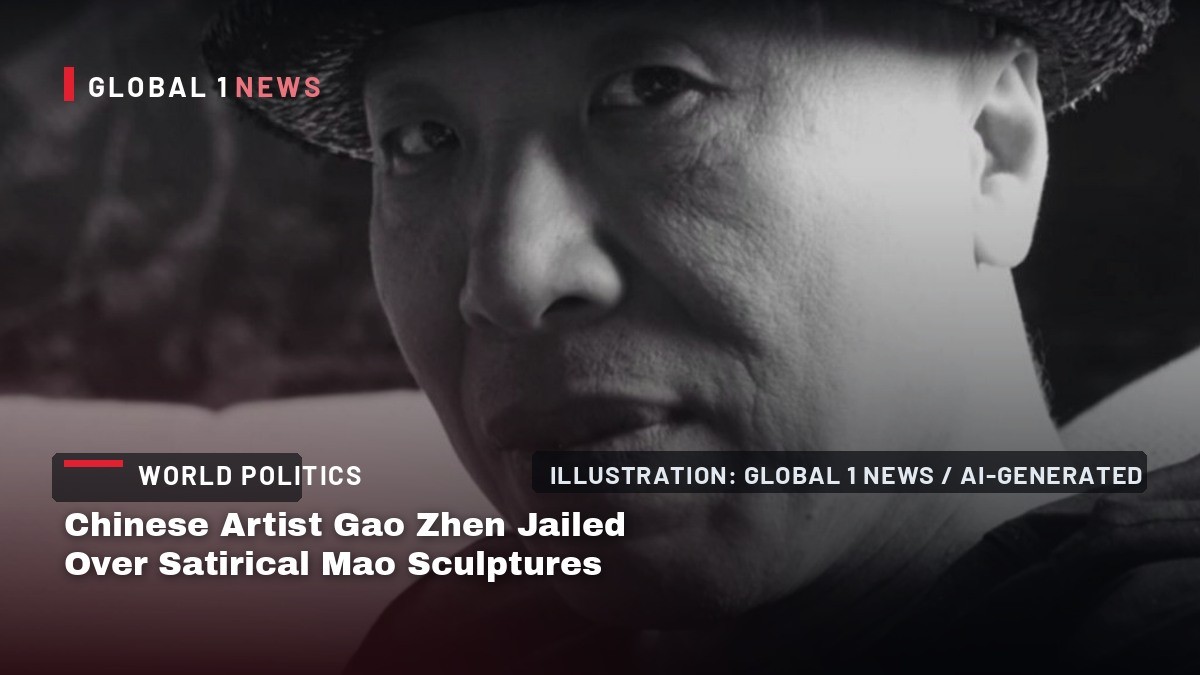
Chinese Artist Gao Zhen Jailed Over Satirical Mao Sculptures
The case of Gao Zhen, a 70-year-old Chinese artist renowned for satirical sculptures of Mao Zedong, has culminated in a maximum three-year prison sentence, according to rights groups monitoring the proceedings. A court in Hebei province ruled on Tuesday that Gao’s body of work “infringes upon the hero's reputation and harms public interest,” a verdict that has drawn sharp international condemnation and raised profound questions about the retroactive application of Chinese law.
Chinese Artist Gao Zhen Jailed Over Satirical Mao Sculptures
The case of Gao Zhen, a 70-year-old Chinese artist renowned for satirical sculptures of Mao Zedong, has culminated in a maximum three-year prison sentence, according to rights groups monitoring the proceedings. A court in Hebei province ruled on Tuesday that Gao’s body of work “infringes upon the hero's reputation and harms public interest,” a verdict that has drawn sharp international condemnation and raised profound questions about the retroactive application of Chinese law. The ruling, delivered after a one-day, closed-door trial earlier this year, marks a significant escalation in Beijing’s management of historical memory and artistic expression under the Xi Jinping administration. Amnesty International has characterized the sentencing as an “assault” on artistic freedom, while the UN Human Rights Office has voiced specific concerns regarding the retroactive nature of the charges. Gao, who has been in detention for two years, plans to appeal the conviction, setting the stage for a legal battle that will test the boundaries of China’s political-legal system.
The Court Ruling and the Specific Charges
The Hebei court’s decision, reported by rights groups on Tuesday, imposes the statutory maximum sentence of three years for the charge of “slandering China's heroes.” The ruling specifically cited Gao’s artworks as the basis for the conviction, determining that they “infringe upon the hero's reputation and harms public interest.” The trial itself was conducted behind closed doors, a procedural choice that has limited public scrutiny of the evidence and legal arguments presented. Given that Gao has already spent two years in detention since his arrest in August 2024, the practical effect of the sentence is that he would be due for release in August 2027 if the verdict is upheld on appeal. The closed nature of the proceedings, which received minimal coverage in Chinese state media, underscores the sensitivity of the case and the government’s desire to manage the narrative without public debate.The Legal Framework: The 2018 Heroes and Martyrs Protection Law
The charges against Gao Zhen were brought under legislation that came into force in March 2018, a law specifically designed to protect the reputation of historical figures associated with the Chinese Communist Party. The Heroes and Martyrs Protection Law criminalizes the defamation of individuals deemed to have made significant contributions to the nation’s revolutionary history. This legal instrument is part of a broader legislative trend under Xi Jinping to codify ideological control into the statute books. The law’s wording is notably broad, prohibiting acts that “distort, vilify, defame, or deny” the deeds of heroes and martyrs. Legal analysts have long noted that the law’s ambiguity allows for expansive interpretation, effectively giving authorities wide latitude to determine what constitutes a punishable offense. The application of this law to artworks created in 2009, nearly a decade before the legislation existed, raises serious questions about the principle of legality and the prohibition on retroactive punishment, a cornerstone of most modern criminal justice systems.The Artist’s Biography and Provocative Works
Gao Zhen, along with his brother Gao Qiang, rose to prominence in China’s art scene during the 1990s and 2000s, building a global reputation for works that skewered the political orthodoxies of their homeland. Their most famous piece, Execution of Christ, exhibited in 2009, depicts a squad of Mao-like figures holding Jesus Christ at gunpoint, a provocative fusion of political and religious iconography. Two other sculptures cited in the case were also exhibited that same year. Mao's Guilt presents a life-sized replica of the leader kneeling in a pose of solemn contrition, while Miss Mao offers a surrealist depiction of the chairman with large breasts and a long, Pinocchio-style nose. These works, which were publicly displayed without legal consequence at the time of their creation, have now been retroactively deemed criminal. The case illustrates the shifting sands of China’s cultural policy, where works once tolerated or ignored can become evidence of criminality when the political climate changes.Timeline of Detention and Legal Proceedings
The sequence of events leading to Tuesday’s ruling reveals a deliberate and methodical legal process. Gao Zhen moved to the United States in 2022, seeking to distance himself from the tightening political environment in China. However, during a visit to his studio on the outskirts of Beijing in August 2024, he was arrested by authorities. Following his detention, Chinese authorities seized his artworks and imposed travel restrictions on his wife and seven-year-old son, barring them from leaving the country. The case was heard in a one-day, closed-door trial earlier this year, a process that rights groups say lacked transparency and due process. The verdict, delivered on Tuesday, represents the culmination of a legal strategy that appears designed to send a message to other artists and dissidents, both within China and abroad. The timing of the arrest, coming two years after his move to the US, signals that Beijing is willing to police its citizens transnationally, even for conduct that occurred years ago.International Reaction: Amnesty International and the UN
The international community has responded with swift and unequivocal condemnation. Amnesty International’s China Director, Sarah Brooks, issued a strongly worded statement on Tuesday, declaring that “no artist should face criminal punishment for creating work that challenges official narratives or encourages critical reflection on history.” Brooks argued that the trial “demonstrates how broadly worded and politically motivated laws are used – and worse, in this case, used retroactively – to silence artists, activists and other individuals who dare to express views that differ from those of the Chinese government.” The UN Human Rights Office echoed these concerns, telling AFP that “the case against [Gao Zhen] raises particular concerns with regard to the retroactive application of criminal law, the use of criminal sanctions to punish artistic expression, and the impact on his family.” These statements reflect a growing international unease with China’s legal-political environment, particularly its willingness to apply laws retroactively to punish expression that was legal when it occurred.The Appeal and the Family’s Ordeal
Gao Zhen plans to appeal the conviction, according to Amnesty International’s announcement on Tuesday. The appeal process will be closely watched by legal experts and human rights organizations, though the prospects for overturning the verdict appear limited given the political sensitivities involved. The case has also taken a significant toll on Gao’s family. His wife and seven-year-old son remain barred from leaving China, effectively making them hostages to the legal proceedings. Earlier this year, Gao’s brother, Gao Qiang, told the BBC that the trial’s “message is clear.” He observed that “even if a work was made 15 years ago, it can still be turned into a crime if today's political climate changes.” This statement encapsulates the existential uncertainty facing artists in China, where the legal status of their work can shift retroactively based on the prevailing political winds.Xi-Era Governance and the Tightening of Political-Legal Oversight
The Gao Zhen case must be understood within the broader context of Xi Jinping’s governance model, which has systematically tightened political-legal oversight across all sectors of society. China watchers have noted that the arrest demonstrates how the Chinese Communist Party is “becoming increasingly extreme in both grasp and reach – including by policing its citizens transnationally and retroactively.” This approach reflects a strategic calculus that prioritizes ideological purity and historical memory management over international reputation or artistic freedom. The use of the 2018 Heroes and Martyrs Protection Law, with its deliberately broad wording, provides the party with a flexible legal instrument to punish dissent without the need for specific, narrowly-tailored legislation. The retroactive application of this law to works created in 2009 signals that no artist, regardless of their international standing or the age of their work, is immune from prosecution.Geopolitical Implications for Foreign Artists and Cultural Institutions
The implications of this ruling extend far beyond Gao Zhen’s personal circumstances, sending a chilling signal to foreign artists, curators, and cultural institutions seeking to engage with China. The case demonstrates that China’s legal system can be mobilized to punish artistic expression that challenges official narratives, even when that expression occurred years ago and was initially tolerated. For Western museums and galleries that have sought to build relationships with Chinese cultural institutions, the Gao case raises difficult questions about the ethics of engagement. International art markets may now view Chinese artists with a more cautious eye, recognizing that their work could expose them to legal jeopardy. The ruling also complicates China’s soft power ambitions, as the international community increasingly views the country’s cultural sector as a tool of political control rather than a space for creative expression. For Beijing, the strategic calculus appears to prioritize domestic ideological control over international cultural engagement, a trade-off that may have long-term consequences for China’s global standing.Historical Memory and the Management of Revolutionary Iconography
At its core, the Gao Zhen case is about the management of historical memory and the sanctity of revolutionary iconography. The sculptures in question directly engage with the legacy of Mao Zedong, a figure whose image remains central to the Chinese Communist Party’s legitimacy. By depicting Mao in satirical, irreverent, or critical poses, Gao’s works challenge the hagiographic narrative that the party has constructed around its founding leader. The 2018 Heroes and Martyrs Protection Law was specifically designed to defend this narrative, criminalizing any expression that might undermine the heroic status of revolutionary figures. The application of this law to Gao’s case demonstrates that the party views artistic criticism of Mao as a direct threat to its ideological foundations. This approach reflects a broader trend in Xi-era governance, where historical interpretation is increasingly centralized and dissent is met with legal sanction. The message to artists, historians, and intellectuals is unambiguous: the official version of history is not open to debate, and those who challenge it do so at their own peril. By Prof. Marcus Chen, Staff WriterThis article was produced with AI-assisted research and editorial support. Sources: BBC News.
What's Your Reaction?
 Like
0
Like
0
 Dislike
0
Dislike
0
 Love
0
Love
0
 Funny
0
Funny
0
 Wow
0
Wow
0
 Sad
0
Sad
0
 Angry
0
Angry
0

Marcus Chen
World Politics Analyst at Global1.News. Based in Beijing, covering US-China relations, global trade, and geopolitical strategy. Brings deep analytical perspective to the power dynamics shaping international affairs.












Comments (0)