
Mawlid in Lagos: Thousands March for Faith and Unity
Thousands of Muslim worshippers filled the streets of Lagos this week to mark Eid al-Mawlid, the celebration of Prophet Muhammad's birth — a day of processions, prayer and community that carried a message reaching far beyond the faithful. In a country gripped by economic hardship, the crowds marched through the city in waves, turning faith into a public statement of unity, tolerance and peaceful coexistence between Christians and Muslims.
Thousands of Muslim worshippers filled the streets of Lagos this week to mark Eid al-Mawlid, the celebration of Prophet Muhammad's birth — a day of processions, prayer and community that carried a message reaching far beyond the faithful. In a country gripped by economic hardship, the crowds marched through the city in waves, turning faith into a public statement of unity, tolerance and peaceful coexistence between Christians and Muslims.
Mawlid in Lagos: Thousands March for Faith and Unity
Lagos, Nigeria — The streets of Africa's largest city became a moving tapestry of white robes, green banners and song this week, as worshippers marked the birth of the Prophet Muhammad with processions, Quran recitations and acts of charity. For Amara Diop, reporting for Global1.News, the celebration offered a window into how faith sustains communities even when times are hard — and how the same spiritual tide rises across the continent, from Lagos to Senegal's own sacred city of Tivaouane.
A City in Celebration: Lagos Marks the Prophet's Birthday
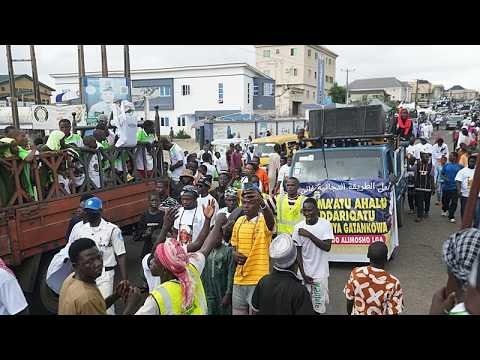
The scale of the Tuesday procession was impossible to miss. Thousands of Muslim worshippers filled the streets of Lagos on Tuesday, August 25, 2026, for Eid al-Mawlid, moving through the city's bustling neighbourhoods in organised waves. From the mainland districts of Mushin and Agege to the island's older quarters, the faithful turned out in numbers that stopped traffic and drew curious onlookers to balconies and street corners.
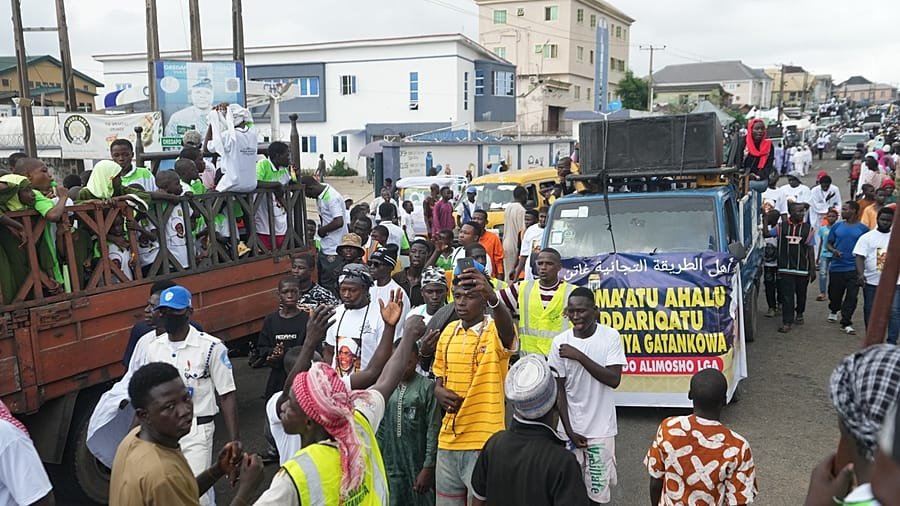
Participants marched through parts of the city in groups, each contingent carrying its own banners and chanting praises of the Prophet. Young men in flowing white agbadas walked alongside elderly scholars leaning on wooden staffs, while women in brightly coloured hijabs and children clutching small green flags added colour to the procession. The rhythm of the march was punctuated by the deep resonance of talking drums, a distinctly West African addition to the spiritual observance.
Mosques and Islamic organizations organized Quran recitations, lectures and charity activities throughout the day. At the central Lagos Central Mosque, clerics delivered sermons on the life and character of the Prophet, while volunteers distributed food and clothing to the needy in the surrounding streets. The atmosphere was festive but reverent, a balance that characterises Mawlid observances across the region.
Lagos, Nigeria's commercial capital, rarely pauses for anything. Yet on this day, the city's relentless energy was channelled into celebration. Markets opened late, offices thinned out, and the usual cacophony of danfo buses and hawkers was joined by the sound of collective prayer. The Federal Government of Nigeria declared Tuesday, August 25, 2026 a public holiday for Eid ul Mawlid, giving workers and students the chance to participate fully.
The holiday was announced by the Minister of Interior, Hon. Olubunmi Tunji-Ojo, who extended felicitations to Muslims in Nigeria and across the diaspora. His statement emphasised the values of peace, sacrifice and brotherhood that the occasion represents — words that carried particular weight in a city where faith and commerce so often intersect. For many Lagosians, the public holiday was a rare moment to step back from the daily grind and focus on the spiritual.
Unity and Tolerance: The Day's Core Message
At the heart of this year's celebration was a message that resonated well beyond the Muslim community. Worshipper Ibrahim Bala, a trader from the Oshodi area, put it simply: Muslims and Christians may follow different faiths but worship the same God. His words, spoken amid the crowd, captured the interfaith spirit that organisers had hoped to project.
Bala said Islam encourages believers to live in unity, respect other religions and view people as equals. He pointed to the Prophet's own dealings with Christians and Jews in Medina as a model for coexistence. In a country where religious identity has sometimes been exploited for division, such statements carry real political and social weight.
The broader Nigerian context makes this message all the more significant. The country is roughly split between a predominantly Muslim north and a Christian south, with Lagos sitting at the crossroads of both worlds. The city's churches and mosques often stand side by side, and interfaith marriages are common. The Mawlid procession through Lagos was a visible reminder that this coexistence is not merely tolerated but actively celebrated.
Biola Ayodele, a young professional who joined the procession with her family, said studying the life of Prophet Muhammad taught her wisdom and offered guidance on how to live as a committed Muslim. She spoke of the Prophet's honesty as a trader, his compassion for orphans and his patience in the face of persecution — qualities she tries to emulate in her own life in a fast-paced city like Lagos.
Worshipper Muhammad Habib described the occasion as one of the happiest days of his life. For him, the Mawlid is not just a religious duty but a moment of collective joy, a chance to see friends, family and strangers united in devotion. His enthusiasm was echoed in the faces of the crowd, many of whom had travelled from distant parts of the city to take part in the procession.
Faith Amid Economic Hardship
The festivities come as many Nigerian households struggle with rising living costs and economic pressures. Inflation has eroded purchasing power, food prices have climbed, and the naira's value against major currencies remains under strain. For many families, the decision to participate in the Mawlid procession meant setting aside scarce resources for new clothes, transport and charitable giving.
Yet it was precisely this hardship that gave the celebration its deeper meaning. Worshippers used the occasion to celebrate their faith, strengthen community ties and share messages of peace and solidarity. The mosques that organised the day's activities also served as distribution points for food and financial assistance, with wealthier members of the community stepping forward to support their neighbours.
The contrast between material hardship and spiritual richness was stark. Here were people who had little, giving generously to those who had even less. The Prophet's own life, marked by periods of poverty and privation, offered a template for how to endure difficulty with dignity. For many in the crowd, the Mawlid was not an escape from reality but a reorientation toward what truly matters.
Religious gatherings of this kind provide moments of joy and solidarity that are increasingly precious in Nigeria's current climate. The sense of belonging, of being part of something larger than oneself, is a form of wealth that no economic statistic can capture. In the laughter of children, the embraces of old friends and the shared recitation of prayers, the crowd found a resilience that no inflation rate could diminish.
The Lagos gathering took place against the backdrop of Nigeria's cost-of-living pressures as the 2027 election campaign season approaches. Political leaders, both Muslim and Christian, have been quick to associate themselves with religious celebrations, but the worshippers themselves seemed less interested in politics than in faith. The message from the streets was clear: whatever the economic challenges, the community would endure together.
Nigeria's Mawlid Tradition: From Kano to Lagos
Eid al-Mawlid is observed on the 12th day of Rabi-ul-Awwal, the third month of the Islamic calendar, a date that has been marked by Muslims for centuries. In Nigeria, the occasion is a national public holiday observed across many Muslim-majority countries, including Nigeria, and it carries particular weight in the northern states where Islamic scholarship has deep roots.
Kano is one of Nigeria's most prominent centres of Islamic scholarship and culture, and its own Mawlid observances are among the most elaborate in the country. The ancient city, with its centuries-old emirate and its famous dye pits and city walls, transforms during the celebration into a sea of colour and sound. Kano city marked Mawlid Nabiyy with vibrant processions and sermons highlighting the Prophet's life of peace and humility.
Kano State Governor Abba Kabir Yusuf called on Muslims to reflect deeply on the teachings of Prophet Muhammad, urging them to embody the Prophet's compassion, honesty and commitment to justice in their daily lives. His message, delivered at a gathering in the state capital, was broadcast across the region and echoed the themes heard in Lagos.
The celebration unites northern and southern Nigeria in a shared spiritual heritage, even as the two regions express it differently. In the north, the Mawlid is often marked by large gatherings at the palaces of traditional rulers and at major mosques, with horse-mounted processions in some cities. In the south, the observance takes on a more urban character, adapted to the rhythms of Lagos and Ibadan.
This unity across regional lines is significant in a country where north-south divisions have sometimes been exploited for political gain. The Mawlid, like the Eid festivals that follow Ramadan, serves as a reminder that Nigeria's Muslim community is not a monolith but a diverse tapestry of ethnicities, languages and traditions bound together by a common faith.
Across the Continent: Senegal's Gamou Connection
As the crowds marched through Lagos, a similar spiritual tide was rising more than 2,000 kilometres to the west. In Senegal, the Mawlid commemoration is known as the Gamou, and it is one of the most important events in the country's religious calendar. The occasion draws millions of pilgrims from across West Africa and beyond, transforming small towns into temporary cities of faith.
Senegal's two main centres of the Gamou are Tivaouane and Kaolack, each associated with a major Sufi brotherhood. Tivaouane is the heart of the Tidianes, while Kaolack is the seat of the Mourides. Both cities swell with visitors in the days leading up to the celebration, as disciples gather to hear sermons, recite prayers and renew their spiritual commitments.
In Tivaouane, attention centres on the Great Mosque, whose official opening is still eagerly awaited. The mosque, a magnificent structure that has been under construction for years, is a source of pride for the Tidianes and a symbol of the community's devotion. Its eventual opening is expected to be one of the largest religious gatherings in Senegal's history.
Senegalese President Bassirou Diomaye Faye visited the Khalife général des Tidianes, Serigne Babacar Sy Mansour, in Tivaouane ahead of the celebration. The visit underscored the close relationship between the state and the religious establishment in Senegal, where Sufi leaders wield considerable moral and political influence. The president's presence was a mark of respect for the Tidianes and a recognition of the Gamou's national significance.
The same spiritual occasion takes distinct cultural expression across West Africa. In Nigeria, the Mawlid is marked by processions and public lectures; in Senegal, it is a time of pilgrimage and communal prayer; in Mali and Niger, it is celebrated with music and poetry. Yet beneath these variations lies a shared devotion to the Prophet and a common understanding of faith as something that must be lived in community.
A Shared Heritage: What Mawlid Means for African Communities
The Pan-African significance of the Prophet's birthday extends far beyond the religious sphere. Islam has been woven into West African identity for over a millennium, shaping not only spiritual life but also architecture, music, law and social organisation. The great empires of Ghana, Mali and Songhai were all profoundly influenced by Islamic culture, and their legacy lives on in the cities and towns where the Mawlid is celebrated today.
The role of Sufi brotherhoods across the region cannot be overstated. From the Tidianes of Senegal to the Qadiriyya of northern Nigeria, these orders have provided spiritual guidance, education and social welfare for centuries. They have also served as bridges between communities, promoting tolerance and peaceful coexistence in regions where religious differences could easily have become sources of conflict.
Faith festivals like the Mawlid sustain cultural memory in ways that formal education often cannot. Through songs, stories and rituals passed down from generation to generation, young people learn not only about the Prophet but also about their own heritage. The processions in Lagos, like the Gamou gatherings in Tivaouane, are living links to a past that continues to shape the present.
What the Lagos celebration says about the resilience of African communities is profound. Despite economic hardship, political uncertainty and the pressures of globalisation, the faithful continue to gather, to pray and to celebrate. The Mawlid is not a retreat from the world but an engagement with it, a statement that faith matters and that community endures.
The africanews report filed by Dominic Wabwireh with AP captured the essence of the Lagos celebration, but the full picture extends far beyond any single report. From the streets of Lagos to the sacred cities of Senegal, from the ancient mosques of Kano to the bustling markets of Dakar, the Mawlid is a testament to the enduring power of faith in African life.
What to Watch For
As the Mawlid observances continue through the Islamic calendar, several developments bear watching. The celebration in Lagos has set a tone of unity and interfaith cooperation that could have lasting implications for Nigeria's social and political landscape. The messages of tolerance and peaceful coexistence heard on the streets this week are likely to resonate in the months ahead.
Upcoming religious and cultural festivals across the continent will offer further opportunities to observe how faith communities respond to contemporary challenges. From the Tabaski celebrations in West Africa to the Christian festivals of Ethiopia, the region's religious calendar is rich with occasions for reflection and renewal. Each of these festivals carries its own messages of hope and resilience.
Senegal's Gamou programmes will culminate in Tivaouane and Kaolack, drawing millions of pilgrims and reinforcing the country's reputation as a land of religious tolerance. The eventual opening of the Great Mosque of Tivaouane will be a landmark event, not only for Senegal but for the entire region. The anticipation surrounding the mosque's completion speaks to the deep well of devotion that sustains these communities.
How interfaith unity messages may influence Nigeria's political season ahead of the 2027 election campaign is a question that will occupy analysts in the coming months. The Mawlid's emphasis on coexistence and mutual respect offers a counter-narrative to the religious polarisation that has sometimes marked Nigerian politics. Whether political leaders will heed this message remains to be seen.
The ongoing role of faith communities in responding to economic hardship will also be a key theme. As the cost-of-living crisis continues to bite, religious organisations are likely to play an increasingly important role in providing social welfare and community support. The charity activities that accompanied the Mawlid in Lagos are a model that could be replicated across the continent.
For African communities, the Mawlid is more than a religious observance. It is a declaration of identity, a celebration of heritage and a source of strength in difficult times. As the crowds dispersed from the streets of Lagos, they carried with them not only the blessings of the Prophet but also a renewed commitment to unity, tolerance and peace. That commitment, nurtured by faith and sustained by community, is Africa's most precious resource.
By Amara Diop, Staff Writer
This article was produced with AI-assisted research and editorial support. Reporting is based on sources cited in the article.
What's Your Reaction?
 Like
0
Like
0
 Dislike
0
Dislike
0
 Love
0
Love
0
 Funny
0
Funny
0
 Wow
0
Wow
0
 Sad
0
Sad
0
 Angry
0
Angry
0
West Africa/Sahel Correspondent at Global1.News. Dakar-based journalist covering politics, security, climate, and development across Francophone and Anglophone West Africa. Tells the stories of a region undergoing profound transformation.










Comments (0)