
China Deploys J-16 Fighters to Egypt for First Africa Drill
China's J-16 fighters have arrived in Egypt for the Eagles of Civilisation 2026 joint exercise, the jet's first deployment to Africa. The 6,000km flight with mid-air refuelling signals Beijing's growing global power projection, with strategic implications for Japan and the Red Sea corridor.
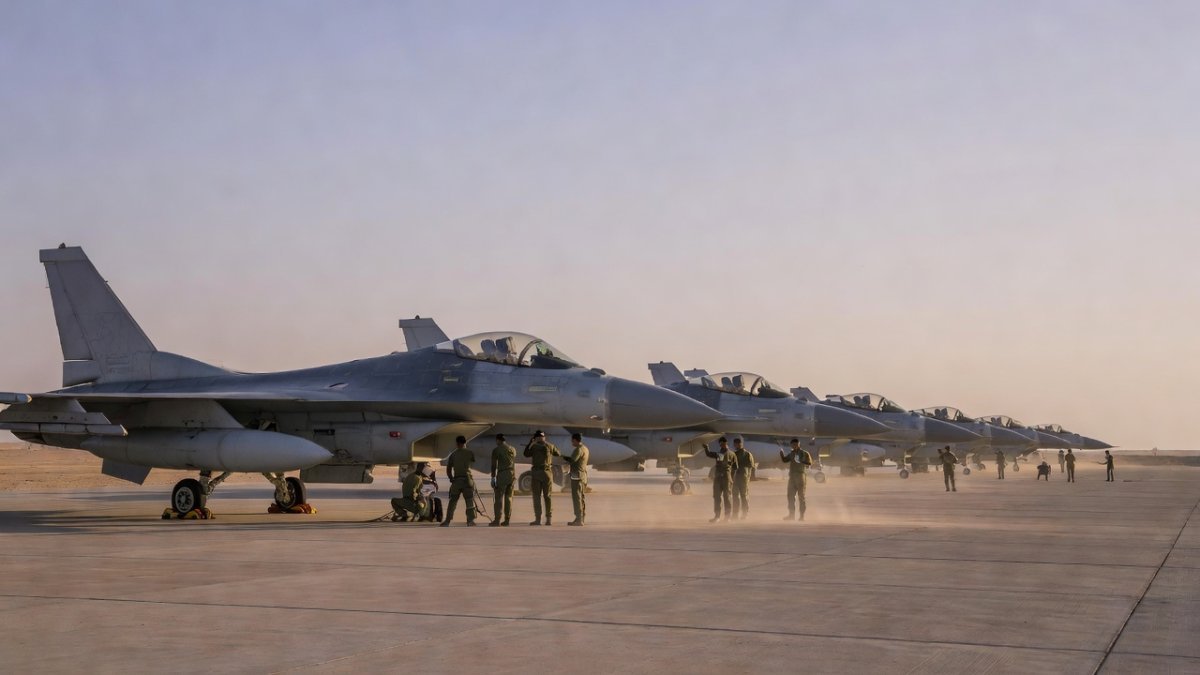
J-16 'Hidden Dragon' Makes Its Africa Debut
A fleet of Chinese J-16 fighter jets has landed in Egypt for the Eagles of Civilisation 2026 joint exercise with the Egyptian air force, marking the first time the twin-seat multi-role fighter has been deployed to Africa. The People's Liberation Army (PLA) Air Force confirmed the aircraft and aircrew arrived at an Egyptian airbase on Friday morning after a 6,000-kilometre (3,700-mile) journey that took nine hours and required mid-air refuelling.
The exercise, announced by the Chinese defence ministry on August 14 and scheduled to run from mid-August to early September, is the second iteration of the China-Egypt air training series. Last year's inaugural Eagles of Civilisation drill saw Beijing deploy the lighter, single-engine J-10C; this year's upgrade to the heavier J-16 signals a step change in the scope and ambition of China's overseas air operations.
A Nine-Hour Flight Across Two Continents
The intercontinental transit was itself the story. According to the PLA Air Force, the deployment was conducted as an integrated formation of fighter jets, aerial refuelling aircraft, special-mission aircraft and helicopters, with the J-16s refuelled in mid-air en route to Egypt.
Video released by the PLA Air Force, filmed from the window of a YY-20A aerial tanker, showed a J-16 being topped up over open water, and another scene depicted the tanker hosting in-flight refuelling for two J-16s at the same time. The ability to move a tactical fighter force across two continents in under ten hours is precisely the kind of capability that Chinese military commentators have long argued the PLA Air Force needs as Beijing's overseas interests grow.
A Fighter Built for China's Frontiers
The J-16, nicknamed the Hidden Dragon, is a mainstay heavy fighter of the PLA Air Force. A twin-seat, multi-role aircraft, it combines air-to-air combat capability with precision strike, and it regularly patrols China's east coast and potential flashpoints such as the South China Sea and the Taiwan Strait.
Its overseas track record has been expanding steadily: the J-16 has previously taken part in drills with Russia and Pakistan, and it now adds Egypt to that list. For Japanese defence planners, the aircraft is a familiar silhouette in the East China Sea, where JASDF fighters are scrambled hundreds of times a year against Chinese military aircraft, including J-16s operating near the Senkaku Islands and through the Miyako Strait.
Cairo Between Washington and Beijing
The choice of Egypt as the venue is significant. Cairo is one of the largest recipients of US military aid in the Middle East and operates a sizeable fleet of American-built F-16s, yet it has been steadily deepening defence ties with Beijing. The second Eagles of Civilisation exercise follows a period of rapid expansion in China-Egypt military cooperation, and reports of an Egyptian pilot seated in a Chinese J-10S trainer during the 2025 drill have fuelled persistent speculation about a possible arms deal.
Chinese defence ministry spokesman Senior Colonel Chen Xi said the 2026 exercise would focus on air combat tactics, air superiority operations and combat search and rescue, and would include force employment drills. He framed the training as a way to enhance mutual trust, deepen substantive cooperation between the two militaries and contribute to regional peace and stability.
Power Projection, Not Just Diplomacy
Chinese military commentator Song Zhongping, a former PLA instructor, told the Global Times that the J-16's participation marked an upgrade from last year's J-10C deployment and reflected the air force's drive to train in unfamiliar environments. He said the different aircraft types across China's air force units all need to go abroad to strengthen combat readiness, and that the journey to Egypt, the J-16's longest-range deployment to date, was a major test of pilots' tactical and technical skills.
"China is a major global power in terms of development, and we also need to rely on cooperation with other countries to support our own development," Song said. "Building up the navy and air force's global power-projection capability is therefore critically important. We can't rely only on diplomatic capability. We also need hard power, including military capability, to safeguard our overseas interests."
The Egypt deployment fits a wider pattern. China has operated its first overseas military facility in Djibouti on the Horn of Africa since 2017, and it has conducted a growing roster of exercises with African militaries, including naval port calls and peacekeeping contributions. What is new is the speed and sophistication of the air component: moving combat jets, tankers and support aircraft over 6,000 kilometres in a single coordinated package is a logistics feat that few air forces outside the United States have demonstrated at this scale.
What It Means for Japan and the Region
For Tokyo, the symbolism is hard to miss. Japan's 2026 defence white paper, approved by the cabinet on August 4, catalogues a steady rise in Chinese military activity around the archipelago, from East China Sea scrambles to drone incursions, and it has flagged China's expanding reach beyond the first island chain as a central concern. That same reach is now visibly extending into Africa, where Japan's own engagement remains primarily economic and diplomatic rather than military.
The Red Sea corridor is also strategically vital for Japan's trade with Europe and the Middle East. When Houthi attacks on shipping forced container lines to divert around the Cape of Good Hope in 2024, Japanese automakers and electronics exporters felt the disruption directly, with longer transit times and higher freight costs. China's deepening military foothold in Egypt, at the northern gateway of that corridor, adds a new dimension to a region Tokyo has long watched closely.
Japan is not standing still on the continent. At TICAD 9 in Yokohama in August 2025, Prime Minister Shigeru Ishiba proposed an economic zone linking the Indian Ocean and Africa, and Tokyo has signalled a shift from aid toward strategic investment as it seeks to offer an alternative to Chinese infrastructure financing. The presence of Chinese combat aircraft in North Africa sharpens that competition, even if the two powers are competing in different arenas.
What to Watch For
Three things bear watching as the exercise unfolds. First, whether Beijing follows the J-16 deployment with additional power-projection milestones, such as extended-range bomber or naval visits to North African or Red Sea ports, which would signal a permanent Chinese military presence in the region. Second, whether the long-rumoured China-Egypt arms deal finally materialises; the J-10S cockpit sighting in 2025 and the steady escalation of exercise platforms suggest the political groundwork is being laid. Third, how Washington and its allies respond, given Egypt's outsized role in US Middle East strategy and the sensitivity of any Chinese military foothold near the Suez Canal.
For Japan, the calculation is equally direct. The same J-16s that shadow JASDF aircraft over the East China Sea are now being flown across continents in formation with tankers and support aircraft. As Beijing's air force builds the muscle memory of long-range deployment, Tokyo and its partners will be watching the skies over Egypt as closely as they watch those closer to home.
By Kenji Tanaka, Staff Writer
This article was produced with AI-assisted research and editorial support. Sources: South China Morning Post, China's Ministry of National Defense, Global Times, The Aviationist, Nikkei Asia.
What's Your Reaction?
 Like
0
Like
0
 Dislike
0
Dislike
0
 Love
0
Love
0
 Funny
0
Funny
0
 Wow
0
Wow
0
 Sad
0
Sad
0
 Angry
0
Angry
0

Japan Correspondent at Global1.News. Tokyo-based voice covering Japanese politics, technology, economy, and culture. Tracks the intersection of tradition and innovation in one of the world's most dynamic societies.















Comments (0)