
Wat Phra Kaew's Ramakien Murals: A Sacred Canvas Around Bangkok's Temple
A Sacred Canvas: The Ramakien Murals of Wat Phra Kaew BANGKOK — For millions of visitors who step into the hallowed grounds of Wat Phra Si Rattana Satsadaram, known worldwide as Wat Phra Kaew or the Temple of the Emerald Buddha, the first glance is often upward, toward the gleaming golden stupa...
A Sacred Canvas: The Ramakien Murals of Wat Phra Kaew
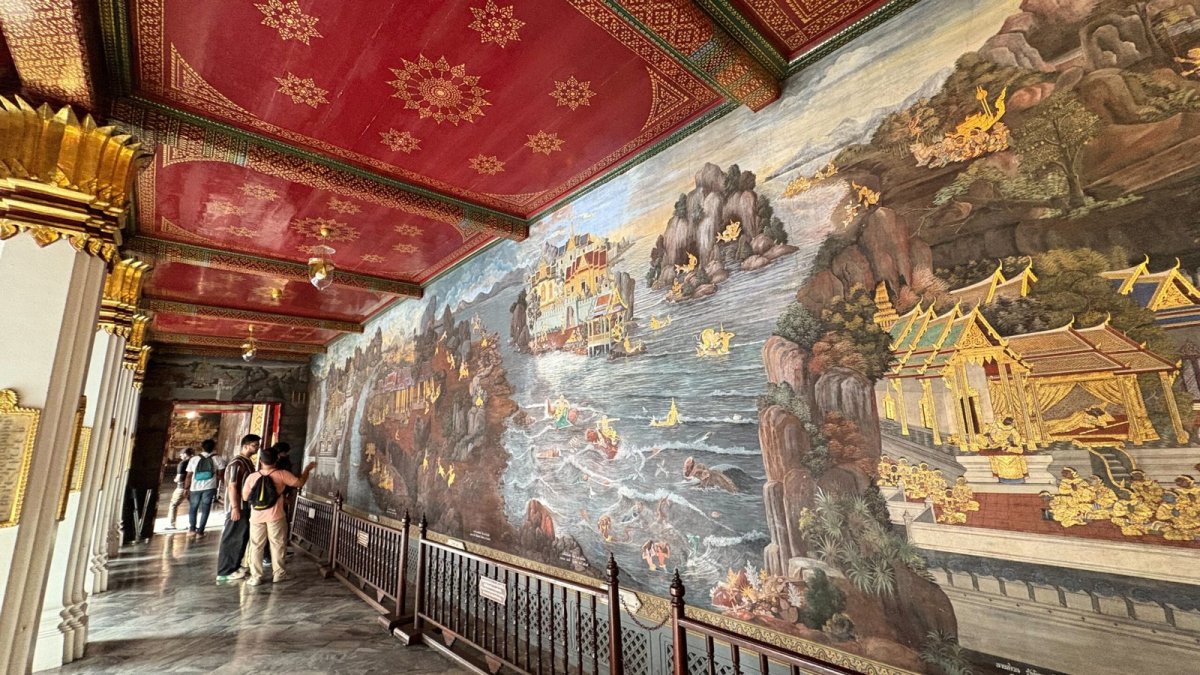
BANGKOK — For millions of visitors who step into the hallowed grounds of Wat Phra Si Rattana Satsadaram, known worldwide as Wat Phra Kaew or the Temple of the Emerald Buddha, the first glance is often upward, toward the gleaming golden stupa or the revered Emerald Buddha itself. But those who take the time to look outward, along the walls of the surrounding cloister, will discover one of Bangkok's most remarkable works of traditional Thai art. Stretching along the inner walls of this sacred corridor is an enormous, intricate visual retelling of the Ramakien, Thailand's celebrated epic of gods, heroes, demons, and mythical battles. This is not merely decoration; it is a masterpiece that wraps around the temple, telling a story that has shaped Thai identity for centuries.
For Thai readers and regional visitors alike, this mural cycle is more than a tourist attraction. It is a living textbook of our literary and artistic heritage, a testament to the skill of generations of Thai artisans, and a profound expression of the Buddhist and Hindu cosmology that underpins our culture. As Thailand continues to position itself as a hub for cultural tourism in ASEAN, the preservation and appreciation of such masterpieces become ever more critical. They are not just paintings; they are the soul of a nation, painted in mineral pigments and gold leaf.
A Royal Commission: The Birth of a National Epic
The story of these murals begins with the founding of the Chakri dynasty itself. Construction of Wat Phra Kaew began in 1783 under the reign of King Rama I, the founder of the dynasty, who established Bangkok as the new capital of Siam. The temple was built within the Grand Palace complex to house the Emerald Buddha, regarded as Thailand's most sacred Buddha image. From its very inception, the temple was designed not only as a place of worship but as a symbol of the kingdom's power, legitimacy, and cultural sophistication.
It was during this same period that the Ramakien murals were first painted. King Rama I, a patron of the arts and a scholar in his own right, is credited with composing a definitive version of the Thai Ramakien, drawing from older traditions and oral tales. The murals were commissioned to accompany this literary work, creating a visual counterpart to the royal text. Over the centuries, the murals have undergone restoration and repainting several times, each generation of artists adding their own subtle interpretations while remaining faithful to the original narrative structure. This ongoing cycle of preservation and renewal is itself a reflection of Thai culture's ability to honor the past while embracing the present.
Walking the Epic: 178 Sections of Divine Conflict
The scale of the mural cycle is staggering. It consists of 178 sections, beginning near the front of the Phra Wihan Yot and continuing around the entire cloister. For a visitor walking the perimeter, the experience is akin to reading a massive illustrated manuscript, with each section flowing into the next. Alongside the main narrative are depictions of Hindu deities and different manifestations of Vishnu, leading into the story of Rama's incarnation on earth. This theological framing is crucial; it establishes Rama not merely as a heroic prince but as an avatar of the divine, a concept that resonates deeply with Thai Buddhist and Brahmanical beliefs.
The narrative complexity is further enhanced by the inclusion of 80 additional images of important Ramakien characters, bringing the total to 258 painted scenes and images. These character portraits serve as a visual glossary, allowing viewers to identify the key players in the epic drama. At the heart of the story is the great conflict between Rama and his divine allies against Thotsakan (the Thai name for Ravana) and his demon army. The murals capture the full sweep of this cosmic war, from the abduction of Sita to the building of the causeway to Lanka, and the final, cataclysmic battles. Among the best-known characters depicted are Rama, his loyal brother Lakshmana, the virtuous Sita, the ten-headed demon king Thotsakan, and the mischievous and powerful monkey god Hanuman.
From India to Siam: The Ramakien's Unique Thai Soul
While the Ramakien is Thailand's adaptation of the ancient Indian epic Ramayana, it is far from a simple translation. Over centuries, the story has been thoroughly indigenized, developing its own distinctive characters, subplots, and artistic traditions. The Thai version places a greater emphasis on certain episodes, expands the roles of characters like Hanuman, and infuses the narrative with local customs, humor, and moral lessons that resonate with Thai audiences. This is not the Indian Ramayana; it is a uniquely Thai epic that reflects the kingdom's own history, values, and worldview.
This cultural adaptation is a powerful example of how Thailand has historically absorbed and transformed external influences, a process that continues today in our engagement with global culture. The Ramakien's influence extends far beyond the walls of Wat Phra Kaew. It has appeared not only in literature but also in the khon masked dance, traditional theatre, music, and visual art. The khon, in particular, is a highly stylized art form that relies on intricate costumes and gestures to tell the epic's stories, and its repertoire is drawn directly from the Ramakien. Across the country, from Chiang Mai to the Isaan region, murals at countless Buddhist temples depict scenes from the epic, demonstrating its deep roots in local communities.
A Living Heritage for Thai Identity and Tourism
For the modern visitor, the cloister at Wat Phra Kaew remains one of the major highlights of exploring the Grand Palace. It offers an unparalleled opportunity to experience Thailand's literary heritage through one of its most enduring art forms. The murals provide a glimpse into how generations of Thai artists interpreted the Ramakien, preserving a story that has been passed down through centuries while showcasing the craftsmanship of traditional Thai painting. The intricate details—the swirling clouds, the ornate palace architecture, the fierce expressions of the demons, the graceful postures of the heroes—are a testament to the patience and skill of the artists who created them.
For Thailand, this heritage is not just a matter of national pride; it is a significant driver of cultural tourism. The Grand Palace and Wat Phra Kaew are among the most visited sites in Southeast Asia, drawing millions of international visitors each year. The murals are a key part of that attraction, offering a deep dive into Thai culture that goes beyond the surface-level sights. For ASEAN neighbors, the Ramakien also holds a special resonance, as versions of the Ramayana epic are found across the region, from Cambodia's Reamker to Laos's Phra Lak Phra Lam. This shared heritage creates a cultural bond, a common thread that connects the diverse nations of Southeast Asia.
As Thailand looks to the future, the preservation of the Ramakien murals is a sacred duty. The Fine Arts Department of Thailand and the Bureau of the Royal Household continue to oversee their care, ensuring that the pigments remain vibrant and the structure remains sound. But preservation is not just about physical restoration; it is about keeping the story alive in the hearts and minds of the Thai people. By teaching the Ramakien in schools, by performing the khon, and by welcoming visitors to walk the cloister and read the walls, we ensure that this masterpiece remains a living, breathing part of our culture. It is a reminder that our identity is not just in our modern cities or our economic growth, but in the stories we tell and the art we create to tell them.
This article was produced with AI-assisted research and editorial support. Sources: Khaosod English.
By Ann Srisawat, Staff Writer
What's Your Reaction?
 Like
0
Like
0
 Dislike
0
Dislike
0
 Love
0
Love
0
 Funny
0
Funny
0
 Wow
0
Wow
0
 Sad
0
Sad
0
 Angry
0
Angry
0

Southeast Asia Correspondent at Global1.News. Based in Bangkok, covering Thai and Southeast Asian politics, economy, technology, and culture. Deep regional perspective on one of the world's most dynamic regions.














Comments (0)