
US Confirms Weapons Deployed in Orbit for the First Time
Air Force Secretary Troy Meink told the AFA Air, Space & Cyber Conference on 14 September 2026 that the United States now has on-orbit space control weapons, the first public acknowledgement that the Pentagon has deployed weapons in space.
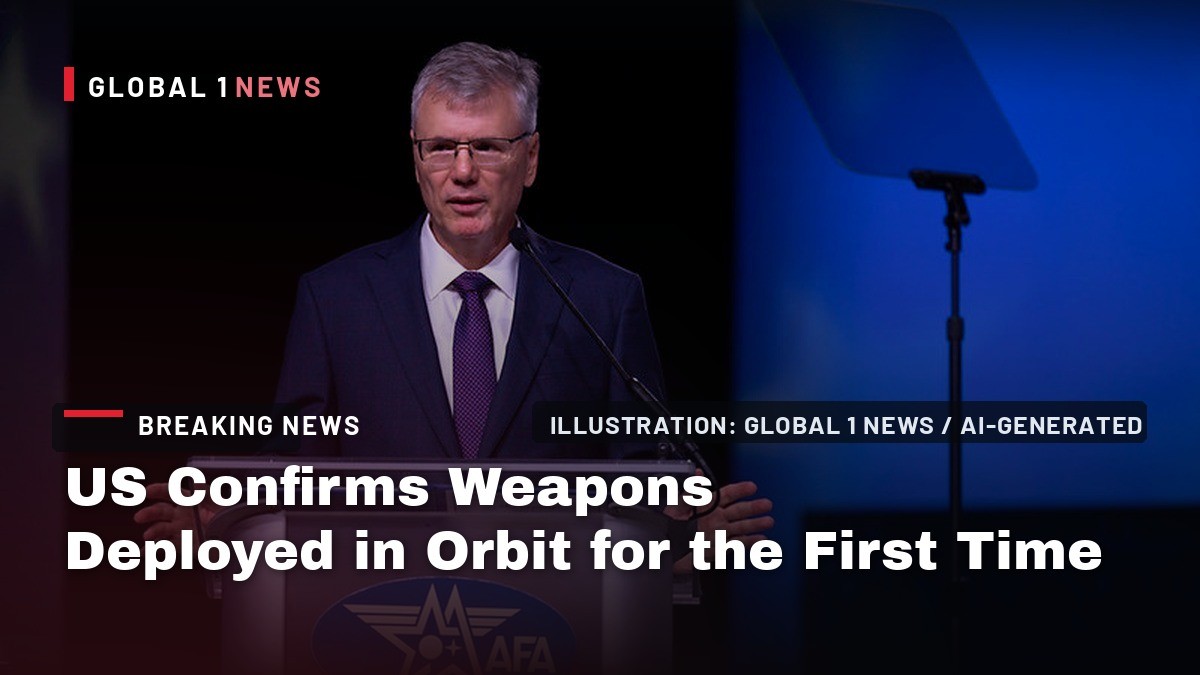
For the first time, a Pentagon official has said out loud that the United States has weapons in orbit. Secretary of the Air Force Troy Meink told a conference hall in Maryland that America "now has on-orbit space control weapons" — and when reporters pressed him, he did not walk it back. He said the wording was deliberate.
Folks, here is what matters: this is not a leak and not a budget line. This is the United States confirming, on the record, that it has deployed weapons in space. What those weapons are, how many there are, and when they went up — the Pentagon will not say.
US Confirms Weapons Deployed in Orbit for the First Time
Washington, United States — Meink delivered the opening keynote at the Air & Space Forces Association's Air, Space & Cyber Conference in National Harbor, Maryland, on Monday 14 September 2026. As Secretary of the Air Force, he is the top civilian overseeing both the Air Force and the Space Force.
Meink Says It Out Loud
Here is the sentence that set off the room, as reported by Air & Space Forces Magazine, DefenseScoop, The War Zone, Ars Technica and the BBC: "Today, we continue to ensure we remain ready to meet the challenges of evolving threats wherever they exist. This is why the United States now has on-orbit space control weapons capable of defending the joint force against hostile adversary action."
Asked at the question-and-answer session immediately afterwards whether he could elaborate, Meink said the acknowledgement was intentional and the phrasing "very well thought out." His words: "That phrase was very well thought out. So whatever I said before is what I say again." At a press roundtable he was asked again. "Not going to go into specifics on the type of weapon," he said. "Just like in air dominance, we need to maintain dominance in space as it becomes more and more important to how we function, how we operate militarily, and economically [and] civilian-wise."
What the Space Force Actually Said
A Space Force spokesperson, in statements to The War Zone, ABC News, the BBC and Ars Technica, set out the position: "It is longstanding policy that the U.S. will protect and defend the Joint Force through all domains. We are increasing readiness against existing threats, and the U.S. has on-orbit space control weapons capable of defending the Joint Force against hostile adversary action."
The spokesperson defined the mission area plainly: "Space control encapsulates the mission areas required to contest and control the space domain — employing kinetic and non-kinetic means to affect adversary capabilities through disruption, degradation and even destruction, if necessary. These capabilities can be employed for offensive and defensive purposes at the direction of combatant commands."
Asked directly to confirm whether the weapons are kinetic, non-kinetic or both, and whether they can be used offensively as well as defensively, the spokesperson declined to break it down: "Beyond that, we will not discuss specific operational methods, payloads, technical characteristics, or employment concepts."
Why This Is a First
DefenseScoop reported it flatly: "The announcement is the first time a Pentagon official has publicly confirmed the existence of U.S. space-based weapons."
Before Monday, the only acknowledged anti-satellite weapons in the U.S. military's inventory were ground-based electronic warfare systems. In June 2026 the Space Force announced operational acceptance of its first acknowledged weapon system — Meadowlands, a ground-based mobile satellite jammer.
The service began openly discussing space warfare in 2025 and published a warfighting framework in March of that year. In December 2025, President Donald Trump issued an executive order — "Ensuring American Space Superiority" — underlining the Space Force's role not only in defending space assets but also in the attack mission. Officials had previously said they planned to field a "substantial on-orbit capability" by 2026. Until Monday, they had stopped short of saying weapons were already there.
The Treaty Does Not Ban This
The 1967 Outer Space Treaty is the principal framework governing activities in outer space. Article IV prohibits states from placing in orbit around Earth any objects carrying nuclear weapons or other weapons of mass destruction, and reserves the Moon and other celestial bodies exclusively for peaceful purposes — barring military bases, installations and the testing of weapons there.
Here is the part that matters for Monday's disclosure: the treaty does not establish a blanket prohibition on conventional weapons in Earth orbit. The Space Force says U.S. military operations are conducted in compliance with international law, including the Outer Space Treaty and the Law of Armed Conflict.
News18 noted the absence of a blanket ban does not mean use would be unrestricted. Legality can also be assessed under the principles governing armed conflict — proportionality, distinction, and the effects of an attack on civilian or commercial space infrastructure. A weapon that physically destroys a satellite could create orbital debris that lingers for years or decades, threatening spacecraft belonging to states and companies that are not parties to the conflict.
What "Space Control" Means in U.S. Doctrine
The Space Force's warfighting framework, reported by DefenseScoop, says space control can refer to offensive and defensive warfare, electromagnetic warfare and other counterspace operations, and that the service is interested in both kinetic and non-kinetic offensive weapons.
On-orbit operations those systems could perform include orbital strike and space link interdiction. Orbital strike includes actions that "destroy, disrupt or degrade adversary space platforms in the space domain" — carried out either by pursuit operations, moving towards an adversary system to deploy weapons, or by standoff operations from a distance.
Space link interdiction is performed solely by non-kinetic means, using electromagnetic or cyber attacks to stop adversaries using their own space-based systems. The Space Force could also deploy defensive systems through escort operations, counterattacks and suppression of adversary counterspace targeting. The Pentagon has no plans to say which of these the on-orbit systems are.
Golden Dome and the Systems Coming Next
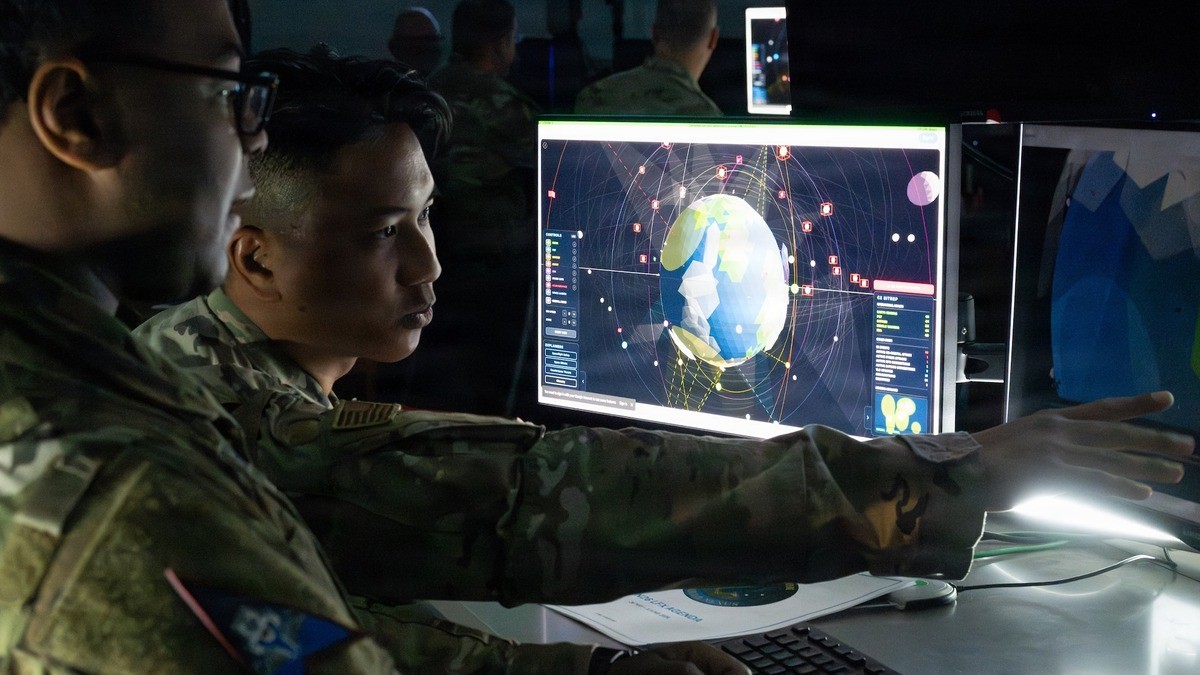
Meink highlighted two efforts the Space Force is working now: the Space-Based Interceptor program and the Space-Based Air-Moving Target Indication constellation. Both are part of the Pentagon's Golden Dome missile defence shield.
On the interceptor programme, one of Golden Dome's more ambitious technical lifts, Meink said it has moved from "initial contract to flight-ready hardware" in under a year. The Space Force is running a prize competition to evaluate affordability and scalability, and could field an initial capability by 2028. Gen. Michael Guetlein, Golden Dome director, said in August that the contractor pool had completed the first increment, Gate One — solidifying a design and component-level testing — and that all providers appear set to move on to Gate Two, where they build prototypes.
The service awarded SpaceX a $4.2 billion contract in May 2026 to build the AMTI constellation, working with the National Reconnaissance Office to track airborne threats from orbit. Meink said the first of those satellites will launch this month, and the service plans an initial constellation working by 2028. "Taken together, these investments will help us adapt and scale the force for today and tomorrow's threats," he said.
Experts: This Is Either Deterrence or a Starting Gun
Victoria Samson, chief director of space security and stability at the Secure World Foundation, told Defense One: "Well, that's huge, because I don't think any US government official has ever said that before."
She speculated to Ars Technica that the weapons could be jammers placed in orbit. "China and Russia are both thought to have space-based jammers. I've always thought that the US must have them, too." And she warned: "Now that the United States has officially acknowledged it has those systems in space, it has opened the door for China and Russia to do the same, which people in the US will then use as justification for why we needed those systems there in the first place."
Clayton Swope, deputy director of the Aerospace Security Project at the Center for Strategic and International Studies, told Ars Technica that from a hardware standpoint such weapons are "doppelgängers to technology already found at scale in orbit. Any radio transmitter could be a jammer. Any inter-satellite optical link could be a laser dazzler." He also called the plural in Meink's statement significant: "The fact that the weapons — plural — are on-orbit is a more significant data point and disclosure."
But Swope doubted the disclosure would deter anyone. "It is too vague to have a meaningful deterrent value. Deterrence is not only about a weapon's fact of existence but also about having an awareness of how the weapon will be used." He added that how and when the weapon would be used, and its destructive potential, are ambiguous — and that space control is broad enough in U.S. doctrine to cover strikes on Earth. "Blowing up a satellite ground station to prevent an adversary from using a satellite is a space control activity." Defense One reported that experts said the admission could accelerate an arms race in orbit, and warned it would likely push America's main adversaries in space to acknowledge their capabilities too.
The Adversary Picture the Pentagon Is Pointing At
The U.S. Space Force says China "develops and operates space and counterspace capabilities as part of a military modernisation strategy," while Russia "views space as a warfighting domain." Both, it says, are developing missiles, jammers, lasers and systems placed in orbit to attack or disrupt American satellites.
CSIS's 2025 Space Threat Assessment warned: "China continues to launch and operate highly maneuverable satellites ... that, if not already deployed for such purposes, could enable a formidable on-orbit counterspace arsenal." Open source data indicate Chinese satellites routinely maneuver close to U.S. military assets in orbit, likely for surveillance — much as U.S. satellites sometimes park beside Chinese or Russian spacecraft.
In early February 2026 it was revealed that two Russian satellites have likely intercepted the communications of at least a dozen European ones since Russia's invasion of Ukraine in 2022, potentially exposing sensitive data or even allowing control of those satellites to be taken. U.S. officials flagged Russia's testing of an apparent anti-satellite weapon in orbit in 2020, and the Biden administration accused Moscow in 2024 of deploying operational anti-satellite weapons. Also in 2024, Rep. Mike Turner, then chair of the House Intelligence Committee, revealed a U.S. assessment that Russia might put a nuclear weapon into space — a detonation that would jeopardise thousands of commercial and military spacecraft, including Starlinks and the International Space Station.
What Nobody in Washington Will Say
Here is what Meink did not say: what the weapons are, how many are in orbit, when they were deployed, or what they can do. He was explicit about the silence. "It is important from a deterrence perspective, but on the other hand, me talking about the details of what we're doing would actually not benefit that deterrence. So I'm not going to talk about the specifics of what we're doing, whether we've tested or not tested, or anything else."
On why the disclosure is being made now: "There's a lot of factors that go into how we talk about these things. We spend a lot of time talking about how we're going to talk about these things."
Defending the deployment later on Monday, Meink pointed straight at Moscow and Beijing. "For over a decade, we've been talking about the fact, and we have expressed concern, that the Chinese and Russians were developing weapons for space. We need to focus on making sure we can protect ourselves operating in that environment."
The Space Force spokesperson told ABC News: "Due to their actions, it is no longer a question that space is a warfighting domain. Open communication strengthens deterrence, prevents adversary miscalculation, and normalizes space operations alongside the other services."
The Questions This Opens
What kind of weapons? The Space Force will not say whether they are kinetic, non-kinetic or both. Where are they, how many are there, and when did they go up? Not disclosed. Has the United States tested a space-based kinetic weapon? CSIS's Swope said there is no public indication that it has. And there was no immediate reaction on Monday from the governments of China or Russia.
What happens next? Samson told Ars Technica the acknowledgement has opened the door for China and Russia to do the same. Swope called it too vague to have meaningful deterrent value. Ars Technica put the stakes this way: "What is clear is there is now an arms race in orbit. The United States and China are leading the way by measures of volume and sophistication, while Russia appears to be the most aggressive in terms of tactics. But it matters less who started the arms race than how it ends."
Those are the facts. The rest, folks, is what the Pentagon is still not telling us.
By Jessica Ali, Staff Writer
This article was produced with AI-assisted research and editorial support. Sources: BBC, The Washington Post, Defense One, DefenseScoop, Air & Space Forces Magazine, The War Zone, Ars Technica, ABC News, Secure World Foundation, Center for Strategic and International Studies, News18.
What's Your Reaction?
 Like
0
Like
0
 Dislike
0
Dislike
0
 Love
0
Love
0
 Funny
0
Funny
0
 Wow
0
Wow
0
 Sad
0
Sad
0
 Angry
0
Angry
0

Editor-in-Chief at Global1.News. Atlanta-based journalist who cuts through the BS and tells it like it is. Lead anchor, host, and the voice you hear when the spin stops and the truth starts.















Comments (0)