
South Korea Records 42.5°C All-Time High in Yangsan Heatwave
South Korea recorded its highest temperature since modern observations began in 1904 when the southeastern city of Yangsan reached 42.5 degrees Celsius (108.5 degrees Fahrenheit) on August 2, 2026. The Korea Meteorological Administration (KMA) confirmed the reading at 1:26 p.m.
South Korea recorded its highest temperature since modern observations began in 1904 when the southeastern city of Yangsan reached 42.5 degrees Celsius (108.5 degrees Fahrenheit) on August 2, 2026. The Korea Meteorological Administration (KMA) confirmed the reading at 1:26 p.m. local time, surpassing the previous national mark of 41.0°C set in Hongcheon in August 2018. The milestone, the first in 122 years of Korean meteorological record-keeping, tests South Korea's evolving climate governance framework and underscores intensifying heat extremes across Northeast Asia.
Yangsan Hits 42.5°C, South Korea's Hottest Temperature in 122 Years
Seoul, South Korea – August 3, 2026 — South Korea's state weather agency recorded an all-time national high of 42.5°C in the southeastern city of Yangsan on Sunday, as a punishing heatwave that has gripped the peninsula for weeks reached a new intensity. The reading triggered the government's second-highest emergency response, renewed scrutiny of climate adaptation policy, and focused regional attention on heat resilience across Northeast Asia.

The Record Itself and KMA Observational Data
The Korea Meteorological Administration reported that Yangsan, about 310 kilometers southeast of Seoul in South Gyeongsang Province, reached 42.0°C at 1:16 p.m. on August 2 before climbing to 42.5°C at 1:26 p.m. It was the highest reading among the agency's 97 long-term observation stations since modern weather observation began on the Korean Peninsula in 1904. The city had already set a new local record of 41.4°C on July 31, and Sunday marked the fifth consecutive day Yangsan exceeded 40°C, with the timing of the daily peak arriving earlier each day as heat accumulated. Forecasters warned the mercury could yet surpass 43°C.
The heat extended well beyond Yangsan. Gyeongju, about 240 kilometers southeast of Seoul, reached 40.3°C at 2:14 p.m. — its first reading above 40°C this year and its highest in eight years, topping the 39.8°C recorded in August 2018. Northern Busan, Gimhae, and Gwangyang also crossed the 40°C threshold. More than 20 localities fell under the new emergency heatwave alert category introduced in 2026, which is triggered when forecasts predict a perceived temperature of at least 38°C or an actual temperature of 39°C or higher for a single day. In Seoul, the KMA upgraded the heatwave advisory for the northwestern part of the capital to a warning at 11 a.m., placing all of Seoul under the second-highest heat alert, with Monday's forecast at 37°C.
Government Response Through Level 2 Emergency Operations
Prime Minister Han Seong-sook activated Level 2 emergency operations at the Central Disaster and Safety Countermeasures Headquarters at 1 p.m. on August 2 — the first such activation in three years and only the second time the level has been triggered since heatwaves were officially classified as natural disasters. The three-tier system, with Level 3 the highest, had last seen a Level 2 activation in August 2023. The prime minister directed ministries and provincial governments to strengthen safety checks on residents most vulnerable to the heat and to maintain a stable power and water supply, ordering that all available channels — public broadcasters, emergency text messages, electronic information boards, and village broadcasts — be used to swiftly inform the public.
The interior ministry prepared to dispatch director general-level officials to the Seoul metropolitan area to assess local heatwave responses and identify areas requiring additional support. The government also advised the public to refrain from outdoor activities and abide by safety measures, while the KMA urged people to "immediately stop all outdoor activities," warning that indoor spaces without air conditioning are dangerous during the current conditions.
Meteorological Science Behind the Extreme Heat
KMA analysts attributed the event to a rare combination of large-scale weather patterns and local geography. The North Pacific High, a semipermanent anticyclone carrying hot, humid air, and the Tibetan High, a seasonal system forming over the Tibetan Plateau, overlapped over the Korean Peninsula "like a lid," trapping heat and preventing air circulation. Dry conditions left by below-average monsoon rainfall intensified surface heating, while a stagnant weather pattern allowed temperatures to build across the southeast.
Local topography further amplified the extremes in Yangsan. Surrounded by mountains, the city sits in a basin that traps heat and limits air circulation, allowing temperatures to climb to record levels even as coastal and inland cities recorded comparatively lower readings. The same conditions that produced Yangsan's consecutive 40°C days have lengthened the upper tail of the observational record, raising questions about how basin communities across South Gyeongsang will adapt to a warming climate.
Public Health Toll and Cooling Infrastructure
The Korea Disease Control and Prevention Agency recorded 1,871 cases of heat-related illness between May 15 and July 31, including 13 deaths, with the toll expected to rise following the August peak. Public health officials have flagged elderly residents and outdoor workers as the groups most exposed — populations explicitly identified in the review that followed the deadly 2018 heatwave, when Hongcheon's then-record 41.0°C helped prompt revisions to national response protocols.
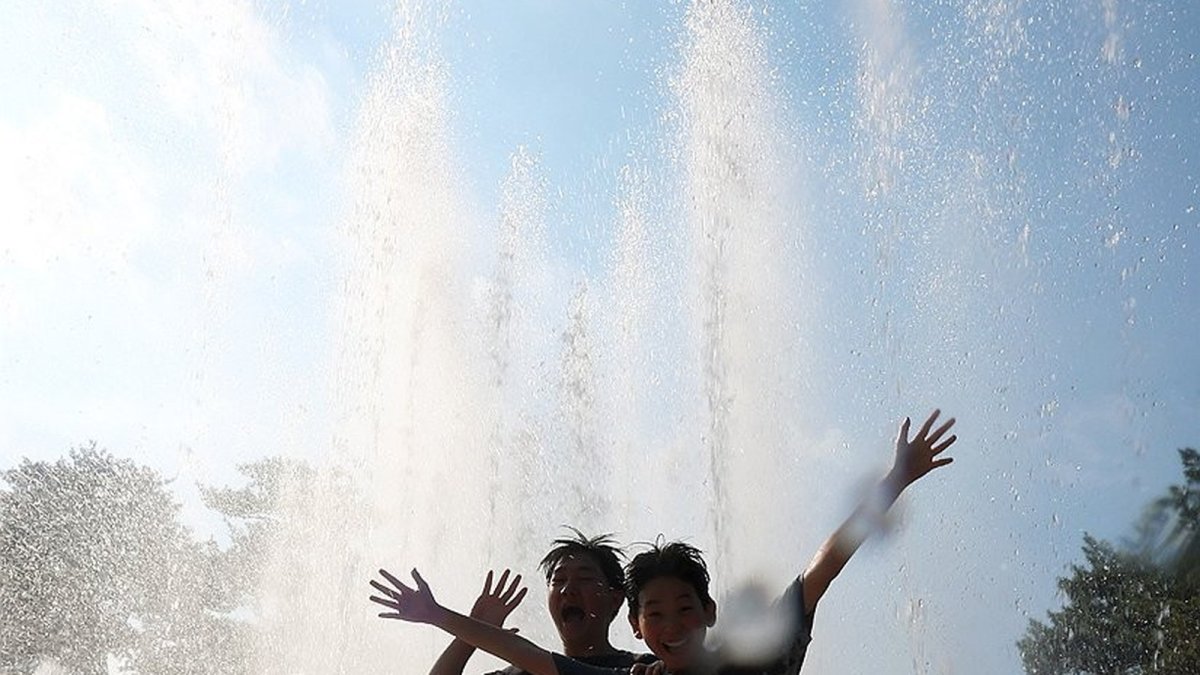
Seoul's network of cooling centers and mist-spray zones now operates under sustained summer grid demand, yet the record temperatures expose coverage gaps for basin communities such as Yangsan. Citizens have sought refuge in air-conditioned shopping malls and cafes; Ju Dong-yeol, a 27-year-old office worker who took shelter in a Seoul Starbucks with his parents, told AFP: "It is too hot to be outside doing anything. I can't think of anything else to do other than stay in air-conditioned places like home, shopping malls and cafes." The heat also disrupted professional sports: Korean Baseball Organization games in Changwon were canceled on both Saturday and Sunday after forecasts showed temperatures above 38°C at first pitch, while Busan's Saturday game was called off and Sunday's was rescheduled to 6:30 p.m.
Regional Dimension Across Northeast Asia
The heatwave is not confined to South Korea. North Korea reported temperatures reaching 40°C in multiple regions, with state media saying residents of Pyongyang endured a full week of tropical nights above 25°C — illustrating parallel stress on the peninsula's energy and health systems. Japan's weather agency issued heatstroke alerts across 30 of its 47 prefectures and applied its new "brutally hot day" (kokushobi) designation, following Japan's own all-time high of 41.8°C recorded last year.
Officials are also monitoring Typhoon Dolphin, tracking toward China's southeast coastal regions south of the peninsula. If the typhoon moves toward eastern China, it could increase humidity across the Yellow Sea and potentially worsen the heatwave and tropical nights in Korea; a path closer to the south of the peninsula could bring stronger winds, greater cloud cover, and rain, temporarily easing the heat. The synchronized extremes across the region — compounded by wildfires in Greece, Tunisia, Algeria, and Morocco, hot dry conditions in Spain and France, and a dangerous heatwave in the western United States — underscore shared atmospheric drivers that extend beyond national borders, strengthening the case for coordinated monitoring among the KMA and counterpart agencies in China and Japan.
Climate Policy Implications and Long-Term Outlook
KMA data show the average annual number of heatwave days in South Korea has more than doubled to 19 in the past five years, from an average of eight days in the 1970s. A heatwave day is defined as a maximum temperature of at least 33°C, while a tropical night occurs when the overnight low remains 25°C or above. Scientists link the increasing frequency, duration, and intensity of such events to human-induced climate change, and the return of El Niño this year adds further pressure on the 2050 carbon-neutrality target that Korea inherited from the Green New Deal framework.
Heatwaves' formal classification as natural disasters since 2023 has enabled the Level 2 and Level 3 headquarters activations now being used, yet the current episode tests whether these institutional adjustments suffice under prolonged basin-trapped heat. Urban planning reviews are examining how mountain-ringed topography in South Gyeongsang amplifies extremes, prompting renewed scrutiny of cooling infrastructure placement and outdoor labor regulations. Policymakers must weigh immediate grid stabilization against longer-term emissions reductions if the observed doubling of heatwave days continues — a balance that will define South Korea's climate governance for the remainder of the decade.
By Prof. David Park, Staff Writer
This article was produced with AI-assisted research and editorial support. Reporting is based on sources cited in the article.
What's Your Reaction?
 Like
0
Like
0
 Dislike
0
Dislike
0
 Love
0
Love
0
 Funny
0
Funny
0
 Wow
0
Wow
0
 Sad
0
Sad
0
 Angry
0
Angry
0

East Asia/Technology Correspondent at Global1.News. Seoul-based voice covering Korean politics, technology, business, and culture. Analyzes how technology and geopolitics intersect across East Asia.















Comments (0)