
Settlers Target Armenian Monastery in Jerusalem's Old City as Attacks on Holy Sites Escalate
In a recent Middle East Eye report, settlers were filmed at dawn on Sunday spitting on the doors of Saint James Monastery in Jerusalem's Armenian Quarter while Israeli police stood by. The footage also captured the same group throwing stones at the home of an Armenian woman who documented the assault from her balcony. The incident forms part of a documented pattern of attacks on Christian sites in occupied East Jerusalem.
In a recent Middle East Eye report, settlers were filmed at dawn on Sunday spitting on the doors of Saint James Monastery in Jerusalem's Armenian Quarter while Israeli police stood by. The footage also captured the same group throwing stones at the home of an Armenian woman who documented the assault from her balcony. The incident forms part of a documented pattern of attacks on Christian sites in occupied East Jerusalem.
Settlers Target Armenian Monastery in Jerusalem's Old City as Attacks on Holy Sites Escalate
Jerusalem, Occupied East Jerusalem – Aug 3, 2026 — Israeli settlers carried out a dawn assault on Saint James Monastery in the Armenian Quarter on Sunday, August 2, 2026, spitting on its doors and hurling stones at a nearby Armenian woman's home while she recorded the events from her balcony, according to video evidence reported by Middle East Eye.
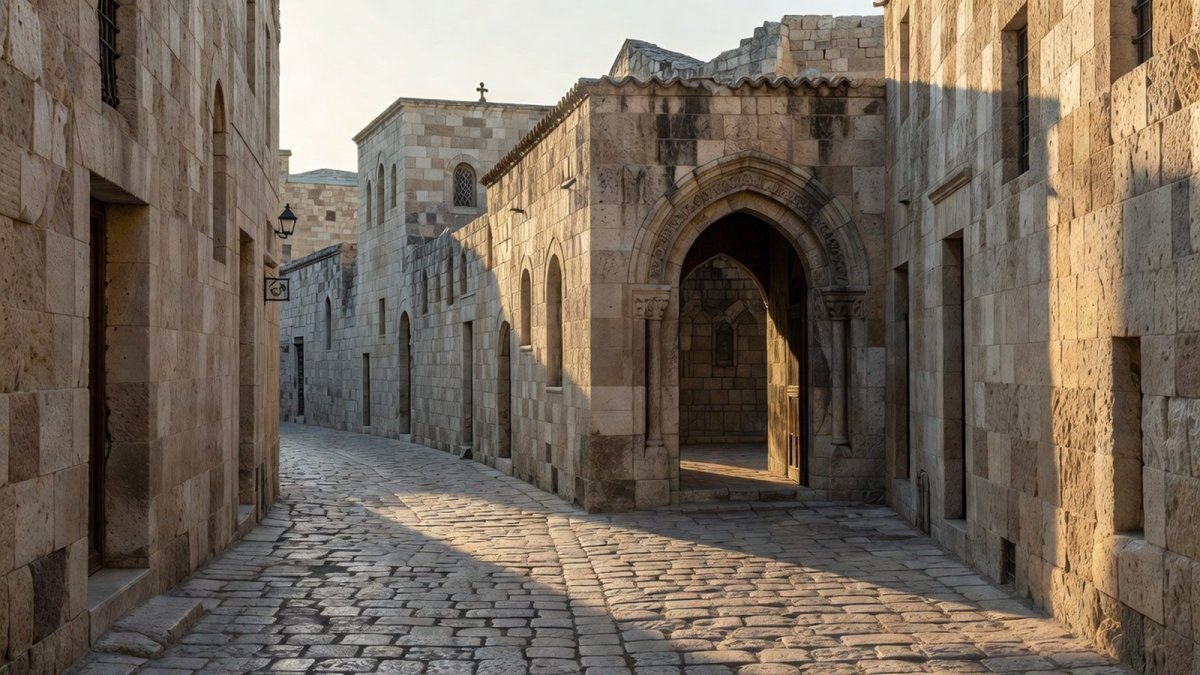
Saint James Monastery in the Armenian Quarter of Jerusalem's Old City (Global 1 News)
Details of the Dawn Assault on Saint James Monastery
The Middle East Eye footage shows settlers, accompanied by Israeli police, approaching the monastery entrance at first light. Settlers spat directly on the monastery doors before moving to throw stones at the woman's residence. She continued filming the attack from her balcony as the stones struck her home. No arrests of the settlers were reported in connection with the incident.
Jerusalem Governorate Account and Circulating Footage
The Jerusalem Governorate, cited by WAFA on August 2, stated that a group of colonists assaulted the Armenian Church by throwing stones and spitting at its entrance. Separate footage circulated by Palinfo on August 3 showed settlers hurling stones at the church while spitting on its entrance. The reports confirm the attack occurred on Sunday in the Old City of occupied Jerusalem.
Presidential Committee Condemns Attack and Calls for Protection
The Palestinian Presidential Committee for Church Affairs issued a statement on Monday, August 3, condemning the assault on the Armenian Monastery. The committee described the incident as a new provocation targeting the Christian presence and its holy sites in the city. It noted that the attack formed part of a continuing series of settler actions against churches, mosques, clergy, and religious sites, and urged the international community to pressure Israeli authorities to halt such attacks and provide international protection for Islamic and Christian holy sites.
Pattern of Attacks on Christian and Muslim Holy Sites
Settler attacks on religious sites in occupied Jerusalem have included a nun assaulted by a settler in May 2026 and an attack on an Armenian restaurant near the New Gate. Repeated cases of settlers spitting at clergy and pilgrims have also been documented. Palestinian figures cited by MEMonitor on August 3 indicate that around 750,000 Israeli settlers live in 156 settlements and 360 settlement outposts across the occupied West Bank, including occupied East Jerusalem.
Statements from the Palestinian Presidential Committee for Church Affairs frame the August 2 assault as one link in an unbroken chain of provocations against Christian and Muslim places of worship, noting that repeated incidents have normalized hostility toward religious minorities.
Footage verified by multiple outlets shows police presence during these events without subsequent arrests, leaving communities to absorb the message that their sanctuaries receive limited safeguarding. The cumulative effect, residents say, is the erosion of the visible Christian and Muslim character of the Old City.
Significance of the Armenian Community in Jerusalem
Saint James Monastery serves as the seat of the Armenian Apostolic Patriarchate of Jerusalem and stands as one of the holiest sites for Armenians worldwide. Armenia became the first state to adopt Christianity as its official religion in 301 CE, and Armenians have maintained a presence in Jerusalem since the 4th century. The Armenian Quarter remains the smallest of the Old City's four quarters. Rights groups document that the Christian population of East Jerusalem has shrunk to roughly 2 percent from about 10 percent over recent decades.
The Armenian presence in Jerusalem, rooted in centuries of continuous stewardship, faces mounting strain as daily acts of intimidation disrupt the rhythms of community life. Families who have safeguarded holy sites for generations now weigh the risks of documenting assaults from their own balconies, aware that each recording may invite further targeting yet remains essential to preserving the historical record.
Each such incident accelerates a longer trend that residents and clergy say fosters an atmosphere of insecurity, prompting families to question whether their long-term future in the city remains viable.
For families and clergy in the Armenian Quarter, each day unfolds against a backdrop of quiet vigilance. Shopkeepers weigh whether to open early or linger behind locked doors, while parents guide children along familiar streets now shadowed by unease. Clergy maintain their rounds of prayer and care, yet the weight of repeated intrusions lingers. Filming from balconies has become a fragile act of preservation, capturing moments that might otherwise fade, even as the act itself draws attention and heightens personal exposure in a place where presence has endured for centuries.
Land Controversy Surrounding the Armenian Quarter
In 2023, a 99-year lease was signed for the Armenian Garden, also known as the Cows' Garden and comprising roughly a quarter of the quarter's land, with a settlement-linked development company. The Armenian Patriarchate later annulled the lease, and litigation over the property continues. Plans for luxury hotels have added further pressure on the historic quarter.
The unresolved litigation keeps the community in prolonged uncertainty. Residents describe the legal contest as an extension of physical attacks, where control over historic land becomes another front in efforts to shrink Palestinian presence in the Old City.
July 2026 Escalation Across Occupied Jerusalem
The Wadi Hilweh Information Center reported that July 2026 saw approximately 200 arrests, 37 deportation decisions, and 19 house demolitions in occupied Jerusalem. More than 9,650 settlers stormed the Al-Aqsa Mosque compound under heavy protection during the same period. Two Palestinians were killed: child Waleed Nidal Abu Sneineh in Qalandiya camp and Khalil Rashad Al-Resheq near the Shuafat camp checkpoint.
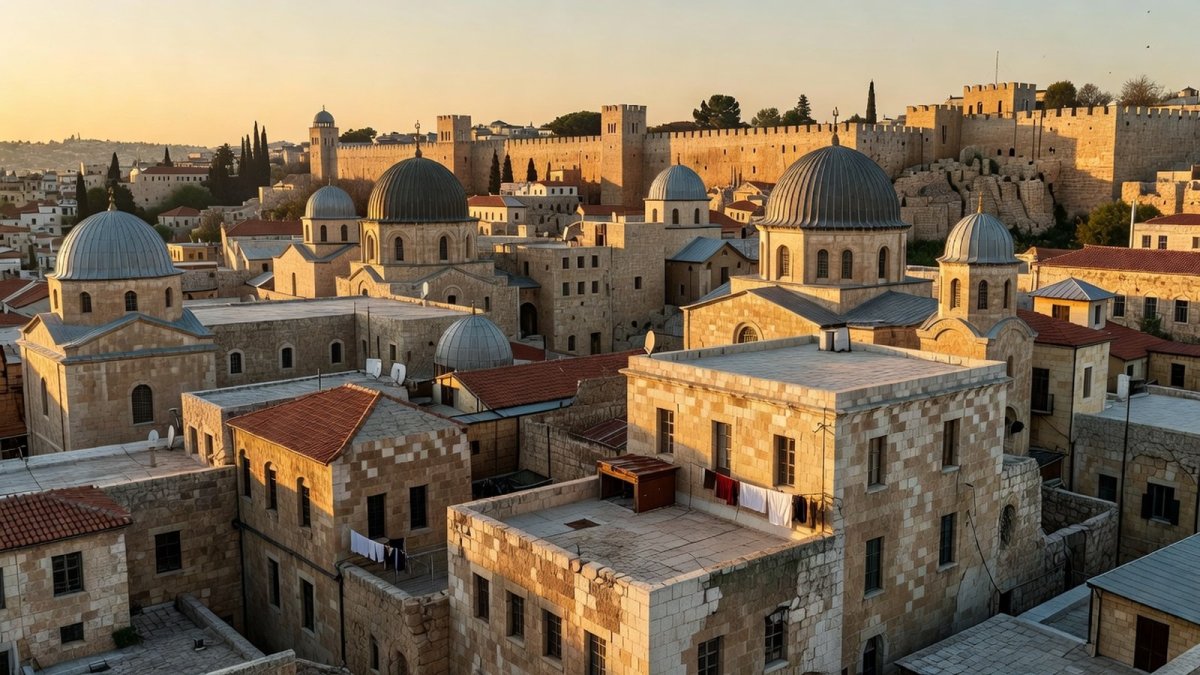
The Old City of Jerusalem, where repeated settler attacks on holy sites have raised alarm (Global 1 News)
Implications for Holy Sites and Palestinian Presence
The Sunday attack coincided with Israeli strikes that killed at least 18 Palestinians in Gaza, according to figures cited by Middle East Eye. Under international law, holy sites in occupied territory require protection, yet repeated incidents raise concerns about the safety of Christian and Muslim places of worship. The shrinking Christian population and ongoing land disputes in the Armenian Quarter point to sustained pressure on Palestinian Jerusalemites seeking to maintain their historic presence in the Old City.
Under international law, occupying powers hold clear obligations to protect holy sites, yet the August 2 events and the simultaneous killing of at least 18 Palestinians in Gaza illustrate how violence in one arena reverberates into another. The committee’s appeal for external intervention reflects a recognition that local mechanisms have repeatedly failed to deter settler actions.
Sustained international attention remains the only avenue cited by Palestinian authorities to halt what they describe as the incremental erosion of Jerusalem’s plural religious heritage.
Under occupation law, authorities hold clear duties to safeguard religious sites and ensure freedom of worship in East Jerusalem. The Fourth Geneva Convention requires protection of civilian property and institutions, including places of worship, from harm or interference. Yet enforcement remains inconsistent, leaving communities to navigate gaps between stated obligations and daily realities. Rights monitors note that without sustained international mechanisms, these legal standards often fail to prevent disruptions at historic locations central to local identity and global faith traditions.
The Armenian Quarter stands as a visible thread in Jerusalem's Christian heritage, watched closely by diaspora communities and pilgrims worldwide. Incidents targeting monasteries and clergy underscore vulnerabilities that extend beyond one neighborhood, raising concerns for the continuity of ancient communities whose endurance shapes shared religious history and cultural memory for believers far beyond the region.
By Fatima Al-Rashid, Staff Writer
This article was produced with AI-assisted research and editorial support. Reporting is based on sources cited in the article.
What's Your Reaction?
 Like
0
Like
0
 Dislike
0
Dislike
0
 Love
0
Love
0
 Funny
0
Funny
0
 Wow
0
Wow
0
 Sad
0
Sad
0
 Angry
0
Angry
0

Gulf/MENA Correspondent at Global1.News. Based in Doha, covering Gulf politics, energy markets, diplomacy, and development across the Middle East and North Africa. Tracks the economic transformation of the Gulf states.














Comments (0)