
Russia Registers 1,586 War Veterans as Candidates in Upcoming Elections, Cementing 'New Elite' Project
Russia's Central Election Commission has registered 1,586 Ukraine war veterans as candidates in next month's federal, regional and local elections, advancing President Putin's 'new elite' project. At least 200 will contest State Duma seats, with critics warning of eroding political competition.
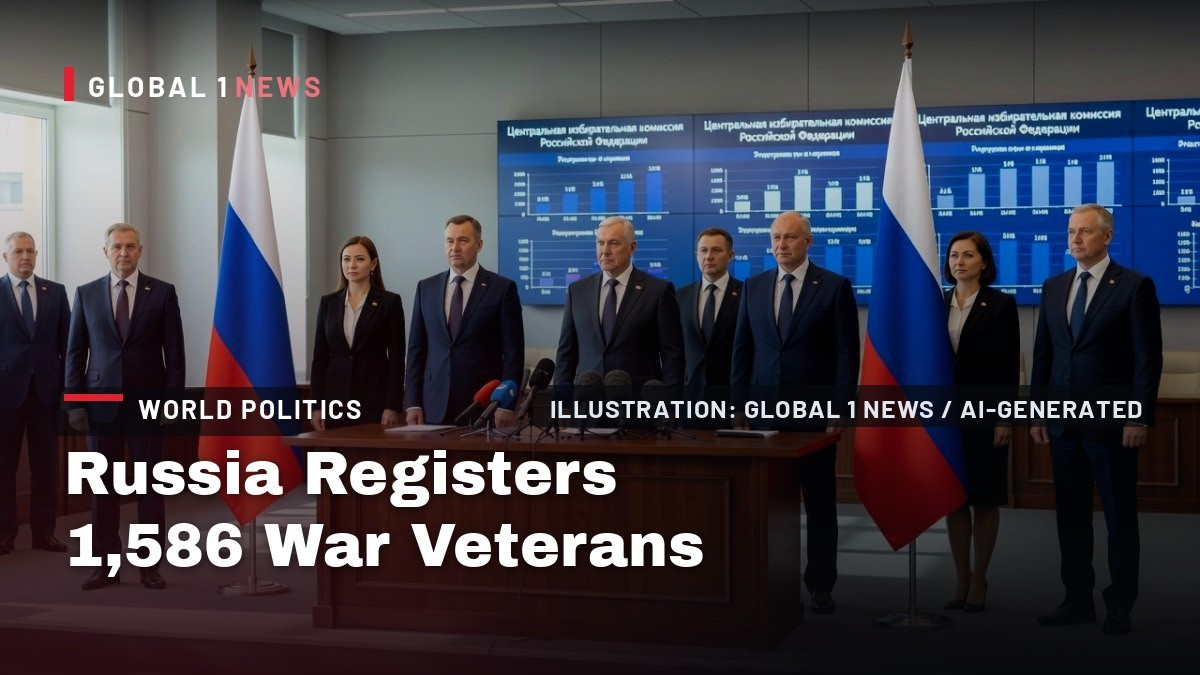
Russian election authorities this week cleared nearly 1,600 Ukraine war veterans to run for office in next month's federal, regional, and local elections, a move that cements the Kremlin's project to install a new political class drawn from the military. Central Election Commission chief Ella Pamfilova announced the registrations on Wednesday, framing the influx of veterans as a "major proof of the renewal of our legislative body." The development marks a significant escalation of a program that has been quietly reshaping Russia's political landscape since 2024.
Russia Registers 1,586 War Veterans as Candidates in Upcoming Elections, Cementing 'New Elite' Project
Moscow, Russia — Russia's Central Election Commission (CEC) has registered 1,586 Ukraine war veterans to run as candidates in elections scheduled for next month, according to a statement made by CEC chief Ella Pamfilova at a press conference on Wednesday. The figure represents the vast majority of the 1,668 veterans who had filed for nomination, with at least 200 of them vying for seats in the 450-member State Duma and one running for governor. The announcement signals the full-scale institutionalization of President Vladimir Putin's "new elite" initiative, which has sought to channel military personnel into civilian governance.
Registration Breakdown and Party Affiliation
Pamfilova detailed that 1,486 of the nominated veterans were backed by political parties, though she did not specify which party fielded the most candidates. The remaining 100 are running as self-nominated independent candidates, a category that typically requires significant local support to qualify. The CEC chief expressed confidence in the candidates' prospects, stating, "I'm confident that our voters will show them total support and trust," as quoted by the Interfax news agency. She described the veteran candidates as "more than worthy" of public office.
Kremlin's 'Easiest' Path to Power
The scale of the veteran candidacies aligns with reports from March 2025, which indicated that the Kremlin planned to place up to 100 Ukraine war veterans into the State Duma this year. That target, described by insiders as the "easiest" way to integrate veterans into government, would account for more than one-fifth of the lower house's seats. With 200 veterans now registered for Duma races, the actual number could exceed initial projections, depending on electoral outcomes in single-mandate districts and party lists.
Putin's 'New Elite' Doctrine
President Putin has repeatedly hailed Ukraine war veterans as Russia's "new elite," a designation that carries both symbolic and practical weight. Since 2024, the Kremlin has launched several state-backed programs, including the "Time of Heroes" initiative, designed to fast-track veterans into administrative and political roles. These programs have been framed as a form of social contract: in exchange for frontline service, veterans receive accelerated paths to power and influence. Analysts suggest this is a deliberate strategy to bind the military class to the state apparatus, ensuring loyalty at the highest levels of governance.
Historical Precedent in 2024 Elections
The current registration wave builds on a precedent set in the September 2024 elections, when 308 war veterans representing the ruling United Russia party won in local and regional races. That earlier cohort provided the testing ground for the current, more ambitious push. The 2024 results demonstrated that veteran candidates could win reliably, particularly in regions with high patriotic sentiment, paving the way for the expanded 2026 slate. The CEC's data suggests that the pipeline from battlefield to ballot box is now operating at full capacity.
Voter Engagement and Online Voting
Pamfilova also noted that more than 2 million voters have expressed a desire to cast their ballots online during the September elections. The unified voting day for the 2026 State Duma election cycle is scheduled for September 18-20, with remote electronic voting expected to play a significant role. The CEC has promoted online voting as a convenience, though critics have raised concerns about transparency and the potential for administrative pressure in a system where the Kremlin controls the digital infrastructure.
Opposition and Critic Perspectives
While the CEC's announcement was celebratory in tone, opposition figures and independent election observers have offered a more cautious assessment. Some critics argue that the mass registration of veterans, many of whom lack prior political experience, is less about democratic renewal and more about consolidating control. The absence of a specified dominant party among the 1,486 party-backed nominees has drawn particular scrutiny, with observers noting that United Russia's organizational machinery is best positioned to absorb these candidates. Independent analysts suggest this could indicate a further erosion of genuine political competition, as the state leverages patriotic sentiment to legitimize its preferred candidates.
Impact on Ordinary Russians
For ordinary Russians, the influx of veteran candidates carries mixed implications. On one hand, the presence of veterans in government may resonate with a public that has largely supported the war effort, offering a sense of representation for military families. On the other hand, the rapid elevation of individuals with combat experience but limited governance training raises questions about administrative competence. Local elections in 2024 showed that veteran politicians often prioritize military-related issues, such as veterans' benefits and regional defense contracts, sometimes at the expense of broader social services. The coming months will reveal whether this trend deepens.
Analysis and Implications
The registration of 1,586 veterans is not merely an administrative milestone; it is a strategic political maneuver. By embedding veterans into every level of government, from local councils to the State Duma, the Kremlin is creating a self-reinforcing power structure. These new politicians owe their positions directly to the war and to Putin's patronage, making them unlikely to challenge the status quo. This could signal a long-term shift in Russia's political class, where military service becomes the primary credential for public office, displacing traditional party loyalists and technocrats.
The broader geopolitical implications are equally significant. A State Duma with a substantial veteran bloc will likely be more hawkish on defense and security matters, aligning closely with the military-industrial complex. For Western observers, this development underscores the permanence of Russia's wartime political trajectory, suggesting that the "special military operation" has fundamentally reordered domestic politics. As the September elections approach, the world will be watching not just who wins, but what kind of political system emerges from this unprecedented experiment in military-to-civilian transition.
By Irina Volkov, Staff Writer
This article was produced with AI-assisted research and editorial support. Sources: The Moscow Times, Interfax.
What's Your Reaction?
 Like
0
Like
0
 Dislike
0
Dislike
0
 Love
0
Love
0
 Funny
0
Funny
0
 Wow
0
Wow
0
 Sad
0
Sad
0
 Angry
0
Angry
0
Russia/Eastern Europe Correspondent at Global1.News. Covering Russian politics, energy, security, and the shifting dynamics of the post-Soviet space. Provides clear-eyed analysis on one of the world's most opaque regions.










Comments (0)