
Protesters Demand Release of Palestinian Women Detainees Amid Abuse Allegations at Damon Prison
Solidarity Rally Outside Haifa Prison Highlights Plight of Female Detainees HAIFA — Dozens of Israeli activists gathered outside Damon Prison on Saturday in a demonstration of solidarity with Palestinian women held at the facility, calling for their immediate release amid mounting reports of mistreatment and rights violations inside Israeli detention centers.
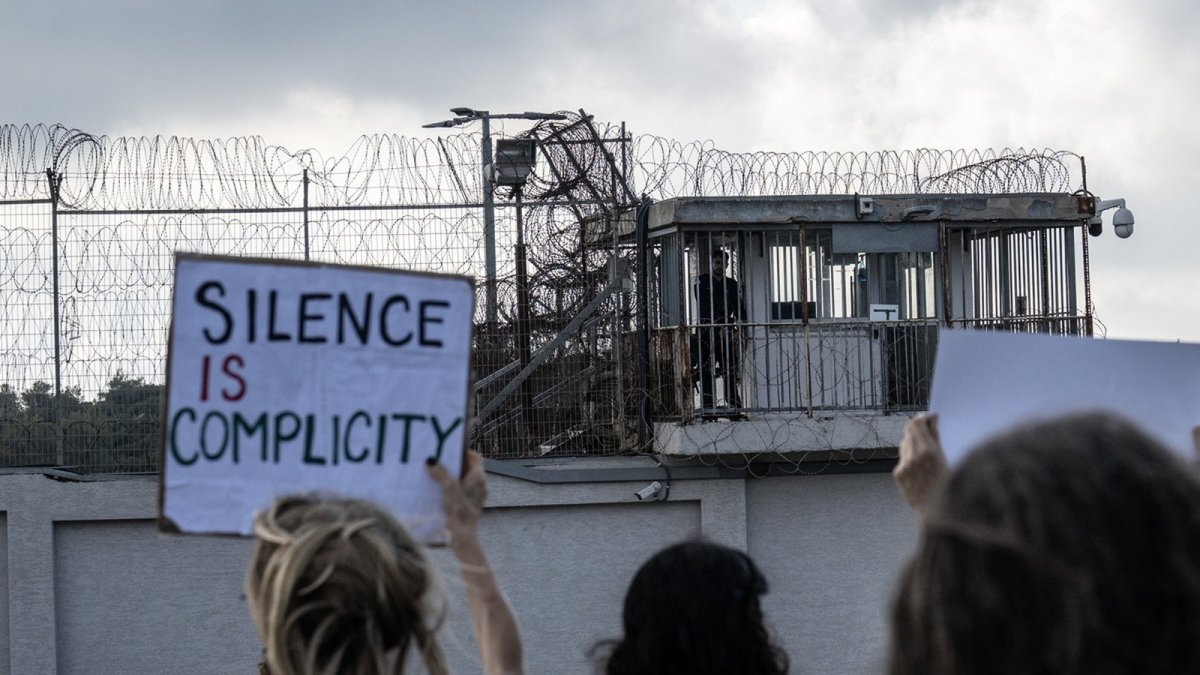
Solidarity Rally Outside Haifa Prison Highlights Plight of Female Detainees
HAIFA — Dozens of Israeli activists gathered outside Damon Prison on Saturday in a demonstration of solidarity with Palestinian women held at the facility, calling for their immediate release amid mounting reports of mistreatment and rights violations inside Israeli detention centers. The protest, reported by Anadolu Agency, comes at a time of heightened scrutiny over the conditions faced by the roughly 94 Palestinian women currently held in Israeli prisons.
The demonstrators, a mix of Israeli human rights advocates and left-wing activists, held banners and chanted slogans demanding an end to what they described as systematic abuses against female detainees. Their action follows a formal complaint lodged in July with the Commission of Detainees' Affairs, a Palestinian governmental body that monitors prisoner welfare, in which a female detainee accused an Israeli interrogator of repeated sexual harassment during her time in custody.
"I was subjected during interrogation to threats of assault against family members, repeated insults and attempts to extract confessions under pressure," the detainee said in her testimony, as relayed by the Commission. The allegations have reignited a long-simmering debate over the treatment of Palestinian prisoners, a deeply sensitive issue that touches on the core of the Israeli-Palestinian conflict and the daily lived reality of thousands of Palestinian families.
Official Figures Paint a Stark Picture of Detention Landscape
According to official figures cited by Anadolu Agency and the Commission of Detainees' Affairs, Israel holds approximately 9,400 Palestinians in its prisons as of early July 2026. This number includes 94 female detainees, more than 350 children, 3,244 administrative detainees — individuals held without charge or trial — and 1,320 people classified by Israeli authorities as "unlawful combatants."
These statistics, while stark, represent more than just numbers. Each figure corresponds to a family disrupted, a community destabilized, and a life placed on hold. For the women held at Damon Prison, located on the outskirts of Haifa, the experience of detention is compounded by gender-specific vulnerabilities that activists say are often overlooked in mainstream discourse about the conflict.
The protest on Saturday was notable not only for its location but for its composition. Israeli citizens standing in solidarity with Palestinian prisoners is a relatively rare occurrence, and organizers told Anadolu that they hoped the demonstration would draw attention to what they called the "invisible population" of female detainees whose stories rarely make international headlines.
Allegations of Sexual Harassment and Coercive Interrogation Tactics
The July complaint detailed by the Commission of Detainees' Affairs is not an isolated incident, according to Palestinian human rights organizations that have long documented patterns of abuse in Israeli interrogation facilities. The detainee's account describes a harrowing experience of psychological pressure, threats directed at her family, and what she characterized as repeated sexual harassment by an interrogator seeking to extract a confession.
"The use of sexual harassment and gender-based violence as tools of interrogation is a grave violation of international law, including the Convention Against Torture and the Geneva Conventions," said a legal researcher familiar with the case who spoke on condition of anonymity due to the sensitivity of the matter. "When such tactics are employed against women who are already in a position of extreme vulnerability, the psychological damage can be lasting and profound."
The Commission of Detainees' Affairs has called for an independent international investigation into the allegations, but such requests have historically been met with resistance from Israeli authorities, who maintain that all detainees are treated in accordance with the law. The Israeli Prison Service has not issued a public response to the specific allegations raised in the July complaint, and figures on the number of formal grievances filed by female detainees were not immediately available.
Administrative Detention: A Shadow Legal Framework
Central to the broader issue of Palestinian imprisonment is the practice of administrative detention, which allows Israeli authorities to hold individuals without charge or trial for renewable periods of up to six months at a time. The 3,244 administrative detainees currently in custody represent a significant portion of the overall prison population, and the practice has been widely condemned by international human rights organizations, including Amnesty International and Human Rights Watch, as a violation of due process rights.
For Palestinian families, administrative detention is a source of constant anxiety. A family member can be taken in the middle of the night and held indefinitely, with no knowledge of the evidence against them and no opportunity to mount a legal defense. The detainee is not informed of the reasons for their detention, and the military court proceedings that review these cases are often conducted behind closed doors, with evidence withheld on grounds of state security.
The inclusion of women in this category adds another layer of hardship. Female administrative detainees are often mothers of young children, and their detention can have devastating consequences for their families. In many cases, children are left in the care of extended relatives, and the psychological toll of separation is borne by both mother and child.
Children in Custody: A Generation Marked by Detention
The figure of more than 350 Palestinian children held in Israeli prisons is one that activists say should be a source of international shame. These children, some as young as 12, are subject to the same military justice system as adults, and reports of night raids, handcuffing, and solitary confinement of minors have been documented by organizations such as Defense for Children International – Palestine.
The detention of children is not merely a legal issue but a deeply human one. For a child, the experience of being taken from their bed by armed soldiers, blindfolded, and transported to a detention facility can be profoundly traumatizing. The long-term psychological effects of such experiences are well-documented, yet the practice continues unabated.
Saturday's protest in Haifa did not specifically focus on child detainees, but the issue loomed in the background. Several activists carried signs referencing the children held in Israeli prisons, drawing a direct connection between the struggle for the release of women and the broader fight for the rights of all Palestinian prisoners.
The "Unlawful Combatant" Classification and Its Consequences
The 1,320 Palestinians classified as "unlawful combatants" occupy a legal gray zone that human rights lawyers say is designed to circumvent international protections. This designation, established under a 2002 Israeli law, allows authorities to hold individuals without trial for extended periods, often in conditions that fall short of the standards required for prisoners of war or criminal detainees.
For the women among this group, the classification carries particular stigma. They are often held in isolation, with limited access to legal counsel and family visits. The psychological toll of indefinite detention, combined with the uncertainty of when or if they will ever be released, is a form of torture in itself, according to former detainees who have spoken publicly about their experiences.
The "unlawful combatant" designation has been challenged in Israeli courts, but the Supreme Court has consistently upheld its legality, citing security concerns. This legal endorsement has allowed the practice to continue, despite widespread criticism from the international legal community.
International Law and the Obligation to Protect
Under the Fourth Geneva Convention, which Israel is a signatory to, occupied populations are entitled to specific protections, including the right to due process and freedom from arbitrary detention. The widespread use of administrative detention, the detention of children, and the allegations of mistreatment of female detainees all raise serious questions about Israel's compliance with these obligations.
The international community has repeatedly called for Israel to adhere to international legal standards, but these calls have largely gone unheeded. The United Nations has documented the issue in numerous reports, and the Committee Against Torture has expressed concern about the treatment of Palestinian detainees, but meaningful accountability remains elusive.
For the activists gathered outside Damon Prison on Saturday, the demand was simple: release the women, end the abuses, and uphold the law. Whether those demands will be met remains uncertain, but the protest served as a reminder that the issue of Palestinian prisoners is not one that will simply fade away.
A Community in Mourning and Resistance
In Palestinian society, prisoners are often referred to as the "living martyrs" — individuals who have sacrificed their freedom for the national cause. Their families bear the burden of their absence, and their communities rally around them with a mixture of pride and grief. The release of prisoners has historically been a central demand in any peace negotiation, and the issue remains a potent symbol of the broader struggle for Palestinian rights.
The women held at Damon Prison are not just statistics; they are mothers, daughters, sisters, and wives. Their detention reverberates through their families and communities, creating ripples of pain that extend far beyond the prison walls. Saturday's protest was a small but significant act of solidarity, a recognition that the struggle for justice for Palestinian prisoners is a shared responsibility.
As the sun set over Haifa and the demonstrators began to disperse, the women inside Damon Prison remained in their cells, their fate uncertain. The protest may not have secured their release, but it sent a message that they are not forgotten. In the words of one activist who spoke to Anadolu, "We will keep coming back until every one of them is free."
By Fatima Al-Rashid, Staff Writer
This article was produced with AI-assisted research and editorial support. Sources: Middle East Monitor, Anadolu Agency, Commission of Detainees’ Affairs.
What's Your Reaction?
 Like
0
Like
0
 Dislike
0
Dislike
0
 Love
0
Love
0
 Funny
0
Funny
0
 Wow
0
Wow
0
 Sad
0
Sad
0
 Angry
0
Angry
0

Gulf/MENA Correspondent at Global1.News. Based in Doha, covering Gulf politics, energy markets, diplomacy, and development across the Middle East and North Africa. Tracks the economic transformation of the Gulf states.














Comments (0)