
Princess Astrid of Norway Dies at 94, Two Weeks After King Harald
Princess Astrid of Norway, the older sister of King Harald V, died on 11 September 2026 aged 94 - two weeks after her brother's death and two days after she was wheeled into Oslo Cathedral to say goodbye to him.
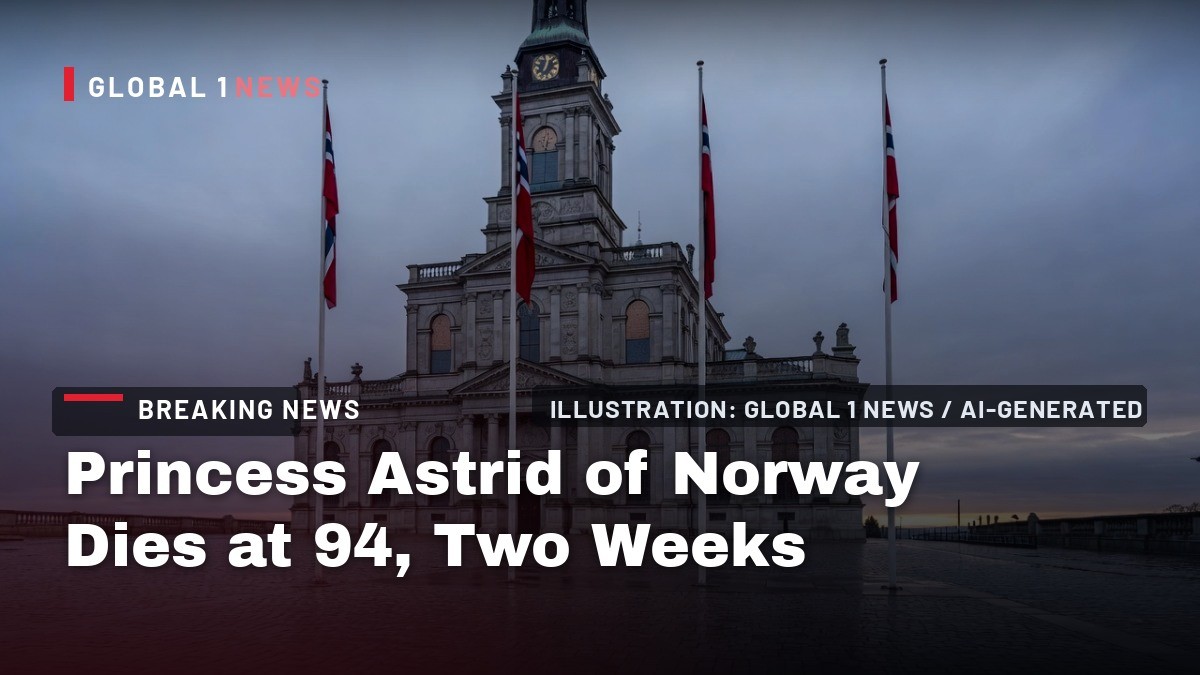
Two weeks. That's all that separated them at the end. On Friday, 11 September 2026, Princess Astrid, Mrs. Ferner — the older sister of Norway's late King Harald V — died in the early hours of the morning. She was 94 years old. And if you want to understand what Norway lost this week, you have to start with a wheelchair, a cathedral, and a woman who refused to miss her little brother's funeral.
Princess Astrid of Norway Dies at 94, Two Weeks After King Harald
Oslo, Norway — The Royal House of Norway confirmed that Princess Astrid, the last surviving child of King Olav V and the woman Norwegians called their "first lady" for fourteen years, passed away quietly on Friday morning. Her death came exactly fourteen days after King Harald V died at Oslo University Hospital Rikshospitalet. Norway's royal house has now suffered two deaths in fourteen days.
A Farewell She Insisted On Making
Look, here's what matters. Princess Astrid was 94. She had been in a wheelchair since 2022. She had been hospitalised in March 2026 with pneumonia, hospitalised again in May with heart failure, fitted with a temporary pacemaker, and discharged over the summer. Nobody would have blamed her for watching her brother's funeral from a window.
She didn't. On Wednesday, 9 September 2026, two days before she died, she was wheeled into a packed Oslo Cathedral shortly before the 1 p.m. state funeral service for King Harald. She came to say goodbye. And days earlier, on 3 September, she had sat alone beside Harald's coffin in the Palace Chapel — the Royal House published photographs of that private farewell, a sister keeping vigil over a brother she had known for 89 years.
At the cathedral, a wreath with a green ribbon carried words that will stay with Norwegians for a long time: "Thank you for everything we have had together. Your Astrid."
The royal family said she had sat by a window at the Royal Palace, looking out at the sea of flowers grieving Norwegians had laid on the Palace Square in memory of King Harald. That image — an old woman at a window, watching a nation mourn her brother — is the whole story in one frame.

The Girl Who Became First Lady at 22
Astrid Maud Ingeborg was born on 12 February 1932 at Solbakken near Skøyen in Oslo — not at the family estate at Skaugum, because Skaugum was still being repaired after a 1930 fire. At an extraordinary Council of State, her grandfather King Haakon VII announced her names: Astrid, after her aunt Queen Astrid of Belgium; Maud, after her grandmother Queen Maud of Norway; Ingeborg, after her grandmother Princess Ingeborg of Sweden.
Her parents were Crown Prince Olav — later King Olav V — and Crown Princess Märtha of Sweden. Her siblings were Princess Ragnhild, born 1930, and King Harald V, born 1937. She was the last surviving child of King Olav V.
She was also a great-granddaughter of Britain's King Edward VII and a second cousin of Queen Elizabeth II. At birth she stood 18th in the line of succession to the British throne. At her death she was one of the last five living great-grandchildren of Edward VII — and the only one who was not British.
Then the war came. In 1940 she fled the Nazi invasion of Norway with her family, spending the war years in exile in the Washington, D.C. area with her mother, brother and sister. The family returned to Norway in 1945. She was educated at Nissen's Girls' School in Oslo, passed her examen artium in 1950, and studied economics and political history for two years at Lady Margaret Hall, Oxford. She studied ceramics, kept her own pottery studio, and was an accomplished skier and yachtswoman.
And then, in 1954, her mother died. Astrid was 22 years old. She stepped in as Norway's first lady — and she carried that role through the reign of her grandfather King Haakon VII and her father King Olav V, until her brother Harald married Sonja Haraldsen in 1968. Roughly fourteen years as the country's de facto first lady, starting at an age when most of us are still figuring out our lives.
A Marriage That Cost Her a Royal Income
Here's a detail I love. She met her husband because she hired him. In 1961, Princess Astrid married businessman Johan Martin Ferner at Asker Church on 12 January. They met when she hired him to sail her yacht in a race. That's how it started — a working relationship on the water that turned into 54 years of marriage.
The marriage drew opposition from the Norwegian Church because Ferner had been married before. King Olav ruled that after the wedding she would be styled "Her Highness Princess Astrid, Mrs Ferner," and she gave up the annual endowment of 50,000 Norwegian crowns she had received as first lady. She was not in the line of succession to the Norwegian throne.
She gave up the money. She took the title. She married the man. That tells you everything about how she ranked things.
The couple had five children: Cathrine, born 1962; Benedikte, born 1963; Alexander, born 1965; Elisabeth, born 1969; and Carl-Christian, born 1972. She also leaves seven grandchildren and at least three great-grandchildren. Johan Ferner died on 24 January 2015, aged 87.
The World's Oldest Working Royal
Folks, this is the part that should stop you cold. Princess Astrid was widely described as the world's oldest working royal and, at her death, the oldest working royal in Europe. In 2024 alone — at 92 years old — she carried out 20 official assignments for the royal family.
Twenty. At 92. In a wheelchair since 2022.
She held 12 patronages and chaired the Crown Princess Märtha Memorial Fund. She was high patron of the Norwegian Women's Sanitary Association from 1955. And she was particularly devoted to children and young people with dyslexia — in May 2026, just months before her death, she attended the 50th anniversary celebration of Dyslexia Norway. She was also an advocate for rescue dogs and an avid sports fan.
Her own words explain it better than I can. "It's fun and nice to be useful," she said. In an interview on her 93rd birthday she put it this way: "I sit in a chair and stuff, but it's my legs that fail and not so much my head, so I remember things, and I can be involved with things." And she told NRK what kept her going: "That I can be of help to someone. That I can still be useful for something. It's a very good feeling."
That's not a royal talking. That's a human being talking. And it's the reason Norwegians loved her.
The Tributes: "Not Afraid to Speak Up"
King Haakon VIII — Harald's son, who became king on his father's death — led the tributes. "Throughout her long life, Princess Astrid represented the Royal House in a warm and dutiful manner," he said. He added: "At the age of 22, she had to step into the role of First Lady when my grandmother, Crown Princess Märtha, passed away. In her work, Princess Astrid was always particularly concerned with care and inclusion for the most vulnerable in society. She was very loyal and always carried out her duties with commitment, presence and an infectious spirit."
And then the line that tells you who she really was inside the family: "Aunt Astrid was an important support for King Harald and the rest of us in the family. We learned a lot from her and she was not afraid to speak up. Her passing is a great loss for us. We will miss her."
Not afraid to speak up. From a nephew who now wears the crown, that's not a polite formality. That's respect.
Her five children — Cathrine, Benedikte, Alexander, Elisabeth and Carl-Christian Ferner — released a family statement: "Dear mother, dear Princess Astrid, thank you for being the best mother we could have. Throughout your life you were there for us — with love and wisdom, warmth and good humor... In our grief, we stand together in gratitude. Thank you for all the good memories. You will always have a big place in our hearts."
Sweden's King Carl XVI Gustaf, who had spoken with her only days earlier at Harald's funeral, said: "The Queen and I have received with sadness the news that Princess Astrid, Mrs. Ferner, has passed away. A few days ago we had the opportunity to meet and speak with Princess Astrid in connection with King Harald's funeral — a meeting we valued greatly. We remember Princess Astrid with warmth."
Flags at Half Mast, Twice in Two Weeks
King Haakon VIII decided that flags would fly at half mast from the Palace balcony on Friday, and again on her funeral day. It's a small gesture on paper. In practice, it means Norway's flag will be lowered for the second time in fourteen days — first for a king, now for his sister.

Context matters here. King Harald V died on 28 August 2026 at 6:35 a.m. at Oslo University Hospital Rikshospitalet, aged 89, after more than 35 years on the throne. He was Europe's oldest monarch. His son immediately became King Haakon VIII and last week took the oath of allegiance to Norway's constitution in parliament.
Harald's funeral on 9 September was an event of staggering scale. A 21-gun salute rang over Oslo at the start of the procession from the Royal Palace to Oslo Cathedral. Norway observed a minute of silence. The monarchs of Sweden, Denmark, Spain, the Netherlands, Belgium, Luxembourg, Monaco and Jordan attended, along with Britain's Prince William, Japan's Crown Prince Akishino, Ukraine's President Volodymyr Zelenskyy, and political leaders from more than 20 countries. Queen Sonja, Harald's widow, and Queen Mette-Marit followed the coffin by car while the new king and senior royals walked behind it, draped in the red Norwegian royal standard.
The speaker of Norway's parliament, Masud Gharahkhani, told the service that "King Harald was close to the people" and recalled that "he wasn't afraid to meet people in his rubber boots."
And in the middle of all that pageantry, wheeled in shortly before 1 p.m., was a 94-year-old woman in a chair, there to bury her little brother.
A Royal House in Transition
Norway's monarchy is largely ceremonial today. Power lies with the elected government and parliament; the royal family's role is largely symbolic and representative. When Norway regained its independence from Sweden in 1905, three-quarters of voters approved restoring the monarchy in a national plebiscite. That's the mandate — not divine right, but a popular vote.
The Norwegian royals are kin to other European royal houses: Harald and Haakon are descendants of Britain's Queen Victoria, as are Britain's King Charles III and Spain's King Felipe VI. King Haakon VIII's children are Crown Princess Ingrid Alexandra and Prince Sverre Magnus.
So this is a family in transition — a new king, a new reign, and now two funerals in a fortnight. Princess Astrid was the bridge to the old world. She was born in 1932, fled the Nazis at eight, studied at Oxford, served as first lady at 22, married for love and paid for it, raised five children, and kept working into her nineties. When she died, she was the last surviving child of King Olav V. That generation is now gone.
The Bottom Line
Harald once described his sister as "boundlessly loyal." Fourteen days after he died, she followed him. And she did it the way she did everything — showing up, in a wheelchair, two days before the end, to say goodbye in person.
Here's what I keep coming back to. Princess Astrid was not the monarch. She was not in the line of succession. She gave up her royal endowment to marry the man she loved. And yet she worked 20 official assignments in a single year at age 92, because — in her own words — "it's fun and nice to be useful."
That's the lesson. Not the titles. The usefulness. The showing up. The sitting alone beside a coffin because your brother shouldn't be by himself.
What to watch next: the Royal House has not said whether her March pneumonia or May heart failure were connected to her death, and a funeral date has not yet been announced. When it comes, expect the flags on the Palace balcony to drop again — and expect Norway to stop, one more time, for the woman who spent nearly seventy years being useful.
By Jessica Ali, Staff Writer
This article was produced with AI-assisted research and editorial support. Sources: Reuters, The Independent, NRK, the Royal House of Norway, Town & Country, Tatler, Wikipedia.
What's Your Reaction?
 Like
0
Like
0
 Dislike
0
Dislike
0
 Love
0
Love
0
 Funny
0
Funny
0
 Wow
0
Wow
0
 Sad
0
Sad
0
 Angry
0
Angry
0

Editor-in-Chief at Global1.News. Atlanta-based journalist who cuts through the BS and tells it like it is. Lead anchor, host, and the voice you hear when the spin stops and the truth starts.














Comments (0)