
Orenburg Rationing Signals Deepening Fuel Crisis as Ukrainian Strikes Cripple Refining Capacity
Orenburg became the 16th Russian region to impose fuel rationing after a Ukrainian drone strike halted the Orsk refinery. With AI-92 and AI-95 capped at 30 liters and odd-even plate rules, Russia's fuel crisis deepens as Moscow turns to Indian gasoline imports.
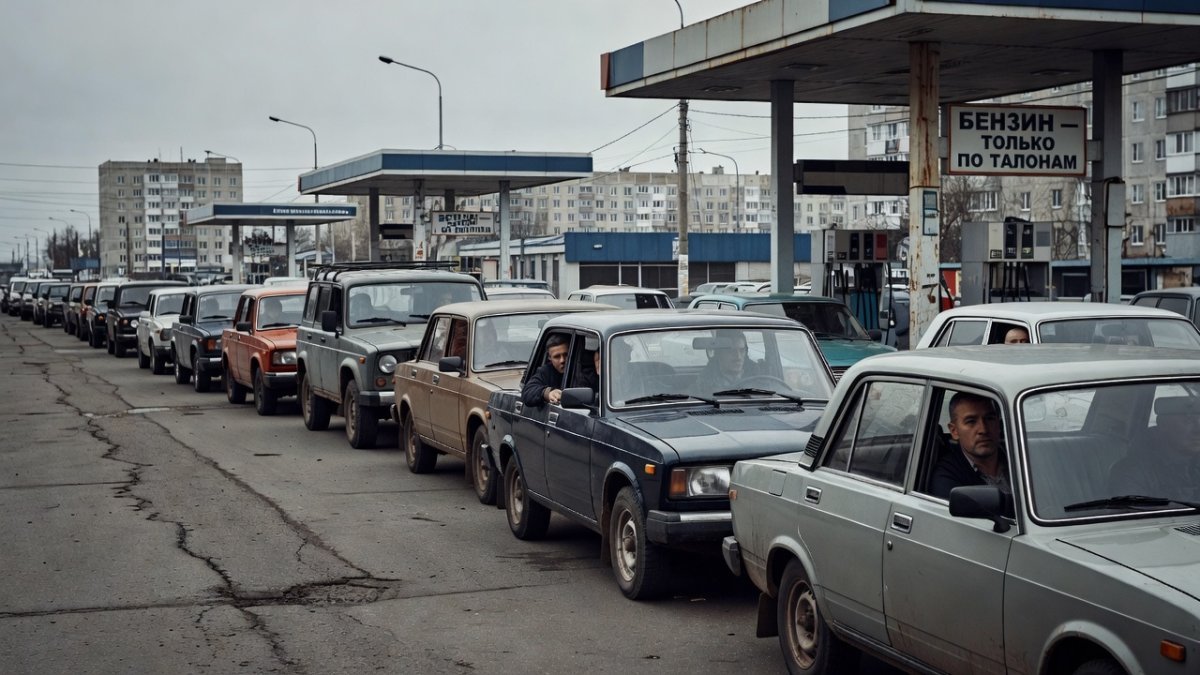
The Orenburg region, a vast territory bordering Kazakhstan, has become the latest and most prominent casualty of Russia's escalating fuel crisis, introducing strict rationing measures this week after a Ukrainian drone attack crippled its primary oil refinery. The move marks a significant escalation in a nationwide shortage that has now spread to at least 16 regions, exposing the fragility of Russia's energy infrastructure and its direct impact on ordinary citizens. With gas stations limiting sales and imposing odd-even license plate systems, the Kremlin's war economy is now visibly colliding with the daily lives of millions of Russians.
Orenburg Rationing Signals Deepening Fuel Crisis as Ukrainian Strikes Cripple Refining Capacity
Orenburg, Russia — Drivers in this regional capital are now navigating a new reality: a strict rationing system that dictates when and how much fuel they can purchase. The measures, introduced this week, follow a devastating drone strike on the Orsknefteorgsintez refinery in the nearby city of Orsk, which forced the plant to halt operations on Tuesday, August 11. This is not a localized disruption but a symptom of a systemic failure that has been building since last autumn, as Ukrainian long-range strikes continue to dismantle Russia's refining backbone.
Rationing Rules and Immediate Impact in Orenburg
Regional authorities have imposed a strict quota system at all gas stations across the Orenburg region. Under the new rules, drivers are limited to between 15 and 30 liters of gasoline per visit for grades AI-92 and AI-95. A complete ban on filling portable fuel containers has also been introduced, a measure designed to prevent hoarding. To further manage demand, an odd-even license plate system has been implemented, allowing drivers to purchase fuel only on alternating days based on the last digit of their plate number.
Local reports describe long queues forming at stations that remain open, with some pumps running dry within hours of the new rules taking effect. The rationing is a direct response to the shutdown of the Orsknefteorgsintez refinery, which has an annual processing capacity of 6.6 million metric tons. Two industry sources told Reuters on Wednesday that the plant halted processing on August 11 following a fire caused by the drone attack. The facility sits roughly 1,500 kilometers from the Ukrainian border, a distance that once seemed to guarantee its safety but now underscores the expanded reach of Kyiv's drone program.
Ukraine's Confirmed Role and Strategic Targeting
Ukraine's General Staff has confirmed the strike on the Orsk refinery, according to a report from Ukrainska Pravda. This is not an isolated incident but part of a sustained campaign. In a separate but simultaneous development, a Rosneft refinery in Komsomolsk-on-Amur in the Russian Far East also caught fire on Tuesday following reported drone activity. The sheer geographic spread of these attacks—from the Urals to the Pacific coast—demonstrates a coordinated strategy aimed at crippling Russia's fuel production capacity across the board.
The Financial Times has reported that Ukrainian strikes have now knocked out nearly half of Russia's refining capacity. This figure, while staggering, aligns with the visible collapse in domestic production. Industry reporting indicates that gasoline output has fallen from approximately 120,000 tons per day in March to around 90,000 tons per day currently. This is a decline of 25 percent in just five months, a trend that shows no sign of abating as Ukrainian forces continue to identify and target vulnerable points in the energy grid.
National Crisis: From Oryol to the Far East
Orenburg is the 16th region to report renewed fuel disruptions following a brief period of stabilization in late July. The central Oryol region was the first to introduce license plate-based rationing back in June, setting a precedent that has now been adopted by authorities across the country. By late June, fuel-purchase restrictions were already in place in 56 Russian regions, with 18 of them enforcing government-mandated caps commonly set at around 30 liters per car, according to data from the independent outlet Mediazona.
The situation in the capital has also deteriorated. Moscow, which initially seemed insulated from the worst of the shortages, has now banned fuel exports and introduced its own rationing measures. While officials claim that queues in the capital have shortened, reports of fistfights at pumps and stations running dry have been widespread since autumn 2025. The crisis has moved from a regional inconvenience to a national emergency, affecting everything from agricultural harvests to public transportation schedules.
Official Claims and the Kremlin's Narrative
Russian authorities and local officials maintain that rationing is a temporary measure designed to stabilize supply while repairs proceed. The Kremlin has consistently blamed Ukrainian strikes and Western sanctions for the shortages, framing the crisis as an act of external aggression rather than a failure of domestic policy. In a statement this week, regional officials in Orenburg emphasized that the restrictions would be lifted "as soon as the refinery resumes operations," though no timeline has been provided.
However, this narrative is increasingly difficult to sustain. The attacks have been ongoing since 2025, when Ukrainian drone strikes on refineries reached record levels. BBC Verify reported that 14 refineries were targeted in August 2025 alone. The pace has not slowed: in May 2026, 16 refineries were hit, and at least six more were struck in June. Refineries in Ufa, another major processing hub, have also been attacked, triggering massive fires. The repeated nature of these strikes suggests that repairs are either insufficient or are being systematically undone.
Importing Fuel from India: A Symbolic Shift
Perhaps the most telling indicator of the crisis is Russia's sudden reliance on fuel imports from India. According to Kpler ship-tracking data cited by Bloomberg, Moscow has begun importing gasoline from India for the first time. Previously, Russia relied primarily on fuel imports from neighboring Belarus and Kazakhstan, both of which have their own supply constraints. The shift to Indian imports, which involves significantly longer shipping routes and higher costs, highlights the desperation of the situation.
This development is deeply ironic for a nation that is one of the world's largest oil producers. Russia's problem is not a lack of crude oil but a lack of refining capacity. The country's dependence on a relatively small number of large, complex refineries has proven to be a critical vulnerability. When these plants are taken offline, even temporarily, the entire domestic supply chain is disrupted. The import of finished gasoline from India is a stopgap measure that cannot address the underlying structural weakness.
Impact on Ordinary Russians and the War Economy
For ordinary Russians, the fuel crisis is not an abstract geopolitical issue but a daily struggle. In Orenburg, drivers are now planning their weeks around fuel-purchasing days. Farmers in the region, who depend on diesel for harvest equipment, are facing the prospect of significant delays. Public transportation in some cities has been reduced, and taxi services have raised prices to reflect the scarcity of fuel. The social fabric is fraying, with reports of confrontations at gas stations becoming routine.
The crisis also has profound implications for the war economy. The Russian military depends on a steady supply of fuel for its operations in Ukraine. While the military is likely prioritized in the allocation of remaining supplies, the diversion of fuel to the front lines exacerbates civilian shortages. This creates a feedback loop: the war effort depletes civilian resources, which in turn fuels public discontent, which the Kremlin must then manage through propaganda and, increasingly, through coercive measures.
Putin's Threats and the Shadow Fleet
In a separate but related development, President Vladimir Putin has threatened retaliation if European states seize Russian ships under a new EU mechanism that allows the confiscation of Russian oil carried by the shadow fleet. This threat, made this week, is a response to what Moscow perceives as an escalation in Western economic warfare. The shadow fleet, a network of aging tankers used to circumvent sanctions, has become a critical lifeline for Russian oil exports. The EU's new mechanism directly threatens this operation.
Analysts suggest that Putin's threat is largely rhetorical, as Russia has limited options for retaliation that would not further harm its own economy. However, the timing is significant. With domestic fuel production in crisis and imports becoming more expensive, Russia's ability to sustain both its war effort and its civilian economy is increasingly in question. The Kremlin is being forced to make difficult choices, and the consequences are being felt in gas stations from Orenburg to Komsomolsk-on-Amur.
Outlook: A Winter of Discontent
The fuel crisis shows no signs of abating. Ukrainian drone technology continues to improve, and the range of attacks is expanding. The Russian air defense system, while extensive, has proven unable to protect all critical infrastructure. As winter approaches, the demand for heating fuel will increase, putting additional strain on an already fragile system. The brief stabilization seen in late July appears to have been an anomaly, not a turning point.
Independent analysts suggest that the Kremlin's options are limited. Increasing imports from India and other non-Western sources can provide temporary relief but cannot replace the lost refining capacity. Rebuilding the damaged refineries would take months, if not years, and would require access to Western technology and components that are currently under sanctions. The rationing measures, while presented as temporary, may become a permanent feature of Russian life for the foreseeable future.
The fuel crisis is a stark reminder of the interconnectedness of Russia's war in Ukraine and its domestic stability. The same drones that are striking refineries are, indirectly, shaping the daily lives of millions of Russians. For the Kremlin, the challenge is not just repairing the physical infrastructure but managing the political fallout of a population that is increasingly feeling the costs of a war it was told would be quick and painless. The queues at gas stations are not just a logistical problem; they are a political liability that no amount of propaganda can fully obscure.
This article was produced with AI-assisted research and editorial support. Sources: The Moscow Times, Reuters, Bloomberg, Ukrainska Pravda, Financial Times, BBC Verify, Mediazona.
By Irina Volkov, Staff Writer
What's Your Reaction?
 Like
0
Like
0
 Dislike
0
Dislike
0
 Love
0
Love
0
 Funny
0
Funny
0
 Wow
0
Wow
0
 Sad
0
Sad
0
 Angry
0
Angry
0

Russia/Eastern Europe Correspondent at Global1.News. Covering Russian politics, energy, security, and the shifting dynamics of the post-Soviet space. Provides clear-eyed analysis on one of the world's most opaque regions.










Comments (0)